The three-year-old male tiger, which was relocated from Madhya Pradesh to Satkosia reserve in Odisha’s Angul district, most likely died because of a wound on its neck, wildlife officials said on Thursday.
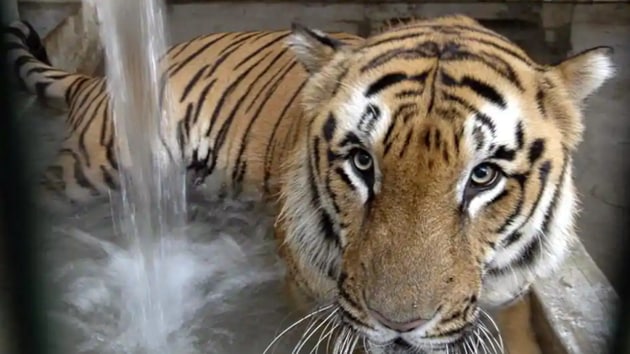
Officials said while speaking to the Hindustan Times the tiger’s carcass was found 500 metres from Raigoda area of the reserve at 1 pm. The tiger, identified as MB2 and named Mahavir by Satkosia officials, was part of the first tiger translocation exercise in the country was shifted from Madhya Pradesh’s Bandhavgarh National Park to the Odisha reserve earlier this year.
Satkosia tiger reserve’s divisional forest officer P Ramaswamy said the spot was inside the Nuagarh reserve forest of Athgarh forest division, which has been proposed to be included in the tiger reserve. The carcass was lying under a bush when officials saw it.
“On prima facie investigation of the carcass, a deep lacerated and five-day-old maggot-infected wound was observed in the dorsal neck region of the tiger which may be the cause of the mortality,” said Ramaswamy, who has been appointed as the investigating officer to inquire into the matter.
“The site of incidence was not disturbed as per the NTCA (National Tiger Conservation Authority) protocol. The exact reason of the mortality and time of incidence will be ascertained after conducting a detailed post-mortem examination. The carcass would be incinerated after post-mortem,” he said.
{{/usCountry}}“The site of incidence was not disturbed as per the NTCA (National Tiger Conservation Authority) protocol. The exact reason of the mortality and time of incidence will be ascertained after conducting a detailed post-mortem examination. The carcass would be incinerated after post-mortem,” he said.
{{/usCountry}}Officials said a team comprising veterinary doctors, NTCA representative, local NGO and others in accordance with standard operating procedure of NTCA has been formed to conduct the post-mortem examination.
Mahavir, weighing 195 kg, was brought to Satkosia tiger reserve on June 21 from Bandhavgarh after a 22-hour-long road journey. It was later released into the core area and had adjusted itself with the new surroundings. Officials said it had mated with the only tigress of the reserve last month.
Though officials were tight-lipped about the reason behind the injury, sources said the tiger may have landed in a snare set by poachers for catching wild boars and deers.
“It’s possible that the tiger suffered injury on its neck while trying to get out of the snare,” said a source.
There were two surveillance teams that was supposed to keep a watch on the tiger’s movements, but officials said they did not detect any unusual movements in the last couple of days.
Wildlife experts expressed their surprise as to how the tiger’s movement could not be detected despite the radio frequency and satellite collar on its neck.
Tiger conservationist Ullas Karanth said the Odisha forest department personnel may have lacked professionalism and expertise in tracking it.
“Just having a radio-collar on the tiger’s neck isn’t enough. Expertise is needed to track it on regular basis,” said Karanth.
He said the authorities, including NTCA and WII, should have taken into account the prey base of the tiger reserve before introducing the tigers.
“At least 500 prey is needed for a tiger for its survival. A proper prey-base study using line-transact method is the proper procedure. I doubt if this was done,” he said.
PK Sen, former director of Project Tiger in an interview to HT, had also questioned the relocation exercise calling the prey base in Satkosia as not enough to support big cats.
“Satkosia is not an inviolate area by any stretch of imagination and there is hardly any herbivores there. In 1996, I had opposed declaring Satkosia as a tiger reserve. It’s a disastrous exercise,” he had said.
The tiger relocation exercise is already in trouble since September when tigress Sundari, relocated from Bandhavgarh in June, allegedly mauled a 45-year-old woman living near the reserve to death. Though it’s not yet confirmed if the woman died due to the tiger attack, the incident triggered violence by locals who burned the forest department’s boats and beat house.
On October 21, Sundari had mauled a 65-year-old man living in the reserve to death while he had gone to inspect his crop of potato tubers. With public anger mounting the state wildlife officials decided on tranquillising the tigress and could only capture it last week after a series of failed operations.
State forest minister Bijoyshree Routray wanted to send Sundari to Nandankanan zoo, but wildlife officials have decided to keep it in a special enclosure inside the tiger reserve.
Officials admitted the deaths dealt a body blow to the ambitious tiger relocation exercise conceived by the Union ministry of environment and forests, National Tiger Conservation Authority and Wildlife Institute of India.
Under the exercise, six tigers (three pairs) from different reserves of Madhya Pradesh were to be sent to Odisha. After Mahavir and Sundari, a second male tiger was to be sent from Kanha and three were to be sent from two national parks in Madhya Pradesh.