Border guards intercept them periodically, but cattle smugglers keep devising ingenuous techniques to send cows and bulls to Bangladesh and feed the beef and leather industry there.
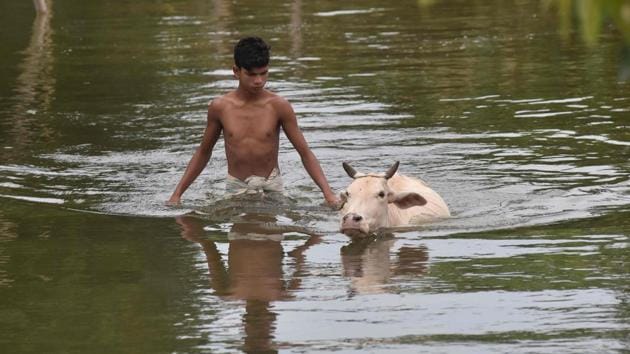
India shares a 4,096km border with Bangladesh and there are multiple points along this boundary – primarily in West Bengal and Assam – where cattle smugglers operate, often after dark.
A cow that costs Rs 5,000 in India fetches up to Rs 50,000 in Bangladesh. The illegal cross-border trade is estimated to be worth Rs 5,000 crore a year.
Less than two decades ago, when a thin barbed wire fence ran 150m from the zero line (actual boundary) along the India-Bangladesh border, the preferred strategy was to torture and irritate the cattle to make them stomp through the fencing.
“The methods included driving nails on the rumps of the cows, or inserting chilli or petrol in their genitals to make them run in pain. These would be applied on the cows making up the last row in a group of 40-50,” a police informer in western Assam’s Dhubri said.
Breaking through the fence usually killed or maimed the first few cows, but the possibility of their death is factored in when the receivers in Bangladesh pay for the “consignment” in advance through hawala transactions.
These transactions, officials say, are controlled by non-Muslim traders, most of them based in Mankachar on the Assam-Meghalaya-Bangladesh tri-junction.
{{/usCountry}}These transactions, officials say, are controlled by non-Muslim traders, most of them based in Mankachar on the Assam-Meghalaya-Bangladesh tri-junction.
{{/usCountry}}The fence was reinforced with a double fencing in the early 2000s. This made the cattle smugglers switch to other strategies.
One of the techniques involves snorkelers, usually children, who use the hollow of papaya stems to breathe underwater and guide cattle across in rivers and channels flowing into Bangladesh.
Of the 263km border, 119.1km is riverine.
The government’s stress on completing the new fence by 2019 – work on some 2,800km is complete – and tighter vigil by Border Security Force (BSF) armed with night-vision cameras and lasers have made smuggling tougher.
But the smugglers defy the hurdles. A popular method, applied mainly by agents in Bangladesh where cattle trade is legal, is a crane made of bamboo.
This involves a sturdy bamboo pole. Agents on the Bangladesh side lower one end of the bamboo for their Indian counterparts to hang a cow. The animal is then swung across the fence.
The latest method is to tie a cow to two pieces of a banana plant and the animal floats across to Bangladesh. A police informer had filmed a consignment being shipped this way on the Kaljani river along the Assam-West Bengal border.
“Ashraful Akand, the kingpin of the operation in Assam, was arrested in West Bengal,” Dhubri police superintendent Longnit Terang said.
The BSF said patrol boats were deployed to prevent cattle smuggling through rivers. “Much of the problem is because there is no law banning movement of cattle from one place to another within India,” a BSF officer said.