Members of two banned militant groups, the National Liberation Front of Tripura (NLFT) and All Tripura Tiger Force (ATTF), began a 72-hour shutdown across Tripura on Friday, alleging that the government had failed to implement rehabilitation promises made under a peace accord signed two years ago.
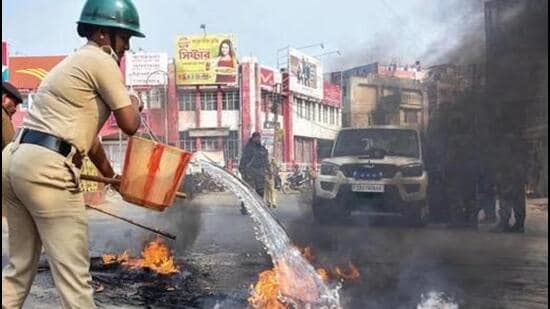
The protesters blocked highways, burnt tyres at Hatai Kotor, and also blocked railway tracks.
The agreement was signed under the leadership of Union home minister Amit Shah in the presence of chief minister Manik Saha, BJP’s ally TIPRA Motha party founder Pradyot Kishore Debbarma and other officials of the Ministry of Home Affairs in Delhi on September 4, 2024. As per the agreement, the Centre sanctioned a ₹250 crore package for the transition of the rebels.
“The accord was signed in 2024 that promised the Tiprasas a package of ₹250 crores for their rehabilitation. As all assurances from the government failed to implement it, we started our agitation from today. It will continue for 72 hours,” a surrendered leader said.
Implementation of all points of the Tripartite Peace Accord, discharge of all cases against the surrendered cadres and issuance of a clean chit are some of their six-point charter of demands.
{{/usCountry}}Implementation of all points of the Tripartite Peace Accord, discharge of all cases against the surrendered cadres and issuance of a clean chit are some of their six-point charter of demands.
{{/usCountry}}Earlier, on June 12, they held a road blockade to press for implementation of the accord and later lifted it after getting assurances from Tribal Welfare Minister Bikash Debbarma.
At least 584 militants of NLFT and ATTF returned to the mainstream after shunning the path of violence in September 2024, three weeks after the central government signed a quadripartite memorandum of settlement with the Tripura government and the two militant groups.
The militants from three NLFT factions, headed by NLFT supremos Biswamohan Debbarma, Parimal Debbarma and Prasenjit Debbarma, and ATTF president Alendra Debbarma surrendered their arms before the Tripura government at the Tripura State Rifles 7th battalion headquarters at Jampuijala, nearly 40 kilometres from Agartala.
Tripura witnessed a series of bloodshed involving several banned militant outfits, including NLFT and ATTF, from the 1980s to the early 2000s.
Formed on March 12, 1989, the National Liberation Front of Tripura (NLFT), with Dhananjoy Reang, a former insurgent leader of Tripura National Volunteers (TNV), was taken over by Nayanbasi Jamatia as the new leader a few years later. The TNV came overground in 1988 after a peace treaty between then Prime Minister Rajiv Gandhi and TNV supremo Bijoy Kumar Hrangkhawl.
Riddled by a series of factional feuds, like most other insurgent outfits of the region, NLFT’s leadership went to Biswamohan Debbarma after Nayanbasi, who was removed from the outfit, went on to form a different outfit called Tripura Resurrection Army but surrendered with all cadres soon after.
Much like NLFT, the All Tripura Tiger Force (ATTF), another dreaded insurgent outfit of Tripura, was also originally founded by cadres who were former members of the Bijoy Kumar Hrangkhawl-led Tripura National Volunteers (TNV), in July 1990.
Initially known as the All Tripura Tribal Force, it was later rechristened in 1992 as All Tripura Tiger Force under Ranjit Debbarma as its supremo. The group disassociated itself with a faction of TNV, then led by self-styled Commander Lalit Debbarma, which laid down arms as per the 1988 TNV peace accord.
The Government of India declared NLFT and ATTF outlawed insurgent outfits in 1997 under the Unlawful Activities (Prevention) Act, 1967, citing their involvement in terrorist and subversive activities. The outfits were also banned under the Prevention of Terrorism Act (POTA), 2002.