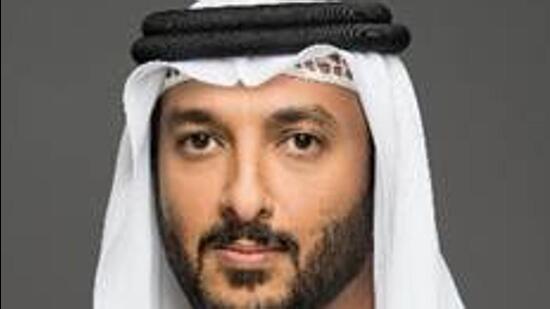
The free trade agreement between India and the United Arab Emirates, expected to drive non-oil trade to $100 billion in five years, is a flexible deal that allows the inclusion of new elements in areas such as digital trade, UAE economy minister Abdulla Bin Touq Al Marri has said. In an interview with Rezaul H Laskar, Al Marri said the Comprehensive Economic Partnership Agreement, which was signed by the two countries in February and became effective in May, opens the door for tripartite cooperation with Indian businesses using the UAE as a base for entering the Israeli market. Edited excerpts:
With the India-UAE free trade agreement coming into force, what has the experience been so far?
The UAE-India Comprehensive Economic Partnership Agreement (CEPA) represents a historic moment that defines our path forward. It builds on decades of friendship and cooperation to establish a new era of progress and prosperity for people in both countries.
The UAE-India CEPA has many firsts to its record. It is the first part of our bold new foreign trade policy designed to re-engineer our economy for the next 50 years. It is our nation’s first bilateral trade agreement, and the first trade agreement to be signed by India with any country in the Arab world. It was sealed in a record short time span of 88 days.
The agreement came into effect on May 1. Through the agreement, we expect to add $9 billion to our national GDP by 2030, increase exports by 1.5% and imports by 3.8% by 2030. Most importantly, it is set to fuel the growth of UAE-India non-oil trade to exceed $100 billion from the current $40 billion within five years of the signing of the agreement.
{{/usCountry}}The agreement came into effect on May 1. Through the agreement, we expect to add $9 billion to our national GDP by 2030, increase exports by 1.5% and imports by 3.8% by 2030. Most importantly, it is set to fuel the growth of UAE-India non-oil trade to exceed $100 billion from the current $40 billion within five years of the signing of the agreement.
{{/usCountry}}Are there areas where more needs to be done?
This is a flexible deal. For instance, it creates a digital framework that enables both countries to leverage emerging and future technologies. In terms of digital trade, there are still elements that are being debated at a global level. Some of those elements will be incorporated in this CEPA as we go forward.
The agreement covers 18 chapters, which include traditional trade matters, goods and services and digital trade. It provides real support for SMEs in both countries. We have also included an investment chapter to facilitate and monitor investment flows between two countries.
This deal brings forward the timeline for updating the existing bilateral investment treaties between both countries. As with all such agreements, there are review clauses through a joint committee to outline some of the areas that have been agreed.
In the future, we can frame it in the shape that will include the latest changes to – for example – digital trade and environmental legislation. This allows us to update and upgrade the deal and resolve future issues.
The Ukraine crisis has triggered both an energy crisis and a food shortage. With the UAE, a key player in energy, and India a major producer of food grains, how can the two sides cooperate to address each other’s concerns?
Today, with many unprecedented challenges facing the world, countries have come to believe more in the power of economic and strategic cooperation. At the peak of the pandemic, the UAE and India worked together to minimise supply chain disruption through the exchange of medical supplies and professionals – helping to protect the lives and livelihoods of our people.
The UAE-India CEPA represents a turning point in our nation’s economic trajectory. It will benefit consumers, producers and companies alike by opening new markets for business, bringing better jobs and higher wages for people, and lowering prices when consumers need it most.
It will further ensure access to global markets through safe, secure and reliable supply chains as well as enhance the efficiency and sustainability of those supply chains – both to accelerate the free flow of trade but also to secure a stronger, more resilient global economic future.
Following the India-UAE FTA, the UAE has signed a landmark free trade deal with Israel. Does this increase the scope for tripartite cooperation?
No doubt, this can pave the way for tripartite cooperation for trade and businesses coming into the UAE from India and then going to Israel and other CEPA markets with added value.
While India-UAE trade in goods has increased over the years, are there plans to increase trade in services?
It’s important to point out this deal has been structured to ensure maximum benefits to both parties. We believe many sectors in both countries will reap considerable benefits from the reduction or removal of tariffs and the acceleration of trade flows.
Championing the private sector is a primary aim of this deal. The agreement covers 11 service sectors and more than 100 sub-sectors, including business services, telecommunication services, construction and related services, educational services, environmental services, financial services, insurance, social and health services, tourism and travel related services, transport services. We see those collaborations accelerating with more avenues for expansion.
So, this is a deal that will allow for the private sector to dictate where the opportunities lie.
India perceives the UAE as a gateway to markets in the GCC (Gulf Cooperation Council) and Africa. In the same way, does the UAE see India as the gateway to markets in South Asia?
The CEPA between the UAE and India is a testament to the brotherly relations the two countries have enjoyed since the establishment of the diplomatic relationship in 1972. Our time-tested relationship, rooted in a similar outlook, a deep affinity and enduring understanding, has blossomed into a strong and multi-faceted bilateral cooperation, positively impacting the lives of millions of our peoples.
India is our second largest trading partner, and we are your third largest trade partner. In 2021 alone, we exchanged nearly $45 billion worth of goods, excluding oil. India is our number one trading partner for non-oil exports, accounting for 14% of the total exports globally.
The UAE is India’s second-largest export destination, after the US, and the third-most important source of India’s imports. We also account for 40% of your total trade with the entire Arab world. Moreover, your country was the 9th largest recipient of foreign direct investment from the UAE with an inflow of $51 billion in 2019.
Over the course of our strong partnership, we worked on things that matter, building on a bedrock of common values. Both our countries strongly believe in fair, sustainable, and rules-based trade. We engaged with each other in a spirit of reciprocity and friendship and, through CEPA, we worked so that people and businesses of both countries mutually benefit from the deepening of the engagement, now and for generations to come.