Number theory: Understanding inflation and the IIP numbers
The National Statistical Office (NSO) released the numbers for Consumer Price Index (CPI) for November and Index of Industrial Production (IIP) for October on December 12. CPI growth fell to 5.88% in November, and IIP contracted 4% in October. What is the larger macroeconomic takeaway of these numbers?
The National Statistical Office (NSO) released the numbers for Consumer Price Index (CPI) for November and Index of Industrial Production (IIP) for October on December 12. CPI growth fell to 5.88% in November, and IIP contracted 4% in October. What is the larger macroeconomic takeaway of these numbers?
PREMIUM
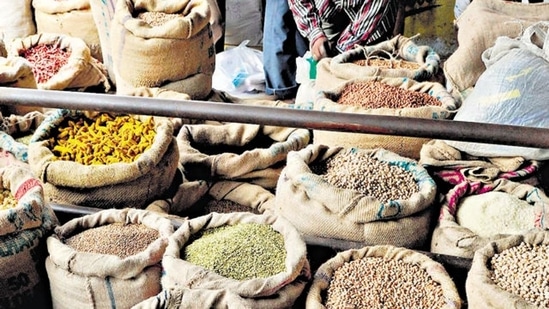
Representational image (AFP)
{{^htLoading}} {{/htLoading}}
Inflation is losing momentum at a faster pace...
{{^usCountry}}{{/usCountry}}
It was expected that retail inflation, as measured by Consumer Price Index (CPI), would slow in November, but what has surprised analysts is the
CPI and WPI growth
... and food price pressures have cooled .
{{^htLoading}} {{/htLoading}}
The deceleration in food prices was largely responsible for lower-than-expected inflation. Food contributes to 39% of the total CPI basket. Data from the Centre for Monitoring Indian Economy (CMIE) allows one to dissect the CPI numbers into food and non-food components. A slightly long-term analysis of these numbers shows that food inflation has stayed in the range of 7-8% since March and it was only in November that it fell to 4.67%. Non-food inflation increased marginally to 6.67% in November from 6.61% in October. November was the 19th consecutive month when non-food inflation was above 6%. Fuel and light, and clothing and footwear were the primary drivers for non-food inflation in November.
Food and non-food components
But core inflation continues to be high...
{{^htLoading}} {{/htLoading}}
Both food and non-food prices (the latter because of the fuel component) are volatile components of the CPI basket. This is why looking at core inflation, which measures inflation excluding the food and fuel component, can offer a better picture on the structural factors driving inflation. Data from the CMIE shows that core inflation increased five basis points to 6.19% in November. It has remained higher than 5.75% in the last 19 months.
“While headline inflation has declined, sticky core inflation remains a cause of concern. Ind-Ra believes that while the headline inflation is under the RBI’s target, sticky core inflation needs continuous monitoring and RBI is unlikely to lower its guard against inflation. While the extent of rate hike has reduced, Ind-Ra still expects the central bank to undertake 25bp (basis points) hike in February 2023 monetary policy,” Sunil Sinha, Principal Economist at India Ratings (Ind-Ra) said in a note.
{{^htLoading}} {{/htLoading}}
Core inflation
... and consumer demand hasn’t picked up despite festive season
The Index of Industrial Production (IIP), a measure of industrial activity, contracted by 4% in October after expanding by 3.1% in September. This is the lowest in 26 months. The IIP contraction was largely due to the 5.7% contraction in the manufacturing sector, which accounts for slightly more than three-fourth of the index, while mining and electricity grew by 2.5% and 1.2% , respectively. A use-based classification of IIP shows that consumer demand continues to be an area of concern. The consumer goods subcategory contracted for the fourth consecutive month in October, coming as a surprise to analysts at the backdrop of festive season.
{{^htLoading}} {{/htLoading}}
“Another view of the dismal performance of industrial sector can be gauged from the fact that except infrastructure and primary goods the output level of other use- based segments is still below the pre-COVID level (Feb 2020). The output levels of all the use- based segments in the past months surpassed the pre COVID levels though in different months, but could not hold it at that level or accelerate it. It appears that weak domestic demand in combination with waning of export demand is impacting industrial output growth” Sinha added in his note.
Use-wise and economic activity-wise growth in IIP
All Access. One Subscription.
Get 360° coverage—from daily headlines to 100 year archives.
Pavitra Kanagaraj is a data journalist. She uses public and private datasets to cover economy, women, and politics. Prior to HT, she did macroeconomic research at UNESCAP and ERF. She co-founded the Rethinking Economics chapter at JNU in 2021.
Get Latest News, breaking headlines, and top India News, and today real-time updates from across the nation. Stay informed on politics, government policies, crime, Today Weather, and major developments on Hindustan Times
Get Latest News, breaking headlines, and top India News, and today real-time updates from across the nation. Stay informed on politics, government policies, crime, Today Weather, and major developments on Hindustan Times
Home/India News/Number theory: Understanding inflation and the IIP numbers
{{^htLoading}}
Advertisement
{{/htLoading}}
SHARE THIS ARTICLE ON
{{#usCountry}}{{/usCountry}}
Notifications
Get breaking alerts directly from the newsroom
Notifications are on!You'll be notified when news breaks