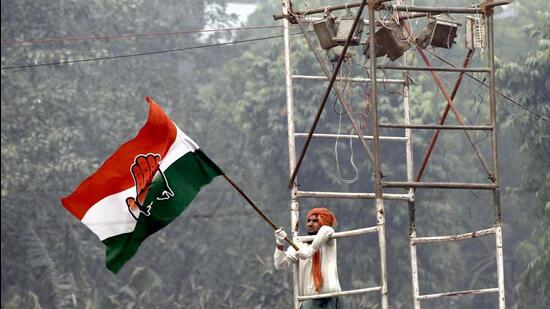
What is responsible for the decline of the Congress? Is it the Gandhis? Or is it something else? This is a question that surfaces after every electoral defeat of India’s grand old party. With the Congress failing to retain its government in Punjab or exploit anti-incumbency as the principal opposition force in Uttarakhand, Goa and Manipur in the latest round of assembly elections, it is hardly surprising that the question has surfaced again. The political success and failure of a
To be sure, the headline vote share numbers of the Congress hide variations in its regional fortunes. A visual representation of vote shares by states provides a snapshot of how the Congress’s footprint has weakened across the country. This underlines the need for a state-wise appraisal of the Congress’s decline.
{{^htLoading}} {{/htLoading}} But its tactical predicament has never been greater
In India’s first-past-the-post (FPTP) system,vote shares are not a goal in themselves. To win an election, a party has to just finish first rather than cross a certain vote share threshold. So, what matters is the ability of a party to convert popular support into seats. It is on this count that the Congress faces its biggest crisis. Its seat-share to vote-share ratio in the 2014 and 2019 elections is the lowest it has ever been, whereas it has been the highest for the Bharatiya Janata Party (BJP). It was on this parameter that Sonia Gandhi established herself as the Congress’s leader in the pre-2014 phase. The seat-share to vote-share ratio of the Congress increased significantly in the 2004 and 2009 elections, putting it in power once again after having lost in 1996.
{{^htLoading}} {{/htLoading}} Strategy versus tactics is a false binary for the Congress
The debate within the Congress can broadly be classified into two poles. The first is best represented by Rahul Gandhi, who has been advocating an ideological confrontation vis-à-vis the core Hindutva agenda of the RSS-BJP. The other pole, which is now represented by the so-called G-23 seems to be advocating for better alliance building .
{{^htLoading}} {{/htLoading}} This was best seen in the G-23 statement issued on March 16, which demanded that the Congress leadership “initiate dialogue with other like-minded forces to pave the way for a credible alternative for 2024”, while also calling for adopting “the model of collective and inclusive leadership and decision-making at all levels”.
An HT analysis of election results shows that this kind of an either-or approach on strategy versus tactics might not be able to revive the Congress. There are two reasons for this. One, the BJP’s current phase of dominance has also put a squeeze on regional parties such as the Samajwadi Party (SP) and the Rashtriya Janata Dal (RJD) in crucial states of Uttar Pradesh and Bihar. The Opposition tried to counter the BJP by forging bigger alliances in 2019 but this did not yield desired results. In fact, a larger vote-share comparison shows that the overall support for non-Congress non-BJP parties has itself come under squeeze in the last two elections (See Chart 1).
{{^htLoading}} {{/htLoading}} The second data point which supports this argument is the fact that the BJP’s victories are increasingly getting bigger and bipolar in nature unlike in the late 1990s, when it was more vulnerable to Opposition unity. In the Lok Sabha constituencies it won, the BJP’s median vote share was an overwhelming 55.2% in 2019. The median ENOP – this measures the degree of political competition in a constituency – in constituencies the BJP won was just 2.2 in 2019. Defeating the BJP will require winning back BJP voters rather than getting anti-BJP votes together.
These numbers suggest that neither of the strategies -- an all-out ideological assault on the BJP or wider tactical alliance formations -- seem to be working at the moment. What the Congress needs to do, perhaps, is adopt a mix of both. It cannot defeat the BJP without taking the ideological challenge head-on, but it also cannot win the ideological battle on its own. This is not going to be an easy task as more regional parties prefer to attack the BJP on local issues rather than its ideological core, lest they lose some of the local anti-incumbency driven votes to the party. The battle for Congress’s survival is not about reversing the party’s declining fortunes; it is about re-establishing its ideological hegemony in India.
{{^htLoading}} {{/htLoading}}