The Indian Medical Association (IMA) on Monday criticised the promotion of Patanjali’s ayurvedic drug Coronil as “unethical” and a “blatant deceiving of the people of the country”.
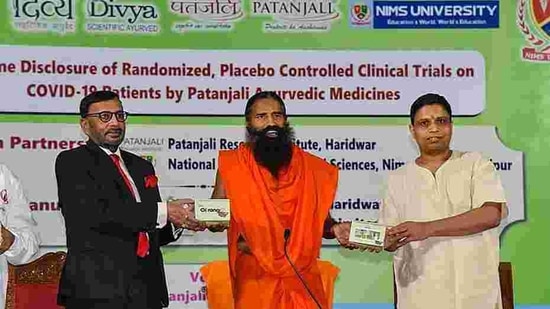
This comes days after the company relaunched its medicine as the “first evidence-based medicine for Covid-19.”
“How can a drug be effective for prevention, treatment and rehabilitation from the disease? If Coronil is effective for prevention, why (is the) government spending ₹35,000 crores for vaccination?” the association said in a statement.
“As per the code of act of Medical Council of India, which (is binding) on every modern medical (practitioner), no doctor can promote any drug.”
Also Read | Patanjali claims Coronil gets Ayush Ministry certification as per WHO scheme
The relaunch of the medicine took place on Friday in the presence of the Union health minister Harsh Vardhan and road transport and highways minister Nitin Gadkari.
“We are delighted and proud to state that Coronil has been granted a CoPP license by DCGI, in accordance with the WHO GMP quality approvals,” tweeted Acharya Balakrishna, chairman of Patanjali Ayurved.
{{/usCountry}}“We are delighted and proud to state that Coronil has been granted a CoPP license by DCGI, in accordance with the WHO GMP quality approvals,” tweeted Acharya Balakrishna, chairman of Patanjali Ayurved.
{{/usCountry}}Following this, the World Health Organisation’s South East Asian Region had to issue a clarification stating, “@WHO has not reviewed or certified the effectiveness of any traditional medicine for the treatment #Covid19.”
In June, when the company first launched the product, the AYUSH ministry directed the company to stop advertising the product till the claim was verified. The company then submitted initial data of its trial at the National Institute of Medical Sciences, Jaipur.
The study has recently been published in the journal Phytomedicine and states that 71% of the patients recovered after being administered the treatment as compared to 50% in the placebo group at day 3.
At day 7, 100% of those administered the treatment recovered while only 60% of those in the placebo arm did.
Doctors on social media have contended that the sample size for the experiments was too small and anyone with severe disease (those with oxygen saturation of less than 90% or acute respiratory distress syndrome) were excluded from the study.
The parameters for “recovery” were not defined, several experts said, questioning the paper released by Patanjali.