The Union Cabinet has approved the PM Electric Drive Revolution in Innovative Vehicle Enhancement (PM E-Drive) Scheme with an outlay of ₹10,900 crore for two years and a Payment Security Mechanism (PSM) of ₹3,435.33 crore under PM-eBus Sewa in a boost to electrification of vehicles.
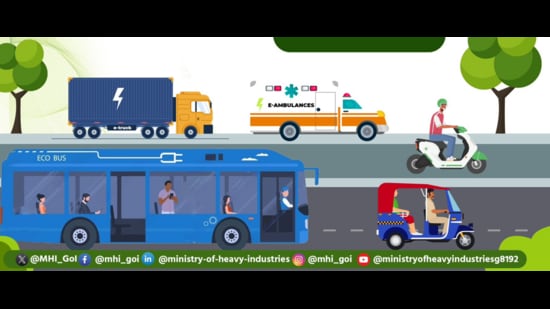
₹3,679 crore will be provided as subsidies for purchasing e-two wheelers, e-three wheelers, e-ambulances, e-trucks, and other emerging electric vehicles (EVs) under the PM E-Drive scheme. In a statement, the government said the scheme will support 2.479 million e-2Ws, 316000 e-3Ws, and 14,028 e-buses.
The heavy industries ministry will implement the scheme and provide subsidies to both the buyer and manufacturer e-vouchers through a dedicated portal. ₹4,391 crore has been earmarked for public transport agencies to procure 14,028 e-buses. “The demand aggregation will be done by CESL [Convergence Energy Services Limited] in the nine cities with more than 40 lakh [four million] population namely Delhi, Mumbai, Kolkata, Chennai, Ahmedabad, Surat, Bangalore, Pune, and Hyderabad. Intercity and Interstate e-buses will also be supported in consultation with states,” the statement said.
States and cities will be prioritised for public buses based on their compliance with guidelines for the scrapping of old vehicles. As many as 22,100 fast chargers for e-4 Ws, 1800 for e-buses, and 48,400 for e-2W/3Ws will be installed with the allocation of ₹2000 crore to reduce the range anxiety of EV buyers.
{{/usCountry}}States and cities will be prioritised for public buses based on their compliance with guidelines for the scrapping of old vehicles. As many as 22,100 fast chargers for e-4 Ws, 1800 for e-buses, and 48,400 for e-2W/3Ws will be installed with the allocation of ₹2000 crore to reduce the range anxiety of EV buyers.
{{/usCountry}}The scheme will also incentivise the adoption of electric trucks with an allocation of ₹500 crore and for modernising testing agencies for the EV ecosystem with an outlay of ₹780 crore.
Pawan Mulukutla, WRI India executive programme director for integrated transport, clean air, and hydrogen, said the Cabinet’s approval reiterates India’s ambitious decarbonisation target in the transport sector by deployment of 50,000–60,000 e-buses in the coming years through schemes such as National Electric Bus Programme and the PM-eBus Sewa. “This was essential to make the project more bankable and ensure further participation of the private players, and who were otherwise wary of delayed payments or defaults. This will ultimately result in lowering of the cost of operations due to greater competition,” he said.
Under the PM-eBus Sewa scheme, 10,000 air-conditioned electric buses will be provided to tier-2 and tier-3 cities under a public-private partnership model. The government told Parliament that ₹541 crore was allocated in the vote-on-account for the scheme for bus operations and allied infrastructure in 75 cities as of August.
Industry players and policy observers have advocated for PSM as a guarantee through which electric bus suppliers/operators will be paid on time as most transport undertakings under the state governments are financially unhealthy and often delay payments to contractors. A similar mechanism by Solar Energy Corporation of India Limited is in place for solar power generation projects.