E-Paper



Rijiju exits law ministry amid judiciary stand-off
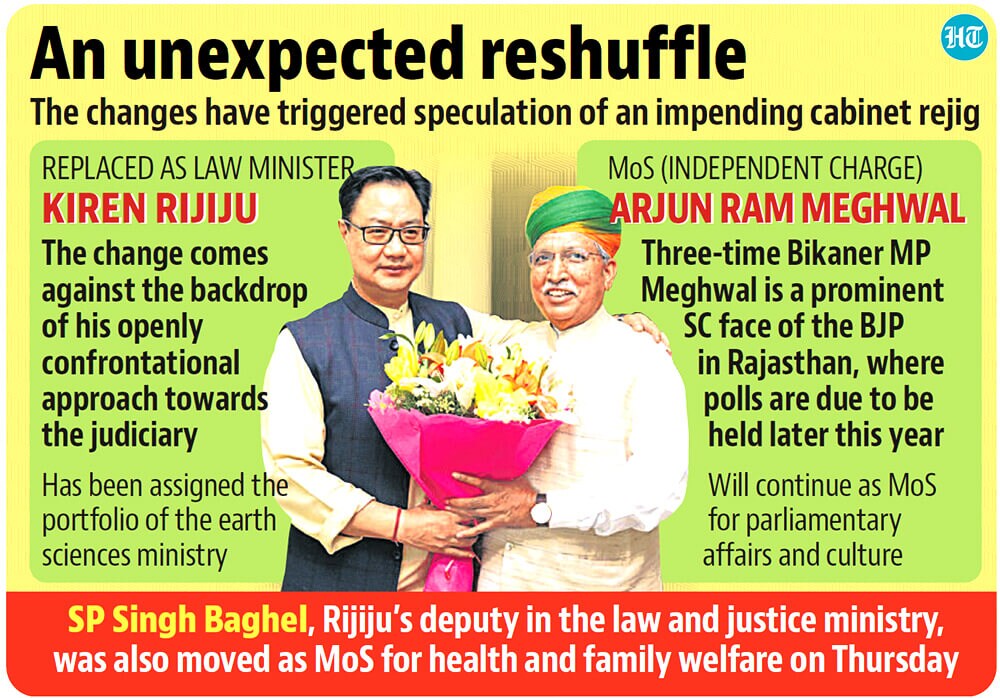
Rijiju was replaced by Arjun Ram Meghwal, who has been assigned independent charge as minister of state for law & justice.


Union minister Kiren Rijiju was divested of the law & justice portfolio and assigned that of earth sciences, and hours later, the minister of state for law and justice SP Singh Baghel was moved to the health ministry, according to official communiques from Rashtrapati Bhavan.

Rijiju was replaced by Arjun Ram Meghwal, who has been assigned independent charge as minister of state for law & justice, in addition to his existing portfolios. Meghwal is also minister of state for parliamentary affairs, and culture. A former bureaucrat and a prominent Scheduled Caste BJP leader in Congress-ruled Rajasthan, where polls are due to be held later this year, Meghwal is a three-time MP from Bikaner. He is known for championing the cause of the environment, and is often seen cycling to Parliament.
Also read: After Cabinet rejig, Kiren Rijiju thanks PM Modi, CJI Chandrachud: ‘Been a privilege’
The changes in the law ministry come against the backdrop of Rijiju’s long battle with the higher judiciary, in which he repeatedly termed the collegium system of appointing judges “opaque” and “alien to the Constitution”. He also suggested that it was the only such system in the world “where judges appoint people known to them”.
While his statements received wide coverage, and even triggered responses from members of the senior judiciary, it is not clear whether they served any material purpose.
To be sure, it is not known whether his approach had anything to do with the change in his portfolio.
At several occasions since last November, Rijiju reproached the collegium system, and his comments were tacitly responded to by Chief Justice of India (CJI) Dhananjaya Y Chandrachud who made an appeal for “constitutional statesmanship” by the executive and judiciary as he spoke at the Constitution Day function on November 25.
Justice Sanjay Kishan Kaul, the second senior most judge and a member of the collegium who is seized of a contempt petition against the government for delays in the appointment of judges, disapproved of the law minister’s public stance during a hearing of this case on November 28, stressing that the Centre cannot “frustrate the entire system” of making judicial appointments just because it doesn’t like it.
Again, on December 8, the bench led by justice Kaul reminded the government that it is bound to follow the collegium system “to a T” because that is the law of the land. On that day, the Supreme Court also urged attorney general R Venkataramani to advise the government functionaries to “exercise control” in their speeches.
A few days later, Rijiju said in Parliament that the Supreme Court should not hear bail pleas at a time when pendency of cases is so high, effectively eliciting a response from CJI Chandrachud during the hearing of a case on December 16 that the Supreme Court exists to answer the cry of the citizens whose liberty have been taken away and thus, no case is small for the highest court of the land.
On January 6, Rijiju wrote to the CJI underlining that the government is an “important stakeholder in the process of appointment of judges in the Supreme Court and high courts”, as he emphasised on the need to have a search-cum-evaluation committee (SEC) with the government’s representative to prepare the panel of names who are eligible for being appointed as judges of the constitutional courts.
Also read: SC junks plea seeking action against V-P, Rijiju for remarks on judiciary
While the collegium was contemplating a response, Rijiju issued another statement critical of judiciary as he addressed an event organised by a lawyers’ association in Delhi on January 23, saying judges do not have to face elections or public scrutiny but are still assessed for their judgments and the way they function. A day later, the BJP MP lamented that the collegium’s decision to make public the secret information received from the Intelligence Bureau (IB) and the Research & Analysis Wing (RAW) regarding the candidates recommended for judgeship is a matter of “grave concern”.
Incidentally, the Supreme Court on Monday declined to entertain a plea demanding action against Rijiju and Vice President Jagdeep Dhankhar and for their remarks on the judiciary and the collegium system, saying the “credibility of the Hon’ble Supreme Court of India is sky-high, it cannot be eroded or impinged by the statements of individuals”.
Shortly after assuming office on Thursday, Meghwal told reporters that his priority will be to ensure speedy justice for all. When asked about the government and the judiciary having been at loggerheads, he said, “The executive and the judiciary have a cordial relationship, and it will stay cordial and constitutional. The boundaries are already there.” He also cleared the appointment of two judges to the top court without hours of taking charge.