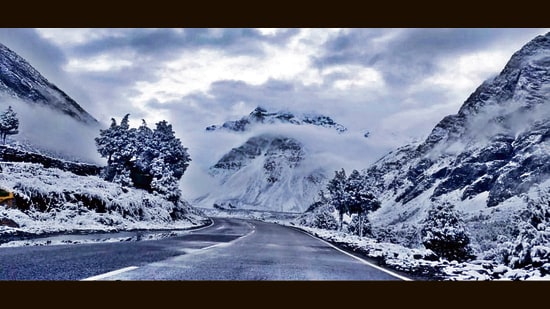
Several towns in Jammu & Kashmir and Himachal Pradesh recorded snowfall on Monday, plunging these regions into an unusual cold spell in the summer month of May at a time when a spate of other rare weather occurrences are being recorded across the country.
Data analysed by HT showed that the average temperatures recorded in the three Himalayan states and UTs of Himachal Pradesh, Uttarakhand and Jammu & Kashmir were among the lowest since 1951 and, as a result, the northern plains were also recording cooler-than-usual temperatures.
Behind the trend is a series of rain-bearing western disturbances, experts said. “The active western disturbance in the past 10 days has brought lot of rain, snow and hail in the north-western Himalaya region,” said RK Jenamani, an India Meteorological Department (IMD) scientist based in Delhi.
Snow is not uncommon in the higher reaches of the Himalayan ranges in May, but what is unusual is how frequently it has snowed in towns at lower altitudes, including Manali and Gulmarg on Monday.
“The weather does not look like that of May,” said Jagdish Chauhan, who owns an apple orchard in Manali, which received fresh snowfall on Monday. “I am wearing full winter clothes and room heating (wood-based) has been reinstalled. The only difference is water has not frozen,” he said, adding that he had not seen such a cold May in decades.
{{/usCountry}}“The weather does not look like that of May,” said Jagdish Chauhan, who owns an apple orchard in Manali, which received fresh snowfall on Monday. “I am wearing full winter clothes and room heating (wood-based) has been reinstalled. The only difference is water has not frozen,” he said, adding that he had not seen such a cold May in decades.
{{/usCountry}}IMD data appeared to bear this out. The records of rain and snow since 1901 showed that the northern hill provinces — Jammu & Kashmir, Ladakh, Himachal and Uttarakhand — were witnessing one of the coldest and wettest first weeks of May since 1951.
The average maximum temperature was 8-10°C lower than the 1981-2010 average, which is considered the normal, and the average minimum temperature was the lowest in Himachal and Uttarakhand since at least 1951.
Similarly, rainfall (or possibly snowfall in higher reaches) in the first week of May has been among the top 10 since 1951 for all these states and UTs except Ladakh, which has a 38% deficit compared to the 1961-2010 average.
Rain or snow in the other three regions is 2.6 to 3.2 times of the 1961-2010 average, the analysis shows.
Jammu & Kashmir has received 53.6mm of rain in first week of May, the highest for any Himalayan province this year, and, not unexpectedly, was one of the three coldest places in India in the first week of May, along with Himachal Pradesh and Uttarakhand.
The trend matches with what has happened in the northern plains, where maximum temperatures have been as much as 15°C lower than what is normal for this time of the year, when the day’s highs usually breach 40°C. This comes after a 2022 when much of the country virtually skipped the spring season and began recorded summer-like temperatures in mid-March.
Experts said that while some of this was expected in a year with El Nino conditions — a particular warming of the eastern pacific that influences weather patterns worldwide — the trends seems to be more concerning than usual and come at a time when the climate crisis is predicted to lead to more such unusual weather.
“In some years this happens. Increase in frequency of large scale western disturbances (WDs) which even penetrate to lower latitudes is a typical symptom of an evolving El Nino. [But] snowfall in May is not good. By now WDs should have moved to northern latitudes,” said M Rajeevan, former secretary, ministry of Earth sciences and climate scientist.
“This pattern, if it persists, can affect monsoon onset. WDs should have moved to north of Kashmir by now,” he added.
The IMD Srinagar office on Monday said Gulmarg, Pahalgam, Sonmarg and Qazigund areas of the Kashmir valley received snow early on Monday morning. The day temperature in the state dropped by 12°C compared to normal, although the IMD predicted next four days to be warmer.
Eight tourists were rescued by police when their vehicle got stuck in snow near Jawahar Tunnel in Qazigund on Monday morning.
There were avalanches at numerous locations along the Zoji La axis and the Indian Army along with Jammu & Kashmir Police (JKP) and General Reserve Engineer Force (GREF) launched a joint operation to rescue stranded tourists on Monday.
IMD Srinagar’s deputy director, Mukhtar Ahmad, said that higher reaches in the state have received snow even in June — the latest being on June 12, 2019 — but independent weather watcher Faizan Arif pointed out that this year even the plains received snow, which, he said, is rare.
In Himachal, mid and lower hills continued to receive sporadic snow even as higher reaches have received up to 9 cm of snow on Monday, IMD said.
Gondla in Lahaul-Spiti district received 9cm of snowfall and Keylong got 4cm of snow and the minimum temperature was -1.5 degree Celsius, making it the coldest place in the state. Another spell of rain and snow is expected in the state on May 13.