Some butterfly species are more prepared to survive displacement from their habitats than others, a new study by researchers from Bengaluru’s National Centre for Biological Sciences (NCBS) has said. The study, which was published in Royal Society’s Biology Letters on Wednesday, has also warned that loss and fragmentation of habitats through urbanisation, agriculture, and climate crisis may take a heavier toll on other species.
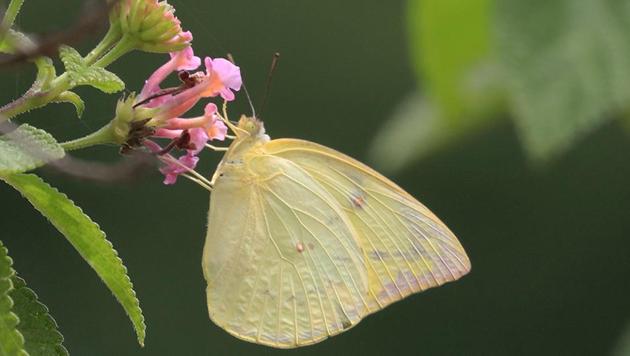
Some butterfly species disperse for several hours or days to find food or breeding grounds. The researchers found that increased flight burden puts additional pressure on the egg-carrying female butterflies, which are physiologically less prepared to navigate through unknown fragmented habitats in search of larval host plants. Butterflies flight movements are for migration and dispersal. The seasonal long-distance migrations are between two known destinations over hundreds of kilometres. When local food resources are exhausted, some species randomly disperse over relatively short distances in search of new unfamiliar resources patches. Other species do not disperse at all.
The researchers said while some long-distance female butterfly migrants stop reproductive activity during migration to invest energy in flying, others lack reproductive plasticity. They arrived at the conclusion after comparing the flight morphology and reproductive status of Lemon Emigrant and Mottled Emigrant butterflies. They have both dispersing and non-dispersing populations.
The researchers found that female milkweed butterflies migrate in a state of reproductive diapause – or halt reproductive activity. In doing so, they invest their energy on flying rather than being burdened with eggs during their journey.
{{/usCountry}}The researchers found that female milkweed butterflies migrate in a state of reproductive diapause – or halt reproductive activity. In doing so, they invest their energy on flying rather than being burdened with eggs during their journey.
{{/usCountry}}“Female emigrants disperse while carrying eggs, and therefore there are long term consequences of fragmenting or vanishing habitats. That’s because the longer they have to fly, there is more uncertainty in finding a suitable habitat patch. As a result, many more female butterflies may perish before they can reach a spot where they may lay eggs,” said Vaishali Bhaumik, lead author and a PhD scholar at NCBS. “The danger with too much fragmentation is that if these butterflies have to fly with eggs, they may either be unable to carry as many eggs as they can at short distances or they may not be able to fly long enough to reach the patches.”
Renee M Borges, a professor at Bengaluru’s Indian Institute of Science, said the findings show most convincingly that there is flexibility in the strategies of butterflies.
“However, more importantly, a strategy can only be maintained if the habitat through which butterflies disperse is conducive to the provision of nectar fuel for the flight. The increasing fragmentation of forests and butterfly habitats can cause a serious problem for the successful dispersal and migration of butterflies,” she said.
Borges, whose expertise lies in insect pollination and plant science, added the analogy for humans is that of driving a car through a bleak landscape where the petrol or diesel station is separated at a greater distance than the maximum fuel capacity of the fuel tank. “Obviously in such a situation the car will stop and the traveller will have to abandon the journey. Similarly, in evolutionary time, natural selection has provided butterflies with an optimal movement and dispersal strategy that assumes that butterflies will have access to resources at appropriate flight intervals. Disruption of these resources by fragmentation could lead to fewer successful dispersals and/or migrations.”
The researchers said habitat fragmentation in recent times has occurred due to growth in human settlements, and cultivation of avenue trees or agriculture fields.
“Butterflies, therefore, have to travel some distance to find suitable plants, which adds to their regular worries of whether or not a patch has too many predators or of finding a suitable plant where caterpillars will be able to feed well and not get eaten up,” said Bhaumik. “Habitat fragmentation is more pronounced in urban areas since roads act as a barrier and butterflies flitting to another patch are likely to get hit by vehicles moving at great speeds. In rural areas, flying from patch to patch is comparatively easier.”
Ajai Misra, chief wildlife warden, Karnataka forest department, said the research finding is the first step towards conservation efforts they have taken up especially for species such as butterflies.
“The Karnataka forest department is utilizing such studies in understanding habitat corridors being used for dispersal/migration by different species so that biodiversity in larger landscapes can be preserved,” he said.