Washington: On a chilly Sunday afternoon in Washington DC, with over 700 guests in attendance, top representatives of the White House, key figures in the Democratic Party, and Republican Party leaders drove up to India House — the residence of the Indian ambassador to the United States (US) Taranjit Singh Sandhu — to celebrate India’s cultural diversity and hail the India-US relationship.
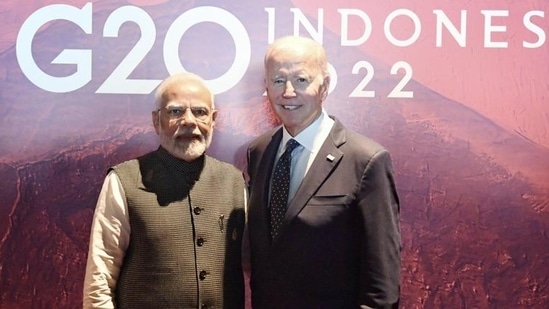
If US deputy national security advisor Jonathan Finer, representing President Joe Biden, lauded the role of Prime Minister Narendra Modi in helping G20 arrive at a consensus in Bali and said that Modi was among the leaders Biden looked to take forward global agenda and share the burden with, Neera Tanden, the President’s staff secretary and senior advisor, saw the moment as a marker of how far the Indian-American community has come.
If America’s doctor, surgeon general Vivek Murthy, spoke of his roots and the future of the India-US health partnership, Aruna Miller — the newly elected lieutenant governor of Maryland, the first Indian-American to be elected to this critical state-level office in the country — traced how Mahatma Gandhi’s non-violent struggle inspired Martin Luther King’s civil rights movement, which in turn opened the doors for both the Voting Rights Act and subsequently the lifting of race-based immigration restrictions.
Besides members of the diaspora and the student community, among those in attendance were President Biden’s special coordinator for international energy security and infrastructure investment, Amos Hochstein, administration officials, Republican state senator, and prominent Donald Trump supporter, Niraj Antani, Congressional staffers, business leaders and philanthropists, and those from the think-tank community.
{{/usCountry}}Besides members of the diaspora and the student community, among those in attendance were President Biden’s special coordinator for international energy security and infrastructure investment, Amos Hochstein, administration officials, Republican state senator, and prominent Donald Trump supporter, Niraj Antani, Congressional staffers, business leaders and philanthropists, and those from the think-tank community.
{{/usCountry}}The lunch, held in the spirit of showcasing India’s religious and cultural diversity and respect for all faiths, was organised to celebrate Diwali, Eid, Gurupurab, Bodhi Day, Christmas, and Hanukkah. Indian cuisine was laid out across the lawn, guests in Indian attire brought colour to the festivities, and Indian cultural performances showcased the country’s pluralism and diversity.
Modi, a key partner
Finer, a key national security official who serves as deputy to national security advisor Jake Sullivan and is among Biden’s confidants, dated his interest in foreign affairs to his travels and stay in India 23 years ago.
Finer said, “2022 was a huge year in US-India relations and we have a bigger year ahead.” Listing out the key markers for 2023, Finer said the two countries will engage in the Quad leaders summit; the US will support India’s G20 presidency; the foreign and defence ministers will meet at their annual 2+2 dialogue; the CEOs dialogue will get relaunched, and there will be a dialogue on critical and emerging technologies.
“And this is just the tip of the iceberg. And it is really emblematic of how the US-India relationship has proceeded.”
Finer, who was speaking for the President at the event, said that Biden saw the relationship with India as one of the most consequential for the US; there was great potential, and the US was deeply committed to it. In a reference to the partisan battles that mark the political environment in Washington, the US deputy NSA pointed out how there was bipartisan support and continuity when it came to the relationship with India.
“There is obviously an increasing alignment of our interests, both geopolitically and as the world’s leading democracies.” Finer also acknowledged the diaspora, and cultural and commercial ties and then spoke of the direct connect between leaders.
“I don’t want this to be lost. And there are ties of our leadership, which we consider to be hugely important. Looking around the world, when the US and President Biden look for partners who can truly help carry the load and truly move forward a global agenda, India and Prime Minister Modi is very high up on the list.”
Finer said this was witnessed in realtime at G20 (at Bali) where the PM was “instrumental in forging a consensus around a joint statement among a far-flung group of countries” and in the comments, the PM has made in highlighting the increased risk related to nuclear issues. Modi’s formulation that this was not the era of war emerged as the point of consensus amid geopolitical tension between the West and Russia.
Finer said that the US was “very excited” about what lay ahead in the relationship, calling Sandhu among the most effective ambassadors in Washington DC.
Diaspora connect
But besides the strategic relationship, the afternoon was a celebration of the diaspora and its achievements.
Neera Tanden, a top Democratic figure, who, as staff secretary, is responsible for processing all the paperwork that lands on Biden’s desk, said that the event demonstrated so much of what the President speaks of when he celebrates diversity as a strength and an inclusive country.
Tanden said she was proud to be Indian-American in the administration and referred to the range of high-level positions in the administration occupied by members of the community — from Biden’s chief speechwriter to the director of science and technology policy, from the surgeon general to, of course, the Vice President. “It shows how far the Indian diaspora has come and I am here to express the administration’s gratitude.”
Murthy, the US’s 21st surgeon general who also served in the position during the final phase of the Barack Obama presidency, went back to his roots.
“When I was a child, my mother would sit with my sister and me, and what she taught us were stories of Indian heritage, from the Ramayana and Mahabharata to the person I was named after Vivekananda.” Murthy said what he learnt from his mother were the diverse traditions in India, but all bound together by common values and a sense of community, and this sense of community had become only more important in the aftermath of Covid-19.
Covid-19, Murthy said, had also shown the importance of collaboration between communities and countries, and it was here that the India-US partnership was “more important than ever” in health. The two countries share not just common health challenges, but also a commitment to lift everyone through access to health care and investment in prevention. This lesson, Murthy said, had come to him from his grandfather, who despite being a poor farmer in a village in South India with five children, spent time raising money to build a youth hostel.
But the loudest cheer from the audience that largely came from the DC-Maryland-Virginia area was reserved for Aruna Miller, the newly elected Maryland lieutenant governor, who has broken a state-level glass ceiling for the community and won on a ticket that included the state’s first Black governor, Wes Moore.
Miller said the profoundness of the moment wasn’t lost on her — of being the first immigrant to be elected to the position in the state, and the first Indian-American in the position nationwide. And then, weaving a wider arc of history, Miller said she would not be standing here but for the struggles before her — Gandhi inspired King; King’s movement led to the Voting Rights Act; the following year, in 1965, the Immigration Act was passed abolishing the national origin formula which discriminatory; that allowed, Miller said, many like her family and others to come to the US.
Pointing out that 30 Indian-Americans had got elected in the recent midterms, at state-city-county levels and the Indian-American presence in the US House had expanded to five members, Miller said, “Our growing influence will help write the next chapter of US history. The ties between India and the US could not be stronger, both recognise their strengths lie in pluralism and democracy.”
The India and India-US story
Laying the stage for the afternoon, Sandhu said that event was meant to celebrate India’s many religions, cultures, geographies, and values, and laid out the India story of today.
“India is a global talking point today—as a beacon of stability amidst geopolitical uncertainties; an usherer of global economic growth; a solution provider to some of the complex challenges of our times; and a consensus builder in times of conflict and rising tensions.”
Providing a comparative perspective, Sandhu said that in 2009, 17% of Indians had bank accounts, 15% used digital payments; 4% had a unique id document and about 37% had mobiles phones. “Today, around 80% have bank accounts; more than 80% of the households in India use some kind of digital payments; nearly 99% of the population have unique ids and more than 90% have mobile phones.” With over 77,000 start-ups and 108 unicorns, a population where 50% was 25 or below, the rural internet users (340 million) outnumbering the urban population (290 million), India has taken to the modern digital age with ease, the Indian envoy said.
Against this backdrop, the India-US relationship had grown. Sandhu said that Biden and Modi met 15 times (in person or virtual) and Secretary of State Antony Blinken and external affairs minister S Jaishankar met 30 times since the administration took office.
Highlighting cooperation across domains, Sandhu said that in IT, Indian tech companies contributed $80 billion to US GDP and created 600,000 jobs in the country. “It is a two-way street”. He also acknowledged the role of the four million-strong diaspora and 200,000 Indian students in America.