
 E-Paper



US supercarrier Nimitz to join Vikramaditya for QUAD Malabar exercise off Goa coast
The two carrier groups, with MiG-29K fighters on board Vikramaditya and F-18 fighters on board Nimitz, will participate in war games, while the involvement of the two other countries, which are, like India and the US, members of the Quad grouping, will strengthen multi-operability in full domain exercises.

 Prefer HTon Google


Indian Navy’s flagship Vikramaditya and US supercarrier Nimitz along with two destroyers of the Australian and Japanese navies will conduct full-spectrum exercises off the coast of Goa as part of Malabar war games from November 17 to 20.
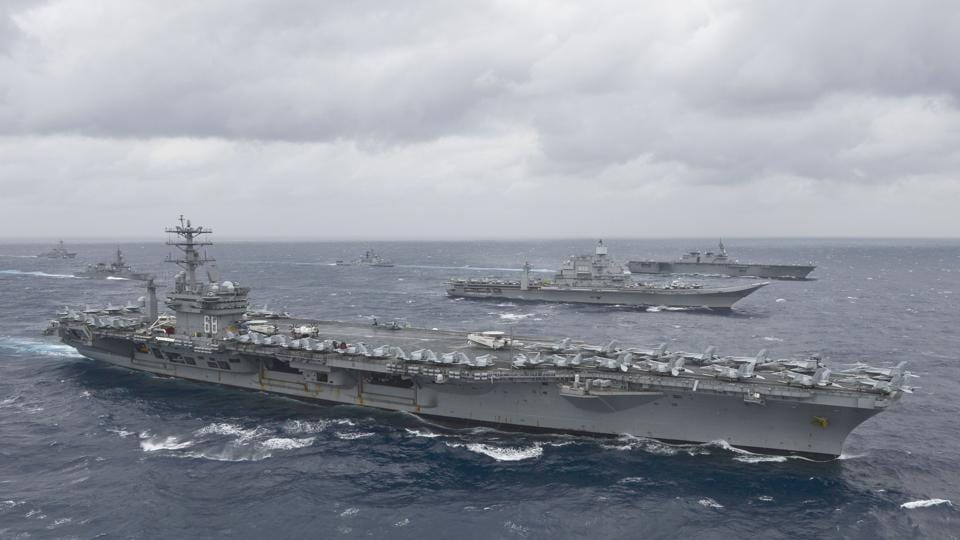
The two carrier groups, with MiG-29K fighters on board Vikramaditya and F-18 fighters on board Nimitz, will participate in war games, while the involvement of the two other countries, which are, like India and the US, members of the Quad grouping, will strengthen multi-operability in full domain exercises. It is also expected to help all four countries understand the ethos and level of training of each other’s navies, commanders and personnel.
The exercise will take place in quite a congested environment with at least 70 foreign warships patrolling the area between the Persian Gulf and Arabian Sea. The People’s Liberation Army (PLA) Navy’s warships are not in the vicinity but are not too far off either -- ostensibly conducting anti-pirate operations off the Gulf of Aden.
According to top naval commanders, the Indian Navy is fully deployed on both the eastern as well as the western seaboard and prepared for contingencies in case the situation takes a turn for the worse in East Ladakh region. Analysts say it is clear that the Quad members are committed to keep the sea lanes of communication open for navigation and are ready to meet the challenge brought upon by PLA Navy by imposing constraints in South China Sea.
With the Indian Navy expected to commission indigenous aircraft carrier INS Vikrant along with its second nuclear powered ballistic missile submarine, INS Arighat, by next year, India will be able to project power from Malacca Straits to Gulf of Aden and beyond, the analysts added.
Under navy chief Admiral Karambir Singh, the focus of the force has also been on rapidly developing military infrastructure in the Andaman and Nicobar Islands so that India can project power well beyond the Malacca Straits. The navy is also keen on building a third aircraft carrier so that it turns into truly blue water navy.
While there is an intensive debate among national security planners over the viability of a third aircraft carrier in an age when so-called standoff weapons and long range ballistic missiles are the order of the day, the navy’s argument is that a rising power like India cannot be tethered to the shore-line. This argument makes sense, say analysts, as China’s influence in Africa, Middle-East and Persian Gulf under the Belt Road Initiative has grown with Beijing leveraging its debt-hold on these countries.
With China reaching the Indian Ocean through Pakistan and Myanmar, the navy wants Indian maritime and commercial interests to be protected by three aircraft carriers, one each of Arabian Sea, Bay of Bengal and Indian Ocean. The counter argument made by the national security planners is that India should simply turn some of its 1,062 island territories into permanent military bases to influence events in the region.
With the US, India, Australia and Japan communicating through deployed assets, liaison officers in each other’s naval commands, and Indian Ocean Monitoring Centres, the Quad, the analysts added, is definitely a force to reckon with in Indo-Pacific with situational awareness of both West Asia and Africa.


