Uttar Pradesh shows why MLAs do not matter in politics in states
An analysis of incumbency level datasets prepared by the Trivedi Centre for Political Data suggests that becoming an MLA does not bestow much power, at least beyond the current term, to a person in the politics of states.
What does it take to win a state election in India? Charismatic chief ministerial candidates or a committed, yet grounded set of MLAs? Logically, the answer should tilt towards the latter. After all, legislative majorities are gained or lost at the level of assembly constituencies.
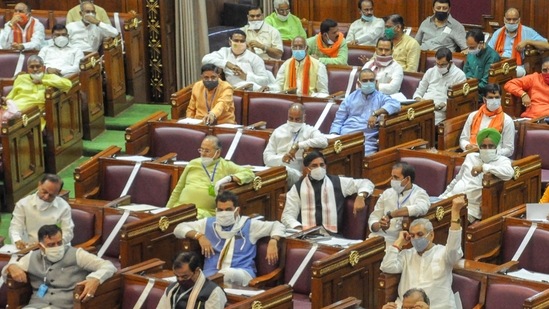
State legislatures are structurally weak when it comes to keeping a check on the executive, the central doctrine of separation of powers in the Indian constitution. (HT File)
However, an analysis of incumbency level datasets prepared by the Trivedi Centre for Political Data suggests that becoming an MLA does not bestow much power, at least beyond the current term, to a person in
Of the 312 BJP MLAs who won their seat in the 2017 assembly election, only 19 had won twice or more times previously.
The current UP assembly is not an aberration
It can be argued that the lack of experience in the current Uttar Pradesh assembly is a result of the massive BJP victory, which led to a loss of the more experienced MLAs from other parties. Historical data shows that this is not the case.
Since 1977, the share of first-time MLAs has never been lower than 65%, and the share of experienced politicians (elected more than twice) has never been more than 15% of the assembly. Since 1977, 444 of the 4577 seats won were occupied by MLAs serving a third term of more. These 444 MLAs boil down to 274 unique individuals, scattered across parties and time: 73 with the BJP, 61 with Congress, 21 with the BSP and 105 with the SP and its previous socialist incarnations.
Since 1977, the share of first-time MLAs has never been lower than 65%, and the share of experienced politicians (elected more than twice) has never been more than 15% of the assembly.
What explains the un-experienced MLA syndrome?
Both parties are voters are responsible for this. At the party level, most sitting MLAs do not even get a chance to keep their seat. In 2017, only 40% of all 403 sitting MLAs re-ran. And only 30% of those who re-ran got re-elected. This is what the voter-induced effect refers to. Once again, 2017 was not an exception on this count. Here again, historical data shows that this is another longstanding trend of UP politics. From 1977 to 2017, an average of 38% of all sitting MLAs get to re-run, and an average of 41% of these re-running incumbents manage to keep their seat.
In 2017, only 40% of all 403 sitting MLAs re-ran. And only 30% of those who re-ran got re-elected.
Upper caste men have a disproportionate presence in the rank of stable political class
The profile of this political class is also quite elitist. 45.3% of them belong to upper castes, against 22% of SCs and OBCs. Muslims make up only 9% of UP’s professional class, that is to say 24 individuals. Over the period, only four Jat politicians have made it to this list. This is also a male-dominated list, as only 9 women figure among these 274 professional politicians.
Muslims make up only 9% of UP’s professional class, that is to say 24 individuals.
Does a high political turnover in assembly help democracy?
The high turnover of UP’s political class has implications for democratic processes. First, the UP assembly is and has for long been an assembly of newcomers. Such a large turnover of political elites translates into a loss of cumulative experience in the assembly. MLAs who come in with the knowledge that they will not be occupying their seat for long have little incentive to learn the ropes of the legislative aspect of their job. This weakens the legislative check on the executive. The extraordinary concentration of power in the hands of a small class of politicians, which includes of course party leaders, faction leaders, local dynasts and strongmen, who succeed in lasting in politics by dint of their grit and talent, but also at times through the control they exert over their constituency.
Uttar Pradesh is not the only state when it comes to a high turnover of MLAs. In most states, this turnover hovers around fifty percent.
This analysis helps put in perspective the phenomenon of concentration of power that we see in states across India. It reveals that the rise of strong, populist, chief ministers is not the sole factor behind the presidentialisation of state politics. There are factors that are structural to electoral competition that are also at play, across political parties. The high probability of defeat for re-running incumbents also reveals the difficulty of meeting voters’ expectations.
The author is Assistant Professor of Political Science and Co-Director of the Trivedi Centre for Political Data. Views are personal. Data used in this article is available at https://lokdhaba.ashoka.edu.in/pct/?e=VS
Get the latest India News, breaking headlines, and real-time updates from across the nation. Stay informed on politics, government policies, crime, weather, and CEC Gyanesh Kumar row Live.
Get the latest India News, breaking headlines, and real-time updates from across the nation. Stay informed on politics, government policies, crime, weather, and CEC Gyanesh Kumar row Live.
Home/India News/Uttar Pradesh shows why MLAs do not matter in politics in states
{{^htLoading}}
Advertisement
{{/htLoading}}
SHARE THIS ARTICLE ON
{{#usCountry}}{{/usCountry}}
Notifications
Get breaking alerts directly from the newsroom
Notifications are on!You'll be notified when news breaks