New Delhi: Maldives President Mohamed Muizzu’s on-going five day visit to India is actually a vindication of Prime Minister Narendra Modi’s neighborhood first policy, aimed at keeping the bilateral ties Teflon coated from the sinusoidal curve of democratic politics. Muizzu, who got elected Maldives President on ‘Out India’ campaign in September-October 2023, has come back to Bharat on an Indian Air Force plane with 12 Cabinet ministers to sign the Comprehensive Economic Maritime Security Partnership agreement. What is more significant is that he has made a call to Indian tourists to come back to the Indian Ocean littoral state.
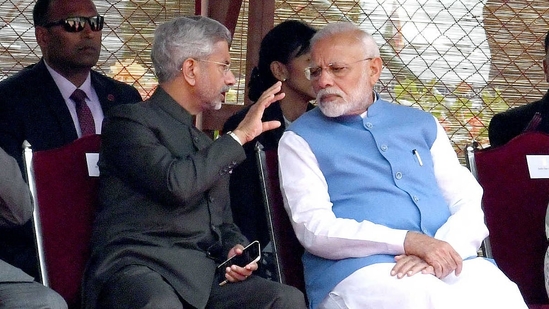
A decade ago, Prime Minister Narendra Modi spelled out his new vision to handle neighborhood nations to the then Foreign Secretary Subrahmanyam Jaishankar. He told Jaishankar that given its stature, size and shared history, India will always be a factor in neighborhood politics as the majority of countries in the Indian sub-continent are democracies. The PM said that China will always be a factor of concern as it will try to influence the Indian neighborhood to restrain the rise of Bharat. Similarly, Western powers, he told Jaishankar, will try to dabble in the Indian neighborhood to get a foothold for their own power play as seen in Bangladesh today. PM Modi said that India should forge stable relationships in the neighborhood which are independent of vagaries of democratic politics.
Also read: Exclusive: CCS may clear the 31 Predator drone deal today
In line with PM Modi’s vision, India created a different dynamic in the neighborhood by investing in critical infrastructure requirements in the neighboring countries. Rather than dictating the projects in which India would like to invest in, the Modi government decided to take on road, railway, power, drinking water, fuel, bridge, ferry and new check posts projects on the basis of requirements of its bilateral partners. Simultaneously, India became the first responder to any economic, natural disaster, medical crisis like Covid-19 pandemic or extraneous factors like evacuating citizens of neighboring countries from war torn Sudan or Ukraine. Besides, India became a pillar of economic stability for its neighbor by offering economic aid to Sri Lanka during the 2022 upheaval and the currency swap agreement worth USD 400 million and ₹3000 crore given to Maldives this week. Maldives is currently facing a serious economic crisis with only USD 49 millions of usable reserves and huge debt repayment of USD one billion coming up in 2026. Barring Pakistan, India has helped all the countries in the neighborhood with debt issues and economic stability if required by them.
{{/usCountry}}In line with PM Modi’s vision, India created a different dynamic in the neighborhood by investing in critical infrastructure requirements in the neighboring countries. Rather than dictating the projects in which India would like to invest in, the Modi government decided to take on road, railway, power, drinking water, fuel, bridge, ferry and new check posts projects on the basis of requirements of its bilateral partners. Simultaneously, India became the first responder to any economic, natural disaster, medical crisis like Covid-19 pandemic or extraneous factors like evacuating citizens of neighboring countries from war torn Sudan or Ukraine. Besides, India became a pillar of economic stability for its neighbor by offering economic aid to Sri Lanka during the 2022 upheaval and the currency swap agreement worth USD 400 million and ₹3000 crore given to Maldives this week. Maldives is currently facing a serious economic crisis with only USD 49 millions of usable reserves and huge debt repayment of USD one billion coming up in 2026. Barring Pakistan, India has helped all the countries in the neighborhood with debt issues and economic stability if required by them.
{{/usCountry}}Also read: View: October 7 is a wake-up call for Indian intelligence
While India is all for promoting its neighborhood first policy, the Modi government has also not shied away from bluntly stating its national interests with the neighbors. It has made it clear to Pakistan that there will be a lethal response to its cross-border terrorism policy towards India. It has also made it clear to Indian Ocean littoral states that they must keep India’s national security sensitivities in mind vis-à-vis China while allowing PL:A spy ship into their exclusive economic zones. The west supported Interim government of Bangladesh was told in no uncertain terms to protect the Hindu minorities from rampaging Islamists post removal of Sheikh Hasina from Dhaka.
While Muizzu played the anti-India card initially, he soon realized that only India will financially support projects that Male requires as China will only invest into those projects that will help Beijing at a later date. For instance, the Greater Male Connectivity Project, water and sanitation projects undertaken by India will transform the Island nation without any vested interests of Bharat. India is currently purchasing power from Nepal and Bhutan, supplying power and fuel to Bangladesh, building infrastructure in Sri Lanka and Maldives, while offering all the neighbors increased medical visas for treatment in India. Fact is that India is playing a role of supplier, consumer, developer, builder and promoter in the neighborhood except Pakistan, which is staring at economic abyss due to poor governance and high interest loans from China.
Also read: View: Will Israel reshape Middle East by attacking Iran ?
While India was the first to respond to vaccine requirements in the neighborhood during the global pandemic that had origins in China, it has also become the first responder to financial distress situations in the sub-continent without any vested interest or leverage. In the past decade, governments have changed in Sri Lanka, Nepal, Maldives and Bangladesh, but the Modi government’s commitment to the neighbors is irrespective of who is in power and as long as it does not harbor anti-India forces. Mohamed Muizzu’s visit to India and his call for Indian tourists to return is also an indicator of India’s purchasing power. India also reached out to new Sri Lankan President Aruna Kumara Dissanayake as soon as he was elected and the new leader also ensured that India’s interests would be protected. Fact is that India had anticipated Diassanayake’s ascent to power as the Leftist leader came on a visit to New Delhi earlier in the year.
With India set to surpass Japan as the fourth largest economy in 2025-26, it is only logical that the Modi government will face competition and criticism from both the west and the Asian powers. But Modi’s neighborhood first policy is yielding dividends as Muizzu today visits Bengaluru, a place where the first lady had completed her college education.