
 E-Paper



Vijay's Tamil Nadu floor test is not about his govt alone. Vote will decide if AIADMK stays or cracks | Explained
Vijay visited AIADMK rebel leader's home where MLA group extended support to TVK govt, but the Tenth Schedule of the Constitution may come into play

 Prefer HTon Google


When Tamil Nadu chief minister C Joseph Vijay faces a trust vote for his TVK-plus-five-allies government today, the outcome will matter far beyond whether his rule survives beyond three days.
The vote has become the stage for another consequential drama, on whether the AIADMK, once the dominant force in Tamil Nadu politics, holds together or fractures just weeks after its worst election performance in decades.
How Tamil Nadu political scene is laid out
Vijay's Tamilaga Vettri Kazhagam (TVK) won 108 seats in the April 23 assembly elections, results of which came on May 4 — a remarkable debut for a party barely two years old. But 108 falls short of the 118 needed for a majority in the 234-seat assembly. Vijay formed the government with support from Congress, the VCK, the CPI and the CPM, plus IUML, all of them DMK allies who switched sides as the incumbent party finished second.
The coalition, on paper, gives him enough in terms of numbers.
But Vijay has been getting, and courting, an additional source of support from an unexpected corner, from a rebel faction within the AIADMK. This faction, led by senior leaders C Ve Shanmugam and SP Velumani, claims to have around 30 of the party's 47 MLAs.
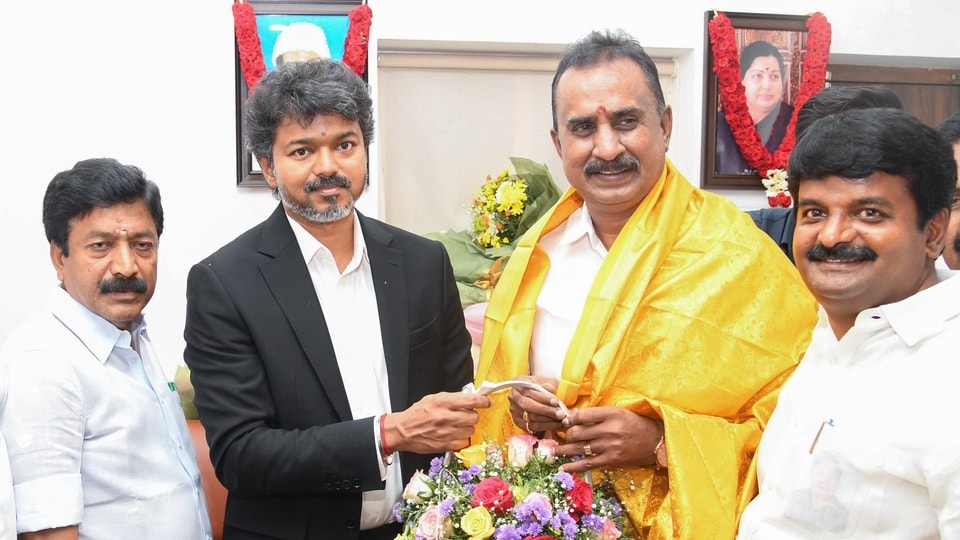
On Tuesday, Vijay visited Shanmugam's Chennai residence, where the group formally extended support to the TVK government, but the rebels' count remains precarious, and that will matter for their immediate future.
Shanmugam spoke of the rebellion as “a new life” for the party that's been in free fall since the death of J Jayalalithaa in 2016. "Amma rule" should return, he said, referring to Jayalalithaa, a filmstar-turned-political supremo like Vijay. He argued that supporting the TVK was the right course for that new life.
The still-official AIADMK, led by General Secretary Edappadi K Palaniswami (EPS), has hit back hard with an existential threat for the MLAs. Senior EPS faction leader Agri SS Krishnamurthy announced at a press conference on Tuesday evening that the party's official position is to “vote against the confidence motion tomorrow (May 13)". He added that all party MLAs had been formally instructed to follow the directive. That's called a party whip, in legal terms.
On the question of any MLA crossing the floor, Krishnamurthy said, "Legal action will be taken."
How split might play out
OS Manian, speaking for the EPS camp, dismissed all talk of a split, asserting that 47 MLAs had already submitted a signed document to the assembly speaker affirming EPS as leader of the legislative party. The rebels, he said, were "spreading a bag of lies" after “failing to secure victories in their own districts”. He alleged they were doing that to get ministerial berths in Vijay's cabinet.
The rebel camp alleges that EPS was open to supporting a DMK-backed arrangement to keep TVK out of power. That, he said, directly contradicted the party's foundational principles. The official AIADMK has denied this, calling it a rumour manufactured to justify defection.
The newly elected speaker of the assembly, JCD Prabhakar of TVK, sits at the centre of whatever comes next. The official AIADMK noted with unease that the speaker allowed Velumani to address the house after Palaniswami. The speaker is also the authority who will decide any disqualification petitions filed after today's vote.
Also Read | Vijay appoints astrologer as OSD; allies Congress and VCK question move
What the law says, and what history shows
The anti-defection law disqualifies any MLA who votes against a party whip. But there is a critical escape route. If at least two-thirds of a legislature party votes together, it may be treated as a merger and the members can be protected from disqualification.
For the AIADMK rebels, two-thirds of 47 is 32. They are claiming to have 30 for now.
This kind of a scenario plays out depending on whether the threshold is met.
Most recently, led by Raghav Chadha, AAP's seven of 10 Rajya Sabha MPs switched to the BJP using the two-thirds argument.
At the other end, Congress-ruled in 2024 showed what happens when numbers fall short. Six Congress MLAs defied their party whip on a budget vote. Total being 40, they were nowhere near two-thirds. The speaker disqualified all six the same day.
A third path of resignation rather than defection was used in Madhya Pradesh in 2020, when 22 Congress MLAs loyal to Jyotiraditya Scindia resigned from their seats rather than vote against the whip, sidestepping the anti-defection law and bringing down Congress veteran Kamal Nath's government in the process.
What the floor test will decide
If the rebel AIADMK MLAs vote with Vijay and their count reaches or crosses 32, they have a credible legal argument for merger protection.
Vijay would emerge with a substantially more comfortable majority, less dependent on any single coalition partner.
And the AIADMK would effectively split into two functioning factions, with consequences that will outlast this assembly term.
If the rebels fall short or change their minds, Vijay may still win the confidence vote on the strength of his existing coalition, but the rebel lifeline proves hollow.
The AIADMK entered this election already weakened, winning only 47 seats from 164 it contested.
AIADMK's many cracks
The AIADMK has been fracturing almost continuously since Jayalalithaa died in December 2016.
Within weeks, her aide VK Sasikala was appointed General Secretary, only for O Panneerselvam to publicly rebel, saying he had been compelled to resign under pressure. Sasikala expelled him, splitting the party into two factions. Sasikala's own bid for CM collapsed when the Supreme Court upheld her conviction in a disproportionate assets case, and she went to jail. Edappadi K Palaniswami or EPS then became legislature party leader. EPS and OPS eventually merged their factions, but EPS later expelled OPS in 2022. OPS is now with the DMK.
The current rebellion is, in that sense, not an aberration. It is the latest chapter in AIADMK's post-Amma script.


