Last week this column highlighted that the widespread rain in northern India that began on January 23 as a result of a western disturbance, a storm originating in the Mediterranean region, was ending a prolonged dry spell in most of the region. The length of this spell was among the longest on record for states like Uttarakhand. Now that the dry spell has ended, and another western disturbance has followed the one that brought rain on January 23, it is useful to check how much of the deficit in precipitation has ended. An HT analysis shows that the rain and snowfall last week has decreased the number of states affected by very big deficits, but the road to normal accumulation of both in northern India is still long.
The India Meteorological Department (IMD) classifies a deficit of 20%-60% compared to the Long Period Average (LPA). (HT file photo)
The India Meteorological Department (IMD) classifies a deficit of 20%-60% compared to the Long Period Average (LPA) – the average precipitation in the 1971-2020 period – as “deficient”; and that of 60% or more as “large deficient”. As HT highlighted last week, most states qualified as large deficient in the period after mid-November. Among 23 big states and union territories (UTs), 21 were at least deficient for the November 16-January 22 period, and 20 were large deficient. The latter number has come down after the spell last week. For the November 16-January 27 period, only 14 are large deficient.
To be sure, the decline in rain deficit so far does not mean things are back to normal. While the number of states in large deficient category has come down, the number of states at least deficient has declined from 21 to 20. The only state that went from being deficient to having a deficit small enough to be classified as normal is Punjab. On the other hand, Uttarakhand and Ladakh continued to be large deficient, even as the deficit has decreased to under 60% in neighbouring Himachal Pradesh and Jammu and Kashmir. As expected, the deficit has not changed significantly in states like Madhya Pradesh, Chhattisgarh, or Bihar -- states anyway less likely to be impacted by western disturbances.
HT graphic
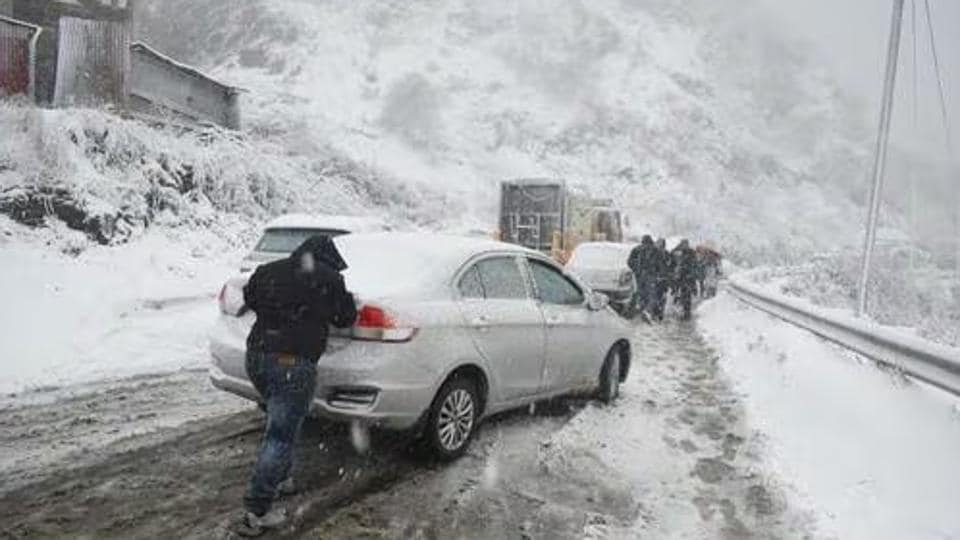
What is true for cumulative precipitation is also true for another related metric: the accumulation of snow. Satellite derived data on the accumulation of snow – also called snow pack – shows that the spell last week had a big impact on its deficit. There was a 27.7% deficit in snow pack on January 21, the highest in this snow cycle (it runs from October to September), in the box containing all four mountainous northern states and UTs. This decreased to 24.4% by January 25. To be sure, such a sudden growth in snow pack also implies large and sudden snowfall, which is affecting normal life in the mountains.
HT graphic
Because the snow pack deficit figure described above is for the entire region, it is important to look at regional differences, which is shown in the accompanying maps. These show that the past week’s spell has decreased the deficit in snow pack across the entire region. However, the spell has had less impact in higher reaches. It is the lower reaches of the mountains that have seen the biggest turnaround, with some places now even in a surplus. This is expected. Because the past average of snow pack in the lower reaches is low, even small amounts of snowfall can plug the deficit there easily. It is harder to remove the deficit in higher reaches because they are expected to have more snow.
HT graphicHT graphic
To be sure, another spell of precipitation started on January 27. This should help in decreasing the deficit in precipitation and snow pack even more. However, given the level of deficit currently in both these metrics, it is unlikely that even this week’s spell can remove the deficit completely.
Abhishek Jha is Assistant Editor-Data at Hindustan Times. He uses statistical programming to generate newsworthy insights from large datasets. He is part of the team that produces Number Theory, a daily data story feature of the paper’s print edition. Since March 2024, he has been writing Weather Bee, a weekly column for the Hindustan Times website. He is a chemical engineer by training, who specialises in stories related to weather, climate, and the environment.
Jha has been at HT since 2018, where he offers data-driven perspective and analysis on politics, environment, weather, climate, economy and society. His work includes data coverage of elections in India and abroad, including the 2019 and 2024 Lok Sabha elections; the disasters and extreme weather resulting from changing climate, such as floods, droughts, heat waves, cold waves, and dwindling snow cap in the Himalayas; the factors that drive poor air quality in northern India; the changing patterns of land use; the Covid-19 pandemic and its impact on labour market conditions; the changing pattern of consumer spending seen in the new consumer spending surveys; and social norms seen in the surveys such as the National Family Health Survey.Read More
Get the latest India News, breaking headlines and real-time updates from across the country. Stay informed about politics, government policies, crime, weather and major national developments.
Home/India News/Weather Bee | Rain Deficit Down After Western Disturbances But Far From Normal

 E-Paper