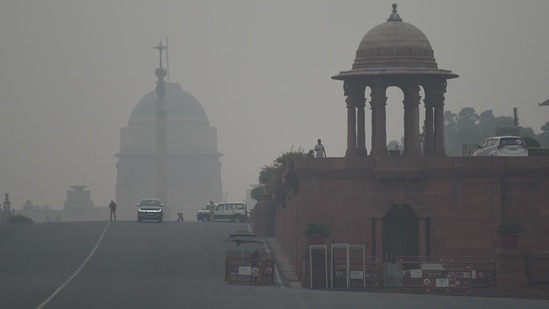
Delhi’s average Air Quality Index (AQI) for November was 321. While this still puts average AQI for November in the ‘Very Poor’ category – it is bad enough to affect most people with prolonged exposure – Delhi’s air quality this November was the second-best since 2016. What explains this relative improvement in Delhi’s air quality this year? (October was also the second best) An HT analysis shows that some of this could be due to the weather in Punjab and
Rain or wind did not clean Delhi’s air
How did Delhi get its best air for the three weeks in the middle? Rain or strong surface winds in Delhi can clean Delhi’s air irrespective of whether the source of pollution is farm fires or local factors. However, these particular weather factors were not the most favourable this year. Unlike in 2018, 2019, or 2020, when it rained for one or two days in November, there was no rain in Delhi this November. Wind speed was also not as fast as in the past (3rd highest in the first two weeks of November and second lowest in the weeks after). Compared to the 2016-2021 average, the wind was 13% slower this November on average, although during the second week it was faster by 15%. This means that the relatively clean air this November is not because of any cleansing of pollutants after they have already accumulated.
{{^htLoading}} {{/htLoading}} Farm fires, a major source of pollution, were fewer than in the past
While rain and wind did not clean Delhi’s air, one major winter pollutant for Delhi (smoke from farm fires) itself was not as big a factor. Active fires in Punjab and Haryana were the second lowest since 2016 this November. If October is also included in the analysis (without rain or strong winds, pollutants would not have anywhere to go even if they were injected in October), 2022 still saw the second lowest number of fires since 2016 . These trends hold even if the entire period of satellite data (2012 onward) is analysed. Moreover, at least on a few days the wind was not blowing from the west to the east, which would bring pollutants from farms to Delhi.
{{^htLoading}} {{/htLoading}} But rains in Punjab, not reasonable farmers, explain lower farm-fires this year
The decline in farm fires suggested by satellite data needs to read with caution, as far as their long-term management is concerned. Data suggests that at least some of the decline in fires could be the result of the weather rather than farmers not resorting to stubble burning. For instance, although it hasn’t rained in Delhi, it rained on five days in Punjab in the first three weeks of November, the period up to when farm fires last significantly. Since 2016, it had rained on more days in November only in 2019 (seven days). It was also one of the rainier years in Haryana, where farm fires are significant even though much lower than in Punjab.
{{^htLoading}} {{/htLoading}} Warmer nights in Delhi might also have played a favourable role
Moreover, while the average maximum or day temperature in Delhi has been lower than both the normal (1981-2010 average) and the average of the 2016-2021 period, minimum or night temperature has actually been warmer than in the past. Delhi’s minimum temperature this November was 1.21 degrees Celsius higher than the 2016-2021 average and 1.25 degrees warmer than the normal. Apart from the apparent decrease in farm fires, this is also likely to have prevented any pollutants from accumulating close to the ground. A week-wise breakup shows that the nights became colder than the 2016-21 average only after the third week, which is when air quality took a turn for the worse without any farm fires.
{{^htLoading}} {{/htLoading}}