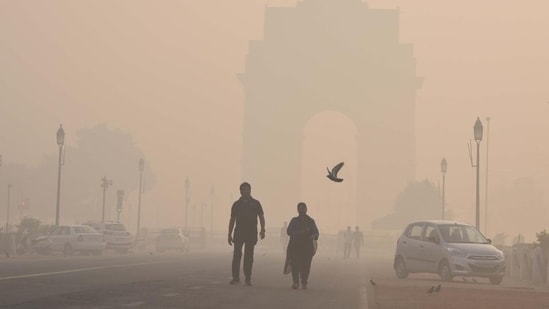
Delhi air pollution: With record pollution levels choking the capital, the Delhi government on Tuesday pushed for “cloud-seeding” or “artificial rainfall” as an emergency measure to combat pollution. Delhi environment minister Gopal Rai called on the Centre to hold an urgent meeting to address the situation and approve the plan to induce artificial rain over the city.
A similar proposal was made last November, but it was abandoned due to unfavourable weather conditions.
The Delhi government had previously said that it would cover the entire cost of the experiment. The plan, divided into two phases, was estimated to cost ₹1 crore per 100 square kilometres. The first phase was expected to cover 300 square kilometres at the cost of ₹3 crores, with the second phase potentially covering 1,000 square kilometres at the cost of ₹10 crores, depending on the success of the initial phase.
What is cloud seeding?
Cloud-seeding is a technique used to modify weather by releasing silver iodide (AgI) into the atmosphere to facilitate the formation of ice crystals, enhancing the cloud's ability to generate rain. Silver iodide aids in the creation of ice nuclei in clouds, which are necessary for artificial rain to occur.
In the process of cloud-seeding, chemicals like silver iodide, potassium iodide, and dry ice are dispersed into the sky via airplanes and helicopters. These chemicals attract water vapour, helping form rain clouds. Typically, it takes around 30 minutes for this method to produce rainfall.
{{/usCountry}}In the process of cloud-seeding, chemicals like silver iodide, potassium iodide, and dry ice are dispersed into the sky via airplanes and helicopters. These chemicals attract water vapour, helping form rain clouds. Typically, it takes around 30 minutes for this method to produce rainfall.
{{/usCountry}}According to ScienceDirect, cloud-seeding can be categorised into two types:
- Hygroscopic Cloud Seeding: This method accelerates the merging of droplets in liquid clouds, creating larger droplets that eventually lead to precipitation. Salt particles are generally released at the cloud's base.
- Glaciogenic Cloud Seeding: This technique induces ice formation in supercooled clouds by dispersing efficient ice nuclei like silver iodide or dry ice, which triggers ice nucleation and subsequent precipitation.
Where was it used previously?
Cloud-seeding has not yet been implemented in India as a method to improve air quality. While IIT Kanpur had planned to conduct an experiment last year, it has been conducting test runs along the Western Ghats since 2018, though the impact on air quality has not been evaluated.
In December 2023, cloud-seeding was carried out in Lahore, Pakistan, which led to an improvement in the Air Quality Index (AQI) from 300 ("poor") to 189 ("moderate"). However, the AQI worsened again within two days.
Not a practical solution?
Scientists and experts have labelled the artificial rain proposal as “impractical,” saying that its effectiveness is not assured.
They said that artificial rain is not a viable solution to Delhi’s winter pollution issue and more research is needed. “Until we have enough data or research to prove its effectiveness, this could be a waste of funds. Additionally, the environmental impact of silver iodide needs to be studied before considering its use,” said Mukesh Khare, an air pollution expert from IIT Delhi.
Sachin Ghude, a scientist at the Indian Institute of Tropical Meteorology in Pune, which conducted cloud seeding experiments in the Western Ghats from 2015 to 2018, explained that not all clouds are suitable for seeding. “We need sufficient clouds, particularly convective clouds. Over the past week, clouds have been scarce. Our tests also showed that even when clouds are present, not all of them will lead to rainfall,” he said.