
 E-Paper



What is the ‘Sudarshan Chakra Mission’ that PM Modi announced in his I-Day speech?
India's 'Sudarshan Chakra' defence system could rival Israel's Iron Dome, known for intercepting rockets from Hamas and Hezbollah with over 90% success.

 Prefer HTon Google


Prime Minister Narendra Modi announced that India will be launching the “Sudarshan Chakra Mission”, aimed at enhancing the country’s security over the next decade.
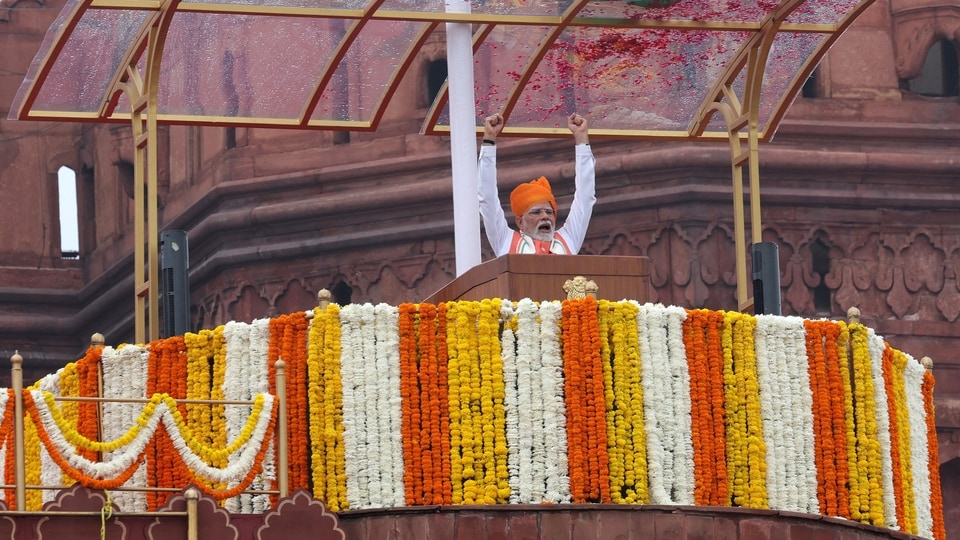
According to Modi, the mission will integrate advanced surveillance, interception, and counter-attack capabilities to enable swift neutralisation of threats across air, land, and sea domains.
Follow live updates on Independence Day 2025
During his Independence Day address from the Red Fort in the national capital, the prime minister also stressed the importance of developing a jet engine domestically for India’s fighter aircraft programme, stating that “it is necessary to march ahead in the defence manufacturing sector.”
Praising the armed forces for the success of Operation Sindoor, Modi said it had dealt a “severe blow to Pakistan”, with new details of the damage inflicted on the country emerging “every day.”
This year, Modi delivered his longest Independence Day speech yet, speaking for 103 minutes (1 hour and 43 minutes) from the Red Fort. The address broke his previous record of 98 minutes set in 2024; his first record was in 2015 with an 88-minute speech.
Also Read | Independence Day 2025: How to add the Indian flag to your WhatsApp, Instagram, profile pictures- Har Ghar Tiranga
What are the objectives of ‘Sudarshan Chakra Mission’?
Modi said that the new “Sudarshan Chakra Mission” will aim to create a shield protecting India’s strategic, civilian, and religious sites from potential enemy attacks, while also developing new weapons.
The system is expected to rival Israel’s renowned Iron Dome, a multi-layered defence network credited with intercepting thousands of rockets from Hamas and Hezbollah since its deployment in the 2010s, with Israel claiming a success rate of over 90 per cent.
“In the next ten years, by 2035, I want to expand, strengthen, and modernise this national security shield. Drawing inspiration from Lord Shri Krishna, we have chosen the path of the Sudarshan Chakra... The nation will be launching the Sudarshan Chakra Mission. The entire modern system should be researched, developed, and manufactured in India, harnessing the talent of our youth. This powerful system will not only counter terrorist attacks but also strike back at the terrorists,” Modi said.
Highlighting the goal of self-reliance, he emphasised that by 2035 the country will enhance and modernise its security infrastructure, drawing inspiration from Lord Shri Krishna’s Sudarshan Chakra. “India aims to develop its own Iron Dome-like defence system, named Mission Sudarshan Chakra, designed to safeguard critical sites, including civilian areas,” he added.
The Sudarshan Chakra Mission, Modi said, reflects India’s commitment to indigenous innovation and robust defence capabilities.
Issuing a stern warning to Pakistan from the Red Fort, Modi declared that “terrorists and those providing them safe haven will be treated alike” and asserted that the armed forces will have the authority to decide the punishment for any future misadventure by the neighbouring nation.
Praising the military for the success of Operation Sindoor, he said it had dealt a “severe blow to Pakistan” with details of the damage inflicted “emerging every day.” He also reiterated that India “will not tolerate Pakistan’s nuclear blackmail anymore” and has established a “new normal” in tackling cross-border terrorism.
The comments came in the context of the April 22 Pahalgam attack, in which 26 people, mostly tourists, were killed. India responded with a series of diplomatic and economic measures, including suspending the Indus Waters Treaty.
On May 7, India launched Operation Sindoor to target terrorist infrastructure in Pakistan, sparking four days of hostilities that ended with an understanding between the two sides on May 10. Modi said the armed forces had been given a free hand to punish those behind the Pahalgam attack, with the military also entrusted to decide on any future retaliation.


