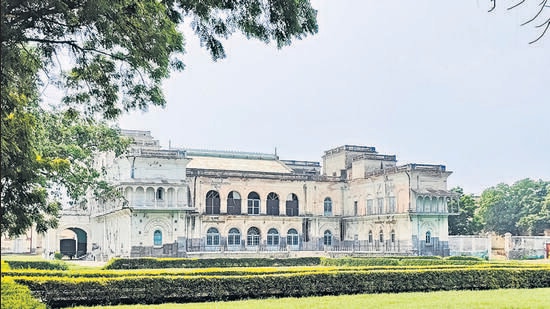
Spread over 10 acres in the heart of Faridkot, the Qila Mubarak is a reminder of what once was. The stately cream and white palace, its veneer now chipped in places, was once the centre of power of the erstwhile princely state’s last ruler Maharaja Harinder Singh Brar.
It is now also one of the several properties worth ₹20,000 crore that was caught in a three-decade-long legal dispute which captured Punjab’s attention. On September 7, the Supreme Court brought
Spread over 10 acres in the heart of Faridkot, the Qila Mubarak is a reminder of what once was. The stately cream and white palace, its veneer now chipped in places, was once the centre of power of the erstwhile princely state’s last ruler Maharaja Harinder Singh Brar.
It is now also one of the several properties worth ₹20,000 crore that was caught in a three-decade-long legal dispute which captured Punjab’s attention. On September 7, the Supreme Court brought down the curtains on this protracted battle, complete with family intrigue and multiple wills, by upholding a Punjab and Haryana high court order on the inheritance of Brar’s royal riches, including movable and immovable assets in four states, ruling in favour of two of his daughters.
Faridkot’s family tree
The royal family of Faridkot descends from Jaisal, the founder of the state of Jaisalmer. Jaisal’s descendant Chaudhary Kapur Singh, converted to Sikhism and founded the principality of Kotkapura in 1705. The first cleavage in the lineage was a dispute between his grandsons that resulted in the separation of the family estate in 1763. Sardar Jodh Singh Brar, took control of Kotkapura, and his younger brother, Sardar Hamir Singh Brar, established himself at Faridkot in 1763. He reconstructed Qila Mubarak in 1775, first built by Raja Mohkalsi who founded the city in the 13th century.
In 1806, the Lahore Darbar seized both Faridkot and Kotkapura estates, and they were “conferred” to Maharaja Ranjit Singh’s general Dewan Mokam Chand. Three years later however, the British empire signed a treaty with Ranjit Singh which barred him from crossing the Sutlej, which essentially secured the restoration of the Faridkot estate and all of its dependencies to Sardar Gulab Singh, who was the grandson of Hamir Singh and chief of Faridkot estate.
Sardar Attar Singh, the son of Gulab Singh, died under mysterious circumstances in 1827 and was succeeded by his cousin Pahar Singh who went on to become the first maharaja of Faridkot. He assisted the British during the first Anglo-Afghan War in 1839-1842. Retired colonel Balbir Singh Sran, who wrote a book ‘Ek Si Riyasat’ (Once there was kingdom) said that during the mid 1800’s, most princely states in the region supported the British to secure themselves. “Maharaja Ranjit Singh had moved towards the east of Punjab and under him the Faridkot ruler would only have been zamindars, while the British made them kings. It was a give and take relationship for the Faridkot estate.”
Balbir Singh ascended to the throne in 1898 but was forced to accept a degree of supervision by the British for the first few years of his reign. Though he received his full ruling powers in 1904, he died without a male heir two years later, and his nephew Brijinder Singh took his place.
Brijinder was conferred with the title of Maharaja in return for helping the British empire during World War I by sending 2800 soldiers and food grain. He died in 1918, leaving the throne to his three-year-old son, Harinder Singh Brar, who became the last ruler of the erstwhile princely state of Faridkot. The council of regency controlled affairs till 1934 when he came of age.
Brar agreed to accede to the Union of India in 1947, but faced the crisis of partition as tens of thousands of Hindu and Sikh refugees poured into Faridkot from Pakistan during the carnage that ensued. Faridkot signed its instrument of accession on May 5, 1948, and became part of the Patiala & East Punjab States Union (PEPSU).
Months after this, Brar enacted the “Raja Faridkot Estate Act, 1948”, declaring that the estate would devolve to his male successor. He executed a will soon after on March 11, 1950 which among other things said that some bank accounts, and four flats at Rohtak Road in Delhi would go to his three daughters in equal measure.
THE DISPUTE
The genesis of the dispute dates back six decades, when a princess married against wishes of her father. Brar and his wife Narinder Kaur had three daughters – Amrit Kaur, Deepinder Kaur and Maheepinder Kaur – and a son, Tikka Harmohinder Singh. In 1952, the eldest daughter, Amrit Kaur, married Major Harpal Singh against the wishes of the family, especially the king. Major Harpal, who had served in World War II in Burma had joined the Faridkot Police in 1946 and was the king’s aide-de-camp before Amrit married him. Colonel Sran said: “The problem was that Harpal was a former employee and not from royal lineage. The king snapped ties with his daughter. Moreover she was just 18 years old at the time, and this was Harpal’s second marriage. He had two children from the first marriage.”
Following this, Brar executed a second will on May 22, 1952 deciding not to leave any property to Amrit..
Amarinder Singh, the grandson of the king’s brother, Kanwar Manjit Inder Singh, says that when Amrit Kaur got married against her father’s wishes, her parents were on a world tour and their grandfather was the head of the family. “The blame fell on my grandfather and that led to differences between the brothers,” he says.
In 1981, the Brar’s only son, till then unmarried, died aged 43 in a road accident in Faridkot. Eight years later, Brar died too, battling with depression in his last years.
It was then that a controversial third will of the king surfaced. During the bhog ceremony on October 26, 1989, a will dated June 1, 1982, was read out by Lal Singh, a close aide of Brar declaring that the entire property left behind by the ruler would be taken over by the Maharwal Khewaji Trust, which came into existence in October 1982. The composition of the trust itself was a matter of controversy with Brar’s wife and mother not part of the board, while his two daughters Deepinder and Maheepinder were named chairperson and vice chairperson of the trust respectively.
According to this version of the will, the trust would always be headed by a royal descendant ; it also specified that because his eldest daughter, Amrit Kaur had married against his wishes, the king had disinherited her. The trust had full control over the properties and income from the assets of the Faridkot princely state.
THE BATTLE ROYALE
In November 1992, Amrit Kaur took the first legal steps in what would turn out a dramatic thirty-year long trial, filing a civil suit at the Faridkot district court, challenging the third will. She argued that her father could not have legally bequeathed his entire estate to the trust because it was an ancestral property governed by Hindu Succession Act, 1956. She claimed that she was entitled to a third of the property along with her two sisters. She also said that the king was not in “a fit state of mind” when the third will was created, and questioned the exclusion of her mother Narinder Kaur and grandmother, Mohinder Kaur. She claimed that the will was invalid, as one of the attesting witnesses, Brijinder Singh Brar, was a beneficiary himself. Maheepinder, unmarried at the time, died in Shimla in 2001 at 57.
Amrit Kaur’s counsel Manjit Singh Khaira said, “Kaur always told me that she was not fighting for money but for honour and pride. She said her father could not disinherit her and the will was forged.”
The king’s brother, Manjit Inder, also filed a civil suit in 2010 claiming that by rule of primogeniture he was entitled to the estate.
In 2013, the Chandigarh district court declared the will illegal, finding it “not to be genuine due to a large number of suspicious circumstances” and granted inheritance to Amrit and Deepinder, dismissing Manjit Inder’s claim.
Five years later, the district and sessions court in Chandigarh upheld the lower court’s order after which the trust challenged this order in the Punjab and Haryana high court. Deepinder, who married into the Burdwan royal family in West Bengal, died in 2018 and her son, Jai Chand took over as chairman of the trust, with his sister Nisha Kehr, vice chairperson.
Jai Chand and Kehr could not be reached for comment.
In June 2020, the high court upheld the Chandigarh court’s order, awarding 37.5% share each in the property of the ruler to his two daughters. The high court modified the lower court order to the extent that it held that the descendants of Manjit Inder would get his mother, Maharani Mohinder Kaur’s 25% share as per her will.
On September 7, the Supreme Court upheld the High Court’s orders. “Since, submissions advanced on the behalf of appellants were dealt with by all three courts below extensively, we do not find any reason to upset the concurrent view taken by the courts below,” the three-member bench led by chief justice of India (CJI) UU Lalit said.
WHAT IS AT STAKE
The Faridkot estate has properties worth ₹20,000 crore including movable and immovable assets in four states of Punjab, Himachal Pradesh, Delhi and Haryana besides Chandigarh.
Properties other than the Qila Mubarak include Faridkot House in New Delhi, located on Copernicus Marg, leased out to the central government at a monthly rent of ₹17.5 lakh. It was valued at ₹1,200 crore nine years ago, and currently houses the National Green Tribunal (NGT). The three-century-old Mani Majra fort in Chandigarh is spread over four acres while the Faridkot House in Mashobra (Shimla) is a 260-bigha estate that has five residences, three of which, including Sherwood House, were destroyed in a fire in 2000.
The family’s gold and royal jewels are valued at ₹1,000 crore, in custody of the Standard Chartered Bank in Mumbai and fixed deposits of about ₹1,600 crore are in various banks. The properties also include 1,200 acres at Bir Sikhanwala in Faridkot, which has been leased out to Punjab Agricultural University (PAU) for 99 years and hundreds of acres of land at Bir Chahal, Sirsari, Bir Ghugiana villages in Faridkot district and Balam Garh village in Muktsar district.
Brar had a collection of 18 vintage cars, including a 1938-model Rolls Royce, 1931-model Bentley, 1954-model Jaguar, 1939-model Packard and Daimler. The cars are still parked inside the fort. The Faridkot aerodrome spread over 200 acres is used by the civil administration and army.
THE CHALLENGE OF DIVISION
What the Supreme Court order essentially means is that after remaining under the Maharwal Khewaji Trust for 33 years, the properties of the Faridkot estate will now directly go into the hands of Amrit Kaur, Deepinder’s children , Jai Chand Mehtab and Nisha Kehr and the last ruler’s brother Manjit Inder’s grandchildren, Amarinder Singh and Heminder Kaur.
The Supreme Court has directed a trial court in Chandigarh to execute a decree for the division of properties among the stakeholders. “The Trust shall be entitled to run the charitable Hospital only up to September 30, where-after all the aspects of management, finance and other control including the need for appointment of a receiver shall be subject to such orders as may be passed by the court executing the decree in the instant matters.”
It however added, “The rest of the properties in the hands of the Trust or any other persons shall be maintained in the same form by all the concerned, till appropriate orders are passed by the court executing the decree passed in the instant matters.”
There is however another legal front that has been opened in the saga. Immediately after the High court’s ruling in 2020, a case was registered on Amrit Kaur’s complaint against 23 of the trust’s members and employees, including Jai Chand and Nisha Kehr. In 2021 the police filed a closure report which was challenged by Amrit Kaur in November. This is scheduled for hearing on September 19.
The lawyer representing Amrit Kaur who now lives in Chandigarh, said that his clients would push for action against the trustees who purportedly forged the third will and “looted the state.”
The trust CEO Jagir Singh Sran said that he did not want to comment on specific points and that they would respect the court’s order. “Till the lower court does not give the decree to the receiver, the properties are still under the Trust. Unfortunately, the order comes amid renovation work as we had plans to open the royal properties to the public as tourist destinations,” he added.
One Subscription.
Get 360° coverage—from daily headlines
to 100 year archives.
Archives
HT App & Website