Hollywood has never shied away from self-lampooning humour. One of the earliest examples is The Bad and the Beautiful (1952), directed by Vincente Minnelli, in which Kirk Douglas plays a scheming, ruthless producer with relish, while the director and writer remain entirely at his mercy. But watching it after laughing through four episodes of Seth Rogen and Evan Goldberg’s The Studio—one of the latest entries in the comedy genre—was a bit of a pain. No humour or irony here; just
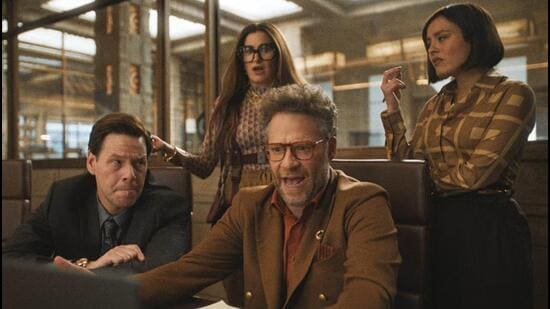
Hollywood has never shied away from self-lampooning humour. One of the earliest examples is The Bad and the Beautiful (1952), directed by Vincente Minnelli, in which Kirk Douglas plays a scheming, ruthless producer with relish, while the director and writer remain entirely at his mercy. But watching it after laughing through four episodes of Seth Rogen and Evan Goldberg’s The Studio—one of the latest entries in the comedy genre—was a bit of a pain. No humour or irony here; just contemptuous cynicism about bad, bad money and poor, poor artists.
In this post-truth, woke world, satire and absurd humour agree with audiences better — only if there’s a sub-text of empathic concern about the need to correct, improve and heal.Anyone who’s ever pitched a film or been asked to rewrite a story at a producer’s whim knows that high-stakes filmmaking is cutthroat, which often come with an additional demand of navigating a whole range of emotional and behavioural traits in crew members — mostly the human being at the helm. Empathy isn’t typically a producer’s strong suit, a director often walks around like she or he carries the weight of the world and ignoring their fragile egos don’t go down well for any crew member.
Of late, with films such as Quentin Tarantino’s Once Upon a Time in Hollywood (2019) or David Leitch’s Fall Guy (2024) self-deprecatory Hollywood is ridiculously fun — clever updates on the best of the genre, like Spike Jonze’s Adaptation (2002), which was as much about the neurosis of its writer protagonist played by Nicholas Cage as about that of the film’s writer, the infamous Charlie Kaufman. Or the Cohen Brothers’ Barton Fink (1991), in which a New York playwright moves to California to write screenplays only to discover how hellish Hollywood is — done with the signature wry humour of the director duo. Or Robert Altman’s The Player (1992); just read its official one-line pitch: “A Hollywood studio executive is being sent death threats by a writer whose script he rejected, but which one?”
The Studio, besides unequivocally being the best-written comedy of 2025 coming from Hollywood, is a riotous cultural barometer of the age.
The producer is now the conglomerate, the studio head. Rogen, who has co-created and co-directed the show along with a bunch of writers, plays Matt Remnick. After having slogged his way up under the mentorship of Patty Leigh (Catherine O’Hara), he gets the top spot from the studio owner Griffin Mill (Bryan Cranston). Matt and his best friend deputy Sal Saperstein (Ike Barinholtz) and a core team that includes the marketing whiz Maya (Kathryn Hahn) are creativity-hustlers on steroid, and Matt’s juggling of his own anxieties — ‘How do I compensate to my former mentor for usurping her’; ‘how to keep the indie alive’; ‘should I sell my Buick to buy film reels to keep analogue filmmaking going’; ‘how do I convince Martin Scorsese to make a Kool-Aid film’ — weigh the team down more quickly than expected post-coronation.
Besides the snap-crackle-and-pop humour in the writing, each of the four episodes so far done in Apple TV’s appointment viewing format for series (an episode drops every Wednesday), each of the four episodes so far can be seen as stand-alone films, accented by a theme — a mini movie about making a movie.
Like the recent Netflix’s heavy hitter Adolescence, The Studio is big on craft, with minute attention to framing, editing and camera movement, a real triumph in a TV series. In the first episode, ‘The Oner’, filmmaker Sarah Polley playing herself is fretting over a long take before the magic-hour light fades while Matt disrupts the shoot with an unwelcome visit. Like every episode of Adolescence, this episode is filmed in a single take, bringing out the difficulty of orchestrating a difficult shot win location, as well as the kinetic energy of a film crew at work in full throttle. Episode 4,‘The Missing Reel’, is a homage to film noir, chronicling Olivia Wilde (playing herself) trying to make an experimental 35-mm reimagining of Chinatown. Scorsese, Ron Howard, Zac Efron and Charlize Theron (in a cameo) are so far the Hollywood biggies playing themselves.
Matt is always up to saving something or correcting something, the neurosis of it all articulated through glimpses into his torn personality. Mention of therapy and punctuate dialogues between Sal and Matt. We know this is a millennial studio head with millennial worries and the acute awareness that every decision of his needs to conform to the standards of new Hollywood, to balance political correctness with creative license; to please the boss without displeasing codes of the age. The next 6 episodes will confirm how far this balance plays out, and whether The Studio will stand the test of time in the evolving art of Hollywood shooting itself.
Sanjukta Sharma is a Mumbai-based journalist and critic.
One Subscription.
Get 360° coverage—from daily headlines
to 100 year archives.
Archives
HT App & Website