The Supreme Court on Monday clarified that it had not approved any modification to Form 6, the statutory application used by citizens to register as voters, as it issued notice on a plea challenging alleged changes made to the form on the Election Commission’s ECINet/ERONet portal.
“Any modified Form 6 has not been approved by us. Let’s be clear. When record will be produced, we would like to see who has modified,” Chief Justice of India Surya Kant said during the hearing.
The bench, comprising CJI Surya Kant and justices Joymalya Bagchi and V Mohana, was hearing a petition filed by advocate Shailendra Mani Tripathi challenging alleged changes to the online version of Form 6, including requirements relating to an applicant’s ancestry and declarations concerning the last special intensive revision (SIR) of electoral rolls.
Deep Dive
What are the recent changes to Form 6 that have raised concerns?
Why did the Supreme Court clarify that it did not approve modifications to Form 6?
How did the Election Commission respond to the objections regarding the changes to Form 6?
Senior advocate Menaka Guruswamy, appearing for Tripathi, referred to the manner in which the SIR was conducted in Delhi and alleged that two additional conditions had been introduced into the voter-registration process.
The court's observation came amid a debate over the functioning of the Election Commission and the manner in which decisions concerning the electoral-roll revision exercise were taken.
{{/usCountry}}The court's observation came amid a debate over the functioning of the Election Commission and the manner in which decisions concerning the electoral-roll revision exercise were taken.
{{/usCountry}}Also Read: SC refuses to restrain Gyanesh Kumar, says can't pass order based on news report
What is the Form 6 controversy?
Form 6 is the statutory application used by a person seeking inclusion of their name in the electoral roll. The controversy relates to an additional declaration that was introduced in the online version of the form during the ongoing SIR exercise.
The online version of Form 6 was modified in July to include a new section requiring applicants to declare whether their own name, or that of a parent or grandparent, appeared in the electoral roll prepared during the previous SIR. Applicants were required to answer the declaration before they could complete the online application.
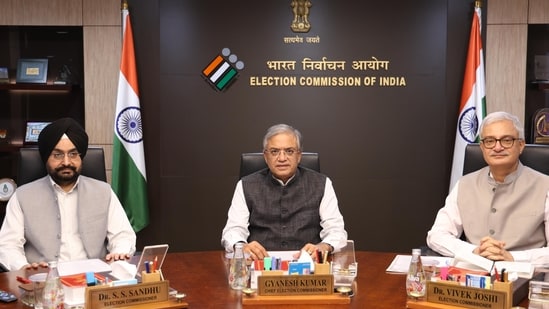
The change became a point of contention within the Election Commission. According to an Indian Express report, election commissioners Vivek Joshi and Sukhbir Singh Sandhu raised objections, arguing that Form 6 is prescribed under the Registration of Electors Rules, 1960, and therefore could not be altered merely by modifying the online form without following the statutory procedure for amending the rules.
Under Section 28 of the Representation of the People Act, 1950, the Centre frames and amends the Registration of Electors Rules after consulting the Election Commission. Amendments to the rules are required to be notified and laid before Parliament.
The Election Commission, however, has maintained that the additional declaration was introduced specifically in the context of the SIR exercise and that the statutory Form 6 itself had not been changed. It subsequently clarified that the additional declaration would apply during the SIR period, while the statutory form prescribed under the 1960 rules would be used outside the exercise.
Why the additional declaration matters
The additional requirements have raised concerns particularly in states where the previous SIR was conducted several years ago.
For a first-time voter who has recently turned 18, their name would not ordinarily appear in an electoral roll prepared during an SIR conducted in the early 2000s. The modified online form therefore required such applicants to establish a link through the name of a parent or grandparent, where applicable.
The requirement has also been questioned in the context of voters whose names were removed from draft electoral rolls during the SIR and who are seeking to have them restored.
Hindustan Times reported that more than 13 crore names had been deleted from draft electoral rolls across states and Union territories under the SIR exercise. A key concern was that Form 6 contains a declaration that the applicant is applying for inclusion for the first time and that their name is not included in another constituency.
Critics have argued that this creates a potential problem for voters whose names had previously appeared on electoral rolls but were removed during the revision exercise and who now need to seek re-enrolment.
ECI withdraws additional declaration in completed states
The Form 6 controversy also comes against the backdrop of the Election Commission recently withdrawing the additional SIR declaration from the online form in states and Union territories where the electoral-roll revision exercise has been completed.
The additional declaration was removed from the ECINET application and portal as well as the websites of the respective chief electoral officers. Applicants in these states and UTs are now required to submit the statutory Form 6 prescribed under the Registration of Electors Rules, 1960.
The ECI had on September 26 clarified that the additional declaration would apply during the SIR period and that the statutory forms under the 1960 rules would be used outside the exercise.
SC asks who modified Form 6
During Monday’s hearing, Guruswamy argued that the alleged modifications had wider implications, referring to the number of electors affected by the SIR in Delhi and West Bengal and claiming that 16 lakh appeals were pending before appellate tribunals.
The bench, however, said the prayers in Tripathi’s petition appeared to be “jumbled up” and asked the counsel to examine them.
Guruswamy said she stood by the prayers in the petition and sought that the matter be tagged with a separate petition challenging the alleged unilateral functioning of the Election Commission.
The court agreed and directed that Tripathi’s petition be tagged with the matter filed by social activist Rakesh Kumar Singh.
The Singh petition alleges that chief election commissioner Gyanesh Kumar took several decisions unilaterally despite objections from the other two election commissioners. The Supreme Court on Monday issued notices to the ECI, the Union government, Kumar and the two election commissioners but declined to pass an interim order restraining the CEC from functioning.
The court said it would first examine the factual position and whether the statutory requirements governing the Commission’s decision-making had been followed.