
 E-Paper



Who was Nambala Keshav Rao aka Basavaraju, top Maoist leader killed in Bastar Op
Basavaraju masterminded the Chintalnar ambush in April 2010 that led to the killing of 74 CRPF soldiers returning from an operation’

 Prefer HTon Google


RAIPUR/HYDERABAD: Nambala Keshav Rao aka Basavaraju, the 70-year-old general secretary of the banned Communist Party of India (Maoist) killed in Wednesday’s gunfight, had taken over the outfit’s leadership in November 2018 when Muppala Lakshmana Rao alias Ganapathy stepped down on health grounds.
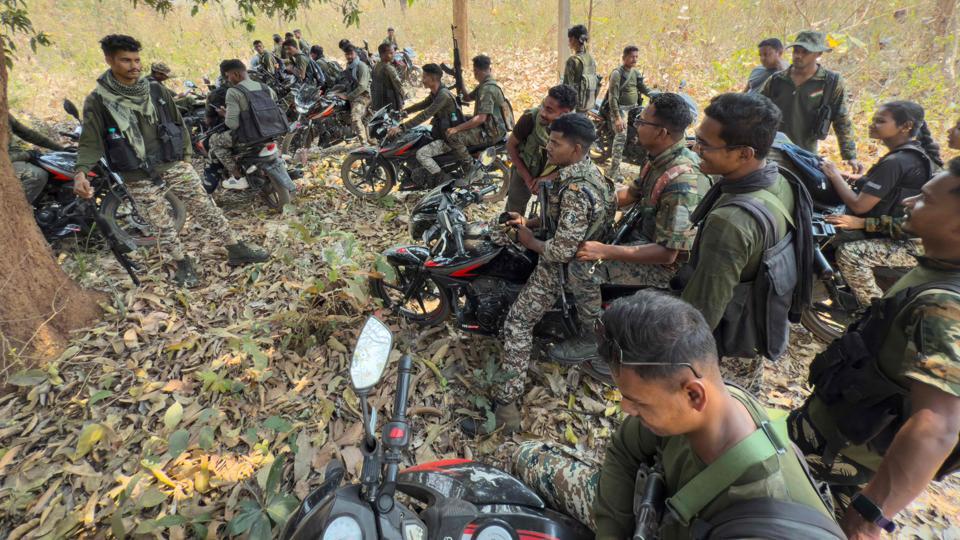
Basavaraju was killed along with 26 other Maoists in a fierce gunfight with security forces in Narayanpur district of Chhattisgarh.
Union home minister Amit Shah confirmed the killing of Nambala Keshav Rao in a post on X, calling it a landmark achievement in the battle to eliminate naxalism.

“Today, in an operation in Narayanpur, Chhattisgarh, our security forces have neutralized 27 dreaded Maoists, including Nambala Keshav Rao, alias Basavaraju, the general secretary of CPI (Maoist), topmost leader, and the backbone of the Naxal movement,” Shah said in a post on X.
“This is the first time in three decades of Bharat’s battle against Naxalism that a general secretary-ranked leader has been neutralized by our forces. I applaud our brave security forces and agencies for this major breakthrough,” he said.
Prime Minister Narendra Modi also complimented the security forces for the “remarkable success”.
Basavaraju, who had trained to be an engineer before had enrolled for a masters when he dropped out, was considered a master Maoist strategist and had a cumulative reward of ₹1.5 crore on his head. According to a 2011 intelligence report, he was known to have always carried an AK-47.
To be sure, Basavaraju was just one of the many aliases that Keshava Rao had including Krishna, Vinay, Ganganna, Prakash, BR, Umesh, Raju, Vijay, Keshav, and Narasimha Reddy.
Son of a school teacher, Keshava Rao hailed from Jiyyannapeta village in Srikakulam district of Andhra Pradesh.
Keshava Rao began his early education in his native village and completed his high school in Talagam (his grandfather’s village in Tekkali revenue block) and pursued Intermediate at Tekkali Junior College.
He was in his second year of undergraduate studies when he got into the B Tech programme at Regional Engineering College, Warangal (currently known as National Institute of Technology - NIT Warangal).
According to security officials, this is when he became associated with Radical Students Union, the students’ wing of the then CPI (Marxist Leninist) People’s War, a major Naxalite outfit founded by Kondapalli Seetharamaiah.
But it was only in 1984 that he got full-time into the CPI (M-L) People’s War, dropping out of his M.Tech course.
He stayed underground for the next four decades.
Residents of Jiyyannapet village told local reporters on Wednesday that he never returned to his village after joining the movement.
In the movement, Keshava Rao earned a reputation as a strategist in Maoist operations and was adept at planning and executing guerrilla warfare, maintaining links with arms dealers, and crafting military strategies.
In 1987, Basavaraju, along with other senior Maoist leaders such as Ganapathy and the late Kishanji, received training in ambush tactics and explosives from former LTTE fighters in the forests of Abujhmad , Bastar.
His rise within the party ranks continued in 1992, when he was elected to the central committee of CPI (ML) People’s War.
Later, with the merger of CPI (ML) PW and the Maoist Communist Centre of India (MCCI) to form CPI (Maoist), Basavaraju was appointed secretary of the Central Military Commission. He held the position for a decade taking over as general secretary in 2018.
Law enforcement agencies have no recent photographs of him, and investigations have revealed that he owns no property in his hometown, which he left in the late 1970s. His primary areas of operation are reported to be Chhattisgarh, Telangana, and parts of Maharashtra.
Police said Basavaraju had been operating out of Abujhmad.
As compared to his predecessor Ganapathy, Keshav Rao was considered more hardline in implementing party ideologies. He was known for his aggressive nature and believed firmly in achieving goals through armed resistance, a senior police officer of the Chhattisgarh intelligence department said.
Keshava Rao was booked in several cases, including the 2003 claymore mine attack on chief minister N Chandrababu Naidu at Alipiri in Tirupati. He also masterminded the Chintalnar massacre in April 2010, where Maoists ambushed CRPF personnel returning from patrol and killed 74 CRPF soldiers.
Another major incident planned by Keshav Rao was the 2013 attack on Mahendra Karma, the founder of Salwa Judum (a state-sponsored anti-Maoist militia). In this ambush, Karma and 27 others were killed.
He is also believed to be the brain behind the attack on Greyhounds police in October 2008 at Balimela on Andhra-Odisha border, killing 37 police personnel.
-kW0H-U20214218012MgB-250x250%40HT-Web.jpg)


