Gold and silver prices remain in sharp focus after touching record highs until Wednesday. On Friday, both metals saw some decline, prompting speculation about the factors behind the pullback. Prices have since remained largely range-bound on Saturday.
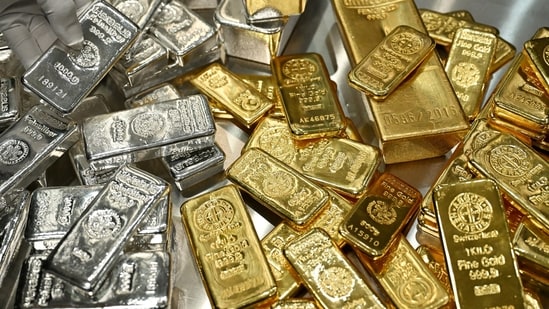
According to a report by news agency PTI, gold of 99.9 per cent purity fell sharply by ₹14,000, or 7.65 per cent"> ₹14,000, or 7.65 per cent, to ₹1,69,000 per 10 grams (inclusive of all taxes) on Friday. The metal had touched a record high of ₹1,83,000 per 10 grams on Thursday, after rising by ₹12,000.
Silver, meanwhile, dropped by ₹20,000, or nearly 5 per cent, to ₹3,84,500 per kilogram (inclusive of all taxes). In the previous session, the white metal had jumped ₹19,500 to scale an all-time high of ₹4,04,500 per kg.
What are the prices of gold and silver in Indian cities today?
{{/usCountry}}What are the prices of gold and silver in Indian cities today?
{{/usCountry}}In Delhi, the price of gold on January 31 stood at ₹16,934 per gram for 24-karat gold, ₹15,524 per gram for 22-karat, and ₹12,704 per gram for 18-karat gold, also known as 999 gold, according to Good Returns.
Silver prices in Delhi were at ₹394.9 per gram, translating to ₹3,94,900 per kilogram.
In Mumbai, on January 31, 24-karat gold was priced at ₹16,919 per gram, while 22-karat stood at ₹15,509 per gram and 18-karat gold at ₹12,689. Silver prices in Mumbai were the same as Delhi, at ₹394.90 per gram or ₹3,94,900 per kilogram.
Hyderabad city matched Mumbai’s gold rates, with 24 karat gold priced at ₹16,919 per gram, 22 karat gold at ₹15,509 per gram, and 18 karat gold at ₹12,689 per gram. Silver, however, traded at a premium in the city, quoted at ₹404.90 per gram and ₹4,04,900 per kilogram.
Also Read | ‘Heavy liquidation, overbought’: What led to the crash in gold, silver prices?
Why the metals rose and then fell
Gold has long been seen as a classic safe haven — an asset investors turn to when they want to protect their savings from financial uncertainty.
With global geopolitical tensions escalating, trade war threats resurfacing, uncertainty over the future path of interest rates, and signs of a shifting world order, investors have been gravitating towards assets perceived as stable amid growing volatility, according to a report by Conversation UK.
The dip in gold and silver prices on Friday was triggered by financial markets reacting to early reports of former US president Donald Trump nominating Kevin Warsh as chair of the US Federal Reserve, an institution central to global financial stability.
At the same time, central banks across the world have been buying gold at an accelerated pace, reinforcing its status as a store of value during periods of uncertainty.
Market movements, however, have not been driven by institutions alone.
Retail investors, individuals trading in smaller quantities, have also played a significant role globally, the report added.
These investors have increasingly viewed gold, silver and other precious metals as a hedge against uncertainty, and as a momentum trade, buying in as prices rise to keep pace with the broader market.
As prices climbed, participation from everyday investors increased, particularly through gold exchange-traded funds (ETFs), which offer an easy way to gain exposure to gold without the need to hold physical bullion.
What happened to silver?
Ahead of Friday’s correction, silver prices had jumped more than 60 per cent in a month, well ahead of gold’s roughly 30 per cent rise.
What sets silver apart is its two-track demand.
It is seen both as a refuge in uncertain times and as an essential industrial input.
Usage in solar panels, electric vehicles and semiconductors has been rising steadily, pushing demand higher.
Supply, however, has struggled to keep pace. The market has been in deficit for five consecutive years, with more silver being used than mined. Because most silver is produced as a byproduct of other metals, increasing output is not straightforward, the report stated.
Together, strong industrial demand and tight supply have helped fuel a surge in retail interest, with individual investors increasingly turning to silver.
Data suggests retail investors have been buying into silver as prices climb — a classic case of fear of missing out. But this strategy carries real risks.
Silver is highly volatile. Between February 2025 and just before Friday’s sharp fall, prices had jumped 269 per cent. Even before the drop, silver showed annualised volatility of 36 per cent, almost double gold’s 20 per cent over the same period.
In simple terms, big rises can be followed by steep falls — and quickly. What moves up fast can just as easily reverse.
Buying after a sharp rally is risky.
Retail investors who enter late often end up buying near the peak, while professional investors and central banks have been building positions over years at much lower prices.
There’s also no income cushion. Unlike shares or bonds, gold and silver pay no dividends or interest. Returns depend entirely on prices rising further, and as recent moves have shown, losses can be sudden and severe.