Unique themes are a major attraction during the Durga Puja being celebrated from September 28 to October 2 this year. The 10-handed idol of Goddess Durga is the centre-piece of celebrations across the country, save one at Durgabari in Tripura’s capital Agartala.
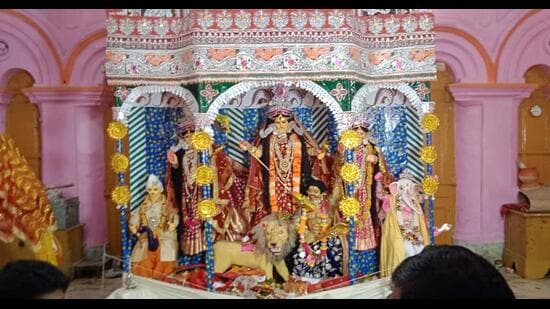
The Durga idol with two visible hands and eight hidden is worshipped at a shrine near the Ujjayanta Palace of the erstwhile Manikya royal family. It draws devotees from across the country and abroad.
The story goes
Unique themes are a major attraction during the Durga Puja being celebrated from September 28 to October 2 this year. The 10-handed idol of Goddess Durga is the centre-piece of celebrations across the country, save one at Durgabari in Tripura’s capital Agartala.
The Durga idol with two visible hands and eight hidden is worshipped at a shrine near the Ujjayanta Palace of the erstwhile Manikya royal family. It draws devotees from across the country and abroad.
The story goes that Sulokkhona Devi, the queen of Krishna Kishore Manikya, fainted sometime in the 19th century after seeing the Durga idol with 10 arms during an arati. She later dreamt about the goddess telling her that the deity with two visible arms could be worshipped. The tradition of having a two-armed idol and eight hands hidden behind the back has since endured.
The Tripura government has sponsored the unique puja at Durgabari for over seven decades since the end of the monarchy and Tripura’s merger with India in 1949. It sponsors puja in most of the temples, including Tripurasundari, one of the 51 Shakti Peethas, at Udaipur in Gomati district, and pujas of the indigenous community.
Jayanta Bhattacharjee, the head priest at Durgabari, said the goddess Durga was worshipped at places wherever the Manikya family shifted their capital—Amarpur, Udaipur, Old Agartala, and then Agartala. “This is the only two-armed Durga idol. The Manikya family has been worshipping the idol...the government took over the temple along with Tripurasundari, Chaturdash Devata Bari at Khayerpur in West Tripura district as per the merger agreement of Tripura with the government of India,” Bhattacharjee said.
The West Tripura district magistrate became the de facto in charge of Durga puja rituals at Durgabari as per the merger agreement. The Gomati district magistrate took over as that of the Shaktipeeth shrine (Tripurasundari temple).
Pannalal Roy, a researcher, said the goddess Durga is offered fruits, vegetables, and non-vegetarian food items during the puja. A buffalo, a goat, and a bird are also sacrificed. The state government sponsors the buffalo. One goat each is sacrificed on the four consecutive days of the puja as part of the rituals.
The high court banned centuries-old ritualistic animal sacrifices six years ago. It subsequently permitted some ritualistic sacrifices, allowing the resumption of animal sacrifices at Durgabari.
Dashami, the fifth day of the festival, is the main attraction of the Durga Puja at Durgabari when the idols are immersed at Dashamighat, with a Tripura Police band playing the national anthem. Devotees throng the Ujjayanta Palace when the idols from Durgabari and Prabhubari are brought there. The idols are then taken to Dashamighat.
The ancestral Manikya sword is also worshipped on every Dashami of Durga Puja. A similar ritual is followed on Dashami of Durga Puja, celebrated in the month of Chaitra. Durga Puja is celebrated twice a year, first during Chaitra, the last month of the Bengali calendar, and Ashwin, the sixth month.
One Subscription.
Get 360° coverage—from daily headlines
to 100 year archives.
Archives
HT App & Website