US President Donald Trump on Tuesday threatened to raise tariffs on India “very substantially” within the next 24 hours, to penalise it for Russian oil purchases that he claimed were fuelling the “Russian war machine”.
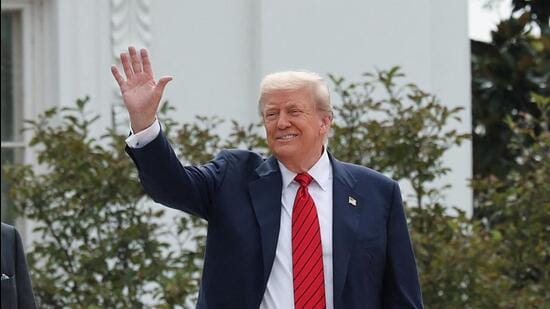
“With India, what people don’t like to say about it, is that they are the highest tariffed nation. They have the highest tariff of anybody. We do very, very little business with India because their tariffs are so high,” Trump said during a television interview.
“So India has not been a good trading partner because they do a lot of business with us but we don’t do business with them... we settled on 25% but I think I’m going to raise that very substantially over the next 24 hours because they’re buying Russian oil. They’re fuelling the war machine. If they do that, then I’m not going to be very happy,” he added.
The president’s latest threat, in brief remarks to American TV channel CNBC, came hours after India mounted its strongest defence yet of Russian energy ties, with external affairs ministry spokesperson Randhir Jaiswal on Monday calling American tariff threats “unjustified and unreasonable.”
“Like any major economy, India will take all necessary measures to safeguard its national interests and economic security,” Jaiswal said on Monday, defending India’s Russian energy imports as essential for affordable energy costs.
{{/usCountry}}“Like any major economy, India will take all necessary measures to safeguard its national interests and economic security,” Jaiswal said on Monday, defending India’s Russian energy imports as essential for affordable energy costs.
{{/usCountry}}Russia on Tuesday backed India’s right to choose its trading partners, with Kremlin spokesman Dmitry Peskov saying sovereign countries have the right to select partners in trade and economic cooperation based on their interests.
“We believe that sovereign countries must have and do have the right to choose their trade partners, the partners in trade and economic cooperation, on their own and independently determine those modes of trade and economic cooperation that suit the interests of a country in question,” Peskov told journalists, commenting on the US threats regarding India.
Trump’s threat comes just a day after the American leader criticised India for making large profits from refining and selling Russian oil on global markets. On July 30, Trump announced a 25% tariff on Indian goods, while citing New Delhi’s purchases of Russian energy and military equipment as irritants in the bilateral relationship.
Later on July 31, Trump termed India and Russia “dead economies” in a post on Truth Social. Following the president’s statements, key administration officials, such as secretary of state Marco Rubio and treasury secretary Scott Bessent have also made statements criticising Indian energy purchases from Russia.
According to the Centre for Research on Energy and Clean Air, India bought 38% of all Russian crude oil exports in June, behind only China. CREA also estimated that India purchased 49 billion euros—roughly $56 billion—worth of Russian fossil fuels in 2024.
The 24-hour ultimatum threatens to derail trade negotiations scheduled to begin August 25 in New Delhi, with both countries having described the talks as making substantial progress toward a breakthrough agreement.
“To India’s surprise, President Trump’s position on Russia has moved considerably since his 2024 election campaign. What he is expressing, however, is consistent with views amongst both Democrats and Republicans across the political spectrum, which hold that India could be doing more to economically constrain Russia’s war of aggression against Ukraine,” said Sameer Lalwani, non resident senior fellow at the Centre for Strategic and Budgetary Assessment.
“India has made reasonable defences of its oil and arms imports, but this will certainly make a trade deal harder and further complicate US-India strategic partnership. That said, there is a plausible path out of this since oil imports from Russia are not as politically salient for the Modi government as agriculture protections, and India has previously cooperated with the last Trump administration on oil imports, specifically from Iran,” Lalwani added.
The president’s new tariff threat creates immediate uncertainty for Indian exporters already grappling with the 25% tariff that is set to take effect on August 7, while potentially forcing New Delhi to choose between energy security and trade relations with its largest export market.
India exported $86.5 billion worth of goods to the US in fiscal 2025, creating a $41 billion trade surplus that has become a persistent irritant in bilateral relations. However, industry experts estimate that 45-50% of Indian goods may avoid additional tariffs due to existing exemptions for electronics, pharmaceuticals, and energy products.
Trump’s escalating threats prompted rare political unity in India, with both the ruling BJP and opposition Congress condemning the American president’s approach in unusually strong terms.
Congress leader Manish Tewari said Trump’s “disparaging remarks hurt the dignity and self-respect of Indians,” adding: “The time has come to call out this constant bullying and hectoring.”
BJP leader Baijayant Jay Panda quoted former US secretary of state Henry Kissinger in a post on X: “To be an enemy of America can be dangerous, but to be a friend is fatal.”
Indian stock markets ended slightly lower on Tuesday as fresh tariff warnings dampened investor sentiment. The BSE Sensex fell 308.47 points or 0.38% to close at 80,710.25, whilst the NSE Nifty dropped 73.20 points or 0.30% to 24,649.55. During intraday trading, the Sensex hit a low of 80,554.40, declining as much as 464.32 points, before recovering somewhat by the close.
Oil & Gas stocks led the decline, falling 0.96%, followed by Energy (-0.74%) and FMCG (-0.61%) sectors.