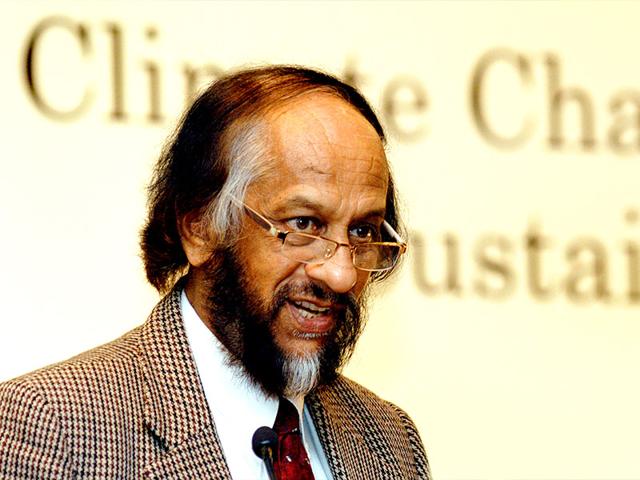
The world is set to take a call on new climate treaty in Paris and sustainable development goals (SDGs) in New York this year. What can be expected from the talks in New York? R K Pachauri, director general of The Energy and Resources Institute and chairperson of Intergovernmental Panel on Climate Change (IPCC), talks to Chetan Chauhan on what is possible and what's difficult.
Q.What is the linkage you see between climate change and sustainable development goals to be finalised this year?
A. Climate change is not explicitly one of the goals in SDGs, and the reason was that there is a separate process under the UN for climate change. But the two are inter-linked as one cannot fight climate change without sustainable development and vice-versa. On climate change I think the process will move forward by June and we will get an indication where we are going. There will be meeting in June in the UN, and I hope it will lead to some action at the global level on these important issues.
Q. Do you expect the world to deliver a climate deal in Paris?
A. There will be a deal. For it to be effective, I strongly feel that the world should agree to ex-ante reviews. In the IPCC fifth assessment report we have clearly developed a pathway to ensure that the temperature increase is limited to 2 degree by turn of the century. Unless we have ex-ante and post ante reviews, it will not be possible for the world to ensure that it is on the right track. If we are serious about the 2 degree target, we have to build a review mechanism in the new treaty. I feel that this would be in the interest of the global community to check whether they are scientifically on right track or not. If we get an agreement in Paris on what needs to be done, it will be a great achievement. Paris should not be the last word it should be start of an aggressive process.
{{/usCountry}}A. There will be a deal. For it to be effective, I strongly feel that the world should agree to ex-ante reviews. In the IPCC fifth assessment report we have clearly developed a pathway to ensure that the temperature increase is limited to 2 degree by turn of the century. Unless we have ex-ante and post ante reviews, it will not be possible for the world to ensure that it is on the right track. If we are serious about the 2 degree target, we have to build a review mechanism in the new treaty. I feel that this would be in the interest of the global community to check whether they are scientifically on right track or not. If we get an agreement in Paris on what needs to be done, it will be a great achievement. Paris should not be the last word it should be start of an aggressive process.
{{/usCountry}}Q. There is a lot of pressure on India to accept emission cuts for the Paris climate conference. What are your views?
A. I think by definition intended nationally determined contributions (INDCs) should be left to countries to decide. As in case of India, as the environment minister announced in Lima, we are targeting 1,00,000 MW of solar power. In my view it will lead to a great effort in reducing greenhouse emissions. We should not hesitate to put the measures being taken in INDCs.
Q . Has India done enough to take benefit of its renewable energy potential?
A. Not yet. Prime Minister has stressed for low carbon growth and has set ambitious targets. Renewable energy has major benefit had it leads to expansion of energy access and reduces dependence on fossil fuel-based electricity. In the context of energy, I will say it is a move towards sustainable development of growth. But, the challenge is to meet the need for decentralised energy need in which the ownership is with the local people. I get sense that we will do a lot in the RE sector.
Q. The SDGs will replace the Millennium Development Goals (MDGs) this year. Has the MDGs been able to achieve its targets?
A. The picture is mixed. On overall picture, I will say MDGs have fallen short of expectations. The whole thing was started with lot of hope that it would start initiatives to reduce poverty. There has been reduction in poverty but the question is whether it happened because of MDGs or variety of other reasons. I think there is a need to carry out assessment of MDGs and its impact, and whether we had resources and capability to implement them in the manner they were expected. I am of the view that there has to be a seamless linkage between MDGs and SDGs. We should not lose sight of MDGs, it will be a mistake. You cannot have sustainability development when a large number of people are still poor.
Q. In this entire debate over climate change and sustainable development, India has been a focal point. How the Delhi Sustainable Development Summit will help in ensuring the low carbon growth path.
A. We hold this conference here and the Indian people get informed about sustainability. People of distinction are here and they are exposing their views, I hope it reaches opinion makers. We will also disseminate the outcome of the conference on a large scale. Secondly, dealing with sustainable development challenges and climate change has large overlap. We have to understand that sustainable development cannot take place without fighting climate change and vice-versa. We have a day-long session to discuss climate change where issues of sustainability will be discussed.