...
...
Next Story

Pathankot attack fallout? India may reschedule Pak talks

India may reschedule proposed foreign-secretary level talks, tentatively slated for later this month, to give Pakistan time to crack down on banned terror outfit Jaish-e-Mohammed (JeM) that is believed to be behind the Pathankot air base ambush, sources said on Sunday.
Updated on: Jan 4, 2016, 00:14:21 IST
Hindustan Times | By , New Delhi
Prefer HTon Google
Advertisement

India may reschedule proposed foreign-secretary level talks, tentatively slated for later this month, to give Pakistan time to crack down on banned terror outfit Jaish-e-Mohammed (JeM) that is believed to be behind the Pathankot air base ambush, sources said on Sunday.

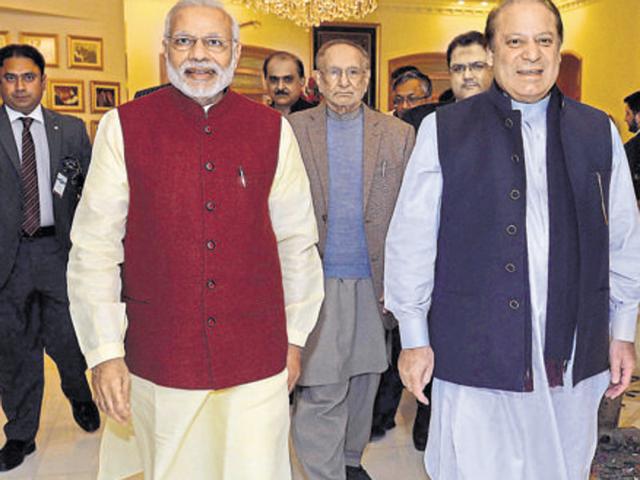
Prime Minister Narendra Modi meeting the Prime Minister of Pakistan, Mr. Nawaz Sharif, at Lahore, Pakistan on December 25, 2015. In the wake of the attack on Pathankot airbase, India may reschedule talks with Pakistan which are likely to be held  in January, 2016. (PIB Photo)
Prime Minister Narendra Modi meeting the Prime Minister of Pakistan, Mr. Nawaz Sharif, at Lahore, Pakistan on December 25, 2015. In the wake of the attack on Pathankot airbase, India may reschedule talks with Pakistan which are likely to be held in January, 2016. (PIB Photo)

They said the national security advisers of the two countries may meet soon to explore how Pakistan could act against the JeM and reaffirm its commitment to the peace process before their foreign secretaries sit down for formal negotiations.

The revelation came as Prime Minister Narendra Modi held a brainstorming session with his key foreign policy advisers even as the terrorists -- allegedly based out of Bahawalpur in Pakistan -- exchanged gun fire with security forces, over 36 hours after the operation began.

Security forces will resume the operation on Monday morning as the guns of the remaining terrorists fell silent towards Sunday evening.

The prime minister’s office remained tight-lipped over the meeting attended by the national security adviser Ajit Doval and foreign secretary S Jaishankar, but sources said the Indian NSA was likely to discuss the attack with his Pakistani counterpart, Lt General Naseer Janjua, and seek action against JeM leader Maulana Masood Azhar.

Read | Pathankot: Search on for 2nd car, number of terrorists may be 8 or 10

“The PM took stock of the Pathankot situation and the possible steps to be taken diplomatically with Pakistan,” said a senior official.

The Narendra Modi government was all for dialogue with the Nawaz Sharif government but rescheduling the talks was necessary to give time to Islamabad to take action against Azhar’s troopers, the sources said.

“Since terror and dialogue cannot go together, Pakistan will have to show its commitment to the peace process so that FS level dialogue take place this month,” said a South Block official.

It is understood that New Delhi will prepare a case study of the Pathankot attack, containing evidence nailing the JeM and their ISI handlers, on the basis of which Pakistan will be pressed to take action against the proscribed group.

The South Block is clear the JeM was used by the Inter-Services Intelligence in the Pathankot attack as the group has been virulently anti-India and opposed to any peace talks. “There is deliberate signature left in the attack so that message is understood by both sides,” said a senior official.

 
ABOUT THE AUTHOR
Shishir Gupta

Shishir Gupta is Executive Editor at Hindustan Times and one of India's top journalists covering national security, strategic affairs, foreign policy and geopolitics. Over the past three decades, he has extensively reported on India's military, diplomatic and security landscape, covering every major conflict and national security challenge, from the 1999 Kargil War and the 2020 East Ladakh standoff to Operation Sindoor in 2025. He has also covered major terror attacks, including the IC-814 hijacking, the 26/11 Mumbai attacks and the 2025 Pahalgam terror strike, along with numerous Pakistan-backed terrorist incidents in the Kashmir Valley and across India. He has reported on national and state elections for more than three decades. A recognised authority on strategic affairs, Gupta has covered India's nuclear programme since the Pokhran-II (Shakti series) tests in May 1998 and has written extensively on global nuclear issues, Indian diplomacy and the country's expanding global outreach. He has also reported widely on international conflicts and terrorism, with a special focus on the Indian subcontinent. Gupta has interviewed Prime Minister Narendra Modi more than four times, including Modi's first interview with the print media after becoming Prime Minister in May 2014. His other interviews include three with the Dalai Lama, as well as conversations with Benjamin Netanyahu, Amit Shah, Yogi Adityanath, S. Jaishankar, Nirmala Sitharaman and Piyush Goyal. He is the author of Indian Mujahideen: The Enemy Within (Hachette, 2011) and Himalayan Face-off: Chinese Assertion and Indian Riposte (Hachette, 2014). He was awarded the Chevening-Wolfson Joint Scholarship at Wolfson College, University of Cambridge, UK, in 1998 and participated in the International Visitor Leadership Program (IVLP) of the US State Department in 2006. He received the Ben Gurion Prize from Israel in 2011 and the K. Subrahmanyam Prize for Strategic Studies in 2015 from the Manohar Parrikar Institute for Defence Studies and Analyses (MP-IDSA). Since 2024, he has hosted Point Blank, Hindustan Times' weekly YouTube show on global geopolitics.

Get the latest India News, breaking headlines and real-time updates from across the country. Stay informed about politics, government policies, crime, weather and major national developments.
SHARE THIS ARTICLE ON
Hindustantimes wants to start sending you push notifications. Click allow to subscribe