
One of Kashmir’s most revered 17th century saints was Resh Peer and referred popularly as Peer (Sufi), Pandit (guru), Padshah (king of both worlds). Mufti Mohammad Sayeed was a contemporary secular exponent of the same tradition.
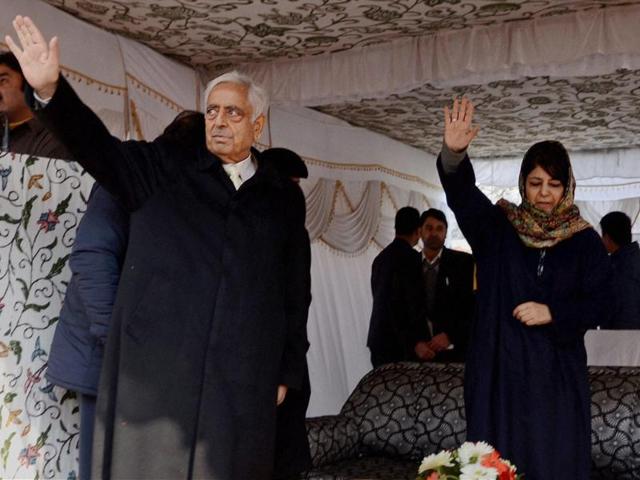
In September last year, at his beloved Pahalgam, Mufti Sahib hosted awazwaan lunch for his extended family. As is the Kashmiri Muslim tradition, four guests shared a trami of culinary delicacies.
Mufti Sahib was sitting on a chair in the centre; I was sitting on the floor with other guests, most of whom were Muslims. When the food was served Mufti Sahib left his chair and said: “I will eat with Amitabh.”
Begum Mufti remarked: “He is basically a Pandit, and is comfortable breaking bread with other Pandits.” She had incisively pointed to two different but compatible traditions that were part of the Mufti’s genetic makeup.
His ancestry was of a Sayeed, descendants of the Prophet (known locally as Peers and respected for their spiritual Sufi tradition), but he combined a practical wisdom and a secular knowledge traditionally associated with Kashmiri Pandits.
In addition, he was a Padshah who was gifted in the art of governance. He refused to change most bureaucrats that had earlier been part of the National Conference regime: only a bad workman quarrels with his tools, he said. He refused to be drawn into petty issues (is evacuating people from their houses my primary concern?); and was a workaholic.
{{/usCountry}}In addition, he was a Padshah who was gifted in the art of governance. He refused to change most bureaucrats that had earlier been part of the National Conference regime: only a bad workman quarrels with his tools, he said. He refused to be drawn into petty issues (is evacuating people from their houses my primary concern?); and was a workaholic.
{{/usCountry}}Mufti Sahib may have been working with an ageing body, but his spirit, energy and enthusiasm was of a 20-year-old. And he expected everyone to work with the same passion: before he fell ill, he had embarked on a six-hour review of development works in downtown Srinagar in chil-e-kalan, the coldest period of the harsh Kashmiri winter.
Read: J-K CM Mufti Sayeed dead, body flown to Srinagar
In our troubled times, where appointments of vice-chancellors can become political and controversial, he asked me (as the chair of several search-cum-selection committees) to get the best from anywhere in the world.
On paper, I was his advisor. In reality, he was a mentor, guide and a revered friend. Jammu and Kashmir and the nation has lost a leader whose generosity knew no limits and someone who was secular to the core.
Thinker, statesman and one of the most astute political leaders of the sub-continent are just adjectives which do not do justice to Mufti Mohammad Sayeed and his formidable legacy. There are at least three abiding legacies that were part of the Mufti era and will continue to define politics of the state in the foreseeable future.
First, the vision of reconciliation within the state and across borders. On both counts he was misunderstood, met with huge odds, but was firm in his commitment. When almost everyone within his party and outside was against the coalition with the BJP, he had only one answer: “Even if the PDP had a majority on its own, we could not ignore Jammu where BJP has a huge majority.”
In fact, as he pointed out, one of Kashmir’s tallest leaders, Sheikh Abdullah’s biggest mistake was to ignore Jammu and even his slogan against the Maharaja’s rule was limited to the slogan, “Quit Kashmir.”
He recognised that the PDP’s alliance with the BJP was like trying to bring the North Pole and South Pole together but if the state had to hold together in body and spirit, there was no other way out.
Similarly, he believed that that dialogue was the only option for long-term reconciliation between India and Pakistan. While the central government seemed not sure of its Pakistan policy, the Mufti was completely clear and he robustly argued his point of view with the highest leadership in New Delhi. He rightly believed that the people of the state are the worst sufferers in any India-Pakistan conflict, and had the greatest incentive in peace in the region and could potentially become a gateway to new vision of peace and prosperity in South Asia.
Second, Mufti Sahib often said that he was an Indian not by compulsion, but purely out of conviction. And for him the idea of India was encapsulated in the celebration of Indian diversity. He predicted correctly the results of the Bihar elections even while political pundits were struggling with their analysis.
“People of India may sometime think communally, but they will never tolerate the naked expression of communalism.” After all, the BJP had lost power, as he reminded us, in MP, Rajasthan and UP including in Faizabad after the demolition of the Babri Masjid. In Jammu and Kashmir too, he believed that the return of Kashmiri Pandits was essential not only for the internally displaced community but because majorities and the politics of majoritarianism is tempered with diversity.
Read: Mufti Sayeed’s dark hour: militants released for abducted daughter
Finally, of course, he believed with complete determination that democracy is a battle of ideas and non-violent dissent must always be given expression and space, however subversive it may seem on the surface. When TV anchors dubbed him a pro-Pakistani separatist after Masraat Alam was released, he did not react at all. In fact, he met them later in Mumbai and other cities with the affection reserved for old friends. Forgiveness and an unwillingness to be petty were part of his DNA.
Mufti Sahib was a much-misunderstood man, because he neither sought publicity nor gave candid interviews. Towards his last, he was planning his memoir and he had even fleshed out a framework. But that was not to be. The nation will realise it far too late that they missed the opportunity of “using” Mufti Sahib as the tallest leader of Muslims in the country and abroad; the state will never ever recover his passing away. I have lost a teacher, the best guru I have ever had.
(The writer, who was the advisor to Mufti Mohammad Sayeed, is a scholar on Jammu and Kashmir and honorary professor of International Relations, University of Melbourne. The views expressed are personal)
Read: Key political milestones in Mufti Mohammad Sayeed’s life
ABOUT THE AUTHOR
Follow the latest breaking news, major developments and agenda-setting stories from India and around the world with the newsdesk at Hindustan Times. Operating round the clock, the desk brings together experienced editors, reporters and correspondents to deliver fast, accurate and contextual reporting across subjects that influence public policy, governance, business, society and international affairs. The HT News Desk covers politics, elections, government policies, the economy, business and markets, science and technology, the environment, law and order, infrastructure, education, climate issues and geopolitics, while closely tracking developments across states, institutions and global capitals. The team also leads coverage of major breaking news events, policy announcements, court proceedings, natural disasters, public emergencies and significant international developments. Reports published by the newsdesk are based on information gathered from reporters on the ground, official statements, government agencies, court records, regulatory filings, recognised institutions and other authoritative sources. Stories undergo editorial scrutiny and verification processes to ensure accuracy, fairness and relevance, and are updated as events evolve and additional information becomes available. Whether covering a key political decision in New Delhi, an economic policy shift affecting millions, a landmark court ruling or a major global event, the HT News Desk aims to provide readers with reliable, fact-based journalism that delivers not only the latest developments but also the context and analysis needed to understand their wider implications.