When the Brooklyn clothing factory where she worked closed its doors, Josefa Marín started picking up cans and bottles from trash cans to make ends meet.
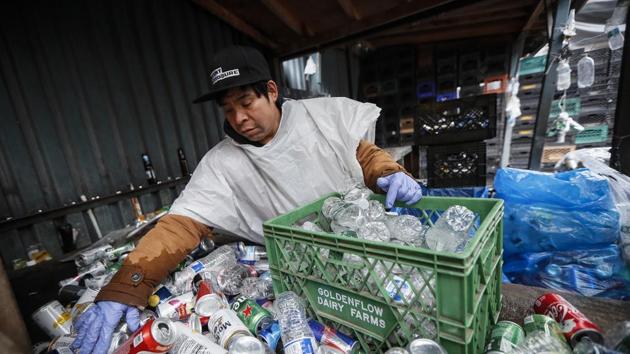
A decade later, the 50-year-old Mexican immigrant is handed hundreds of recyclables by bars and clubs and by concierges of private buildings, who know her so well that they even give her the keys to their trash rooms so she can take what she needs.
For Marín, working alongside her partner, Pedro Galicia, canning is a little business that allows her to pay bills, cover her $1,500 per month rent and put food on the table for two kids.
“This is our job, we have learned to survive doing this, whether it’s hot in the summer or cold in the winter,” she said, hunkered down wearing plastic gloves, while fishing through containers.
In one of the most expensive cities in the world, where monthly rents in wealthy neighborhoods surpass $10,000, people who scour through trash might be viewed by some as probably homeless, but many so-called canners refute that claim.
They are called “bottle professionals” by some redemption centers employees who describe them as people who know by heart each recycling and trash pick-up route, who buy from other canners and who take the job seriously thanks to a 1982 law in New York that allows consumers to return empty containers for five cents.
“They have the buildings that they are dedicated to. And if they do their job properly through their network, they should be able to earn, you know, 200 to 250 dollars a day, which should equate out to over 30 dollars an hour,” said Conrad Cutler, president of Galvanize Group, a redemption center that sends trucks to Manhattan to buy from about 220 canners. “It’s not work that everybody would want to do, but it’s certainly an honest way to make a living.”
{{/usCountry}}“They have the buildings that they are dedicated to. And if they do their job properly through their network, they should be able to earn, you know, 200 to 250 dollars a day, which should equate out to over 30 dollars an hour,” said Conrad Cutler, president of Galvanize Group, a redemption center that sends trucks to Manhattan to buy from about 220 canners. “It’s not work that everybody would want to do, but it’s certainly an honest way to make a living.”
{{/usCountry}}The closing of restaurants and bars in the city due to the coronavirus will mean less bottles and cans for canners.
However, those who collect cans from residential buildings and concierges expect big quantities as residents hunker down.
The majority of canners use gloves and some now use masks as protection against germs, but they keep going out on the streets as they need cash on a regular basis.
“I think we have a high immunization system because we are always around trash,” said Ana Martínez de Luco, a nun who co-founded Sure We Can, a Brooklyn nonprofit redemption center. Some canners sit on the nonprofits board.
It isn’t clear what will happen to these underground economy workers if New York City starts putting restrictions on people leaving their homes in an attempt to control the virus outbreak.
Mayor Bill de Blasio said Tuesday that residents should be prepared to “ shelter in place ” if the city and state decide it is safer to keep people away from each other indoors.
Under the Bottle Bill, beverage distributors return redemption centers the five-cent deposit and pay them a 3.5-cent handling fee. Besides New York, nine more states in the country have bottle bills.
Distributor trucks, for example, park every day in front of Sure We Can. The smell of beer from empty bottles fills the air and a clinking noise is heard all day as dozens of canners come from the streets, take out their material from shopping carts and place it in clear bags or cardboard boxes.
They all know how to sort each container: some belong to Corona, others to Pepsi, others to Polar Spring. Each canner will get between six and six and a half cents per can or bottle if they do the sorting.
That’s what Josefa Teco works on every week. Teco, 57, who is a Mexican immigrant started canning five years ago, when she became unemployed after the tortilla factory she worked at moved out of state due to high rents.
She and her husband Juan have informal agreements to take recyclables from several bars and from a building they also help clean. They make around $10 for a bag of 200 cans and bottles.
“I am not going to ask people ‘give me a dollar.’ No, no. I prefer to do this so I can have my money, to eat, and for all expenses,” she said.
Sure We Can serves more canners each year: about 500 in 2017, more than 700 in 2018 and more than 800 last year, de Luco said.
The job is not only done by Latin American or Chinese immigrants, she said, but also by the elderly, people with disabilities and all kinds of low-skill workers or business owners out of a job. Many are not “bottle professionals” but people who needs some extra cash. De Luco is fighting for the nonprofit to stay alive after the landlord asked them to leave so he can sell the property.
There are no official statistics on how many canners are the in the city, but an environmental consulting firm called Eunomia estimates the number to be approximately between 4,000 and 8,000.
Chicago Crosby is one of them. The New Yorker started canning seven years ago, when her mother got sick and she took a leave of absence from her job that became permanent. At first, she would get strange looks, she said, but now people help her on a regular basis, giving her all their empty bottles and cans.
“I am mainly doing pickups from this person, that person, and it is so many now,” said Crosby. “I have to keep a calendar of who called me on this day, I know it is every two weeks for this one, I know it is one week for that one. So that keeps me very, very busy.”
Canners have sometimes been at odds with officials because once recycling is left on the curb it belongs to the city. However, Belinda Mager, director of communications for the city’s Sanitation Department, said that it is not illegal for individuals to redeem cans and bottles and her department does not oppose residents who do this to make ends meet.
“Our goal is to send zero waste to landfills,” she said.
For Jesus Corral, 41, and Carlos Vega, 44, canning is a temporary lifeline until they find a better job. The Mexican immigrants sleep in a public park in Greenpoint and walk the streets opening trash cans.
“What do you have?” Corral asked in Spanish on a recent morning to an employee of a Brooklyn meat warehouse, who then went to the back and came out with only a few empty water bottles.
“That’s okay. We already made our money for the day,” explained Vega, who had spent all night canning. “I am looking forward to the summer. We make more. People drink more, so, more bottles.”