The Kharmore or lesser florican population in the Sonkhaliya grasslands of Ajmer are drastically declining, conservationists have warned. Over the past three years the number of the bustard sightings has come down from 400 to 100 in Rajasthan alone, indicating long-term population decline.
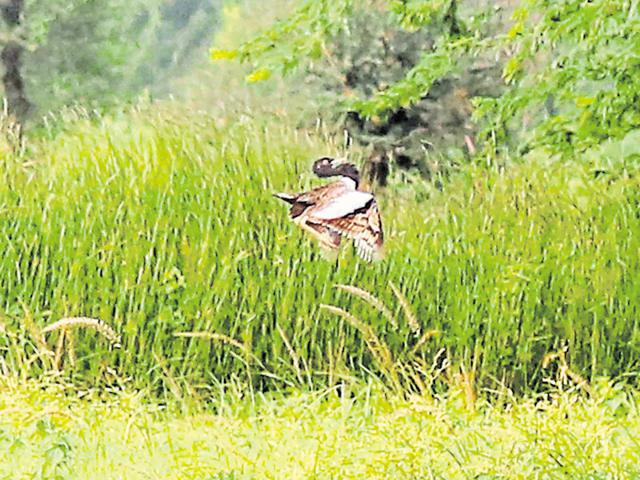
According to the forest department records, the highest Kharmore count was recorded in 2012 (around 400), but their numbers of started falling steadily thereafter. Over 300 Kharmores were spotted in 2013, while over 200 were sighted in 2014. This year around 100 have been sighted post the breeding season.
Lesser florican, endemic to India and some parts of Pakistan and Nepal, is listed as an endangered species in the International Union for Conservation of Nature (IUCN) Red List, 2011, and under the Schedule I of Wildlife (Protection) Act, 1972.
Talking to HT, Ajmer’s deputy conservator of forests (DCF), Rajeev Chaturvedi, maintained that rampant mining - legal and illegal - in the district, was a major reason behind the decline in the number of the bird’s population.
“At every meeting of the district environment committee, we point out how mining in the area is affecting the bird’s breeding, but nothing much has done so far - either to revoke mining licences on revenue land or to check illegal mining on private land. The result is for everyone to see. The area has already lost the Great Indian bustard and it seems only a matter of time before the lesser floricans also disappear,” he said.
{{/usCountry}}“At every meeting of the district environment committee, we point out how mining in the area is affecting the bird’s breeding, but nothing much has done so far - either to revoke mining licences on revenue land or to check illegal mining on private land. The result is for everyone to see. The area has already lost the Great Indian bustard and it seems only a matter of time before the lesser floricans also disappear,” he said.
{{/usCountry}}The forest department has only posted three forest guards in the area to take care of the habitat and protection of the bird, he added.
Ornithologist Ajay Gadikar, who has been studying the bird in Rajasthan and Madhya Pradesh for many years, also described it as a “disturbing trend”.
“During my visit to Sonkhaliya in October first week, I tried to understand the reasons for the decreasing number. One cannot point out any single reason responsible for the dwindling numbers, but the lesser florican count does show variations depending upon the south-western monsoon progress, growth of grass in the area, food availability and disturbance in its breeding grounds,” he said.
Know the bird
Lesser florican is local to India, although some records are found in Pakistan and Nepal as well
In India, its major population is found in southern Rajasthan comprising of Ajmer and Bhilwara districts. The main population is seen around village Sonkhaliya of Ajmer district
The bird species breeds in grasslands (to hide themselves) and cropland (where they can feed on insects)
Ornithologists say its non-breeding period sightings are very rare.