They fly thousands of miles to roost near western Rajasthan’s ponds and lakes every winter, but many end up as dog food.
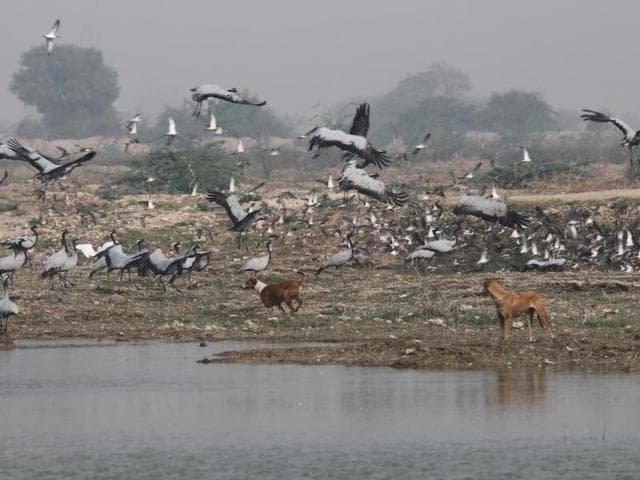
Stray dogs are making a feast of demoiselle cranes, locally known as kurjaa, that have come in flocks of several thousands from their summer habitat in central Eurasia to the desert state.
Hem Singh Gehlot, assistant professor of zoology at Jai Narayan Vyas University, said on Thursday about 5,000 of these high-fliers have reached western Rajasthan, especially Jodhpur, as this area offers an adequate food supply for them to breed and raise their young.
But on the flipside, stray dogs in the area as well as strays from neighbouring villages have become a menace for this migratory species. “The attacks were more rampant on cranes nesting along village ponds,” he said.
Another hazard is overhead power lines. Gehlot said about 20 birds die of electrocution every year. The thin cables carrying high-voltage electricity are difficult to detect from high up, especially under foggy conditions.
{{/usCountry}}Another hazard is overhead power lines. Gehlot said about 20 birds die of electrocution every year. The thin cables carrying high-voltage electricity are difficult to detect from high up, especially under foggy conditions.
{{/usCountry}}The demoiselle crane is the smallest of the species, weighs 2 to 3 kilos and its wingspan is roughly 180cm. Every winter, thousands of them flock to Khichan, near Phalodi town in Jodhpur district, and the nearby salt pans of Malar Ran and Bap Ran.
A unique community effort by villagers near their breeding grounds has ensured a robust population over the years. According to conservationists, 22,000 birds were spotted and recorded in 2013.
But increasing attacks by dogs, which were known to hunt down state animal Chinkaras too, and a web of power cables could undermine conservation efforts.