It’s a mini Chipko movement. Hundreds of students and youths have come forward to resist felling of thousands trees on either side of NH 112 that connects Barasat and the checkpost of Petrapole on India-Bangladesh border, a distance of about 60 kms. The administration is cutting down the trees in order to make way for turning the two-lane highway into a four-lane one.
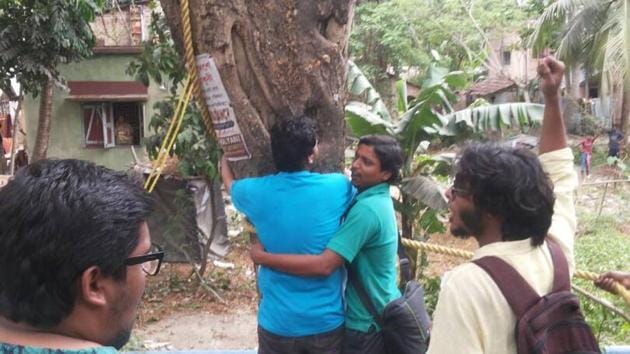
Most of the trees facing the axe are huge and are 70 to 100 years old, some even older.
Read: Uttarakhand residents hug trees to protest against smart city project
NH 112 is a part of Jessore Road that connects Kolkata with Dhaka. The trees including shisham, siris, mahogany have created canopies covering large stretches of the road made famous by Beat poet Allen Ginsberg’s long poem September on Jessore Road.
An order for felling about 4,000 trees to expand the highway was issued in July 2016, but the chopping actually started a couple of month ago.
Over the past three-four days, students from local schools, colleges and youths associated with various cultural activities began adopting the Chipko strategy to form mini human chains encircling and embracing the trees when the local administration is sending contractors to fell the trees.
For the past couple of weeks, however, they were conducting protests. They took out rallies, held meetings and even performed condolence meetings for the trees. Agitations took place at Habra, Ashoknagar, Bongaon and Barasat.
Chipko movement is a forest conservation movement during the 1970s that derived its name from the way the agitators hugged trees to prevent contractors from felling them. Ironically, the new history books for class VIII students of West Bengal Board of Secondary education has introduced a paragraph on Chipko movement.
Read: A Chipko movement in California
“We are not against development, but they seem to be felling trees indiscriminately. We are only a few hundred now but we need other volunteers so that the design can be thwarted. When the protesters are protecting trees at one point, the administration is targeting trees at some unguarded location,” said Manasi Sarkar, a first year student of Presidency University, who lives at Habra that falls on the way.
The agitators have made documentaries, performed street theatre and organised rallies, while rights organisation Association for Protection of Democratic Rights have moved Kolkata high court, seeking a stay on felling of trees. An online petition to National Green Tribunal got nearly 9,000 signatures over the past three weeks.
The state government has taken a ‘go slow’ policy and to avoid direct conflict with students, even though no political party has lend its support yet.
Read: Green heroes:Jharkhand’s tree saviour
“We don’t believe in beating up agitating students but we hope they know the entire plan before continuing with the agitation. By law, we are bound to plant five trees for each tree felled. But since chief minister Mamata Banerjee is sensitive to environment issues, we have decided to plant seven-eight trees for each tree axed,” state food minister Jyotipriya Mallick, who also heads the Trinamool Congress organisation in North 24 Parganas district, told HT.
Mallick added that 90 acres of land have been earmarked for planting new trees and that plantation has started.
He also argued for the widening of the road that leads to the border trading point of Petrapole. “This road facilitates annual trade worth Rs 22,000 crore. This will significantly increase after the expansion, as we plan to use it to connect with the states in the northeast as well. Five bridges have also been planned on busy intersections to avoid traffic jams,” Mallick added.