Two days after the police lathi-charged students as they tried to march to Parliament, I was in Dadar, Mumbai, where a solidarity protest was scheduled.
The atmosphere was tense. Police stood behind barricades; there were rumours about students being detained. Bands of teenagers milled about, uncertain which way to go.
Eventually, as the crowd swelled, the mood shifted from wariness to power, with a hint of joy. Two boys marched by wearing matching Spiderman masks and chanting “Inquilab Zindabad” (Long
Two days after the police lathi-charged students as they tried to march to Parliament, I was in Dadar, Mumbai, where a solidarity protest was scheduled.
The atmosphere was tense. Police stood behind barricades; there were rumours about students being detained. Bands of teenagers milled about, uncertain which way to go.
Eventually, as the crowd swelled, the mood shifted from wariness to power, with a hint of joy. Two boys marched by wearing matching Spiderman masks and chanting “Inquilab Zindabad” (Long Live the Revolution). Another, dressed as Superman, handed out roses to policemen and fellow protesters.
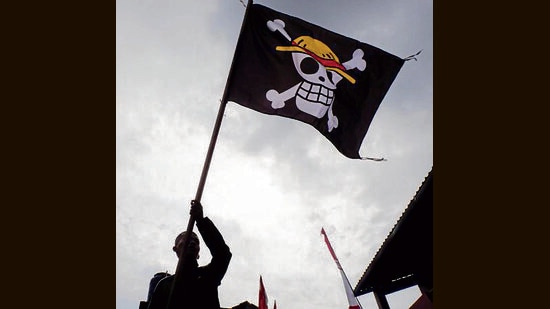
And over and over I saw banners bearing what would, a few months ago, have seemed like an odd symbol: a black flag with a grinning skull and crossbones on it, the skull also sporting a straw hat.
The flag has been in the news repeatedly, over the past year.
In Jakarta, Indonesia, when pay perks and privileges for lawmakers (amid rising costs) sparked deadly protests last August, people hung it outside homes and on vehicles in solidarity. In Nepal, last September, it was draped across the gate of the Singha Durbar palace, the seat of government, amid what was nicknamed the Gen Z revolution (prompted by corruption and mass unemployment, with the final spark being a social-media ban).
It has also turned up in Madagascar, the Philippines, France, Peru, Mexico, the US, Bulgaria, Timor-Leste. And that was all just last year.
In 2024, it swept across Bangladesh, popping up seemingly overnight in street art across Dhaka, during student-led protests that took down the Sheikh Hasina government (the trigger there was a controversial jobs quota system, added to years of economic slowdowns and violent crackdowns against protestors). A year before that, it appeared for the first time in Indonesia, amid small pro-Gaza protests.
PIECE DE RESISTANCE
So what is this unusual version of the Jolly Roger or pirate flag?
It comes from the popular Japanese manga series One Piece, by Eiichiro Oda. It is the insignia of the Straw Hat Pirates, a crew led by a cheerfully anarchic captain named Monkey D Luffy. Their search for a legendary treasure called One Piece sees the band of misfits go up against other pirates, bounty hunters, criminal organisations and the authoritarian world government that rules their planet.
Since it began its serialised run in 1997, the manga volumes have sold more than 600 million copies globally (in over 40 languages).
An anime series based on the graphic novels premiered in 1999 and has aired over 1,100 episodes and counting. There have also been 14 animated feature films, videogame spin-offs, and an ongoing live-action TV series produced by Netflix (One Piece; 2023-).
So when Gen Z (born between 1997 and 2012) hoists Luffy’s flag, the protestors are drawing on a story they grew up with.
The metaphor is not subtle. The Straw Hats sail into societies ruled by cruel or corrupt elites, knock over the people in charge and sail away again. In the Philippines, 23-year-old organiser Eugero Vincent Liberato put it plainly last year. “We see the flag as a symbol of liberation against oppression,” he told The Guardian, adding that people should “always fight for the future we deserve.”
UNDER ONE FLAG
There is a temptation to treat this as something peculiar to Gen Z, a sort of politics of whimsy. But protesters have always drawn on icons from popular culture.
In popular examples, the Guy Fawkes mask has been used by groups ranging from the Anonymous hackers to people protesting an era of digital surveillance. The white bonnets of The Handmaid’s Tale have been used in women’s rights and pro-choice marches.
Demonstrators protesting Thailand’s 2014 military coup began flashing the three-finger salute from The Hunger Games (where it is used by citizens rebelling against a murderous regime).
Today, the icons may also include meme frogs, cartoon hamsters, superheroes and pirates.
Action against such symbols only grants them greater legitimacy. In Indonesia last year, the Straw Hat flag with its cartoon skull acquired much of its political charge after government figures began to denounce its display around Independence Day (August 17) as “divisive” and “potentially treasonous”.
Some governments have tried bans and come off seeming a little ridiculous. It doesn’t help that such orders are almost impossible to enforce. After the three-finger salute was banned in Thailand in 2014, for instance — in a move that made news worldwide — it simply resurfaced in subtler form amid fresh pro-democracy protests in 2020.
Meanwhile, such symbols are spreading at a speed not possible before the social-media age.
There is no central committee deciding which icons to adopt, no manifesto defining what a symbol represents, just a bottoms-up adoption of a symbol emerging from shared imagination.
This allows the symbols to be both instantly resonant, and usefully fluid. An Indonesian truck driver angry about government spending, a Nepali student furious over corruption, and a teenager marching through Dadar may not share the same political ideas. But they all recognise the heroes of the story: the group of rebels confronting a system that needs to be held to account.
One Subscription.
Get 360° coverage—from daily headlines
to 100 year archives.
Archives
HT App & Website