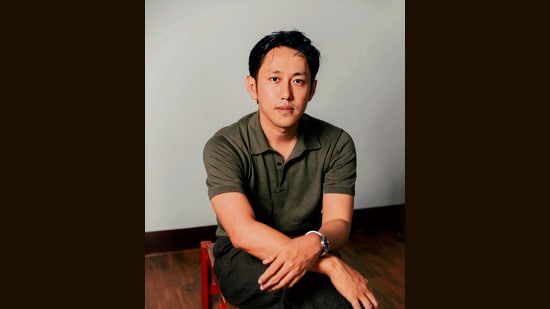
It is a first-of-its-kind win for India; and an astonishing breakthrough for Naga cinema.
“I don’t think I fully comprehended the whole thing. I’m still trying to sort of process it all, but I know I’m grateful,” filmmaker Theja Rio, 31, tells Wknd.
He is commenting on the fact that his debut feature, Angh — the story of a tribal chief battling the loss of his tribe, and of a unique way of life — was first selected in competition
It is a first-of-its-kind win for India; and an astonishing breakthrough for Naga cinema.
“I don’t think I fully comprehended the whole thing. I’m still trying to sort of process it all, but I know I’m grateful,” filmmaker Theja Rio, 31, tells Wknd.
He is commenting on the fact that his debut feature, Angh — the story of a tribal chief battling the loss of his tribe, and of a unique way of life — was first selected in competition at the Toronto International Film Festival, then won at TIFF. And in doing so earned automatic eligibility for the Oscars.
Late last week, Rio’s exquisite film became the first from Nagaland to feature at TIFF. It premiered there, then won the prestigious Platform Prize (for best film in a non-English language). Starting this year, the winner of the Platform Prize becomes automatically eligible for the Best International Feature Oscar too, so that’s where it’s headed next.
The jury statement lauded its “refreshing perspective, strength of filmmaking, and deeply resonant portrait of a world”; it praised “the filmmaker’s vision, audacity and courage.”
“It’s a story with a wide view on changing communities and the effect of missionaries and kind of small-scale colonisation in that one community,” says Platform lead and TIFF director of programming Robyn Citizen. “There’s this very intimate father-son story as well. So it was working on several different levels for us in terms of story, and was helped quite a bit by the striking cinematography.” (More on this in a bit.)
Angh (Konyak for Chief), follows tribal leader Anghba, who has only ever known one way of life: the ancient ways of his forest tribe. Now it is the 1960s. Christianity has arrived, in the form of a foreign missionary. This man’s culture offers comfort and ease, alongside a new faith, even if it does all come at a cost.
The new ideas turn out to be more powerful than Anghba had accounted for. As the tribal hamlet empties out, he starts to realise he may not be able to argue effectively for a life of struggle and scarcity, even if it does protect his culture, his heritage, and his forest (already being altered dramatically by new ideas such as private property and arterial roads).
***
“I think Angh comes from a point of internal conflict for myself,” says Rio. He was born and raised in a community where the church holds a central place. But at some point it began to strike him that “we have been deracinated or uprooted culturally in our faith as well.”
Born and raised in Kohima, Rio moved to Delhi as a schoolboy, graduated in English literature, then earned a Master’s degree in direction at the UK’s National Film and Television School.
He began his career with shorts set in Nagaland that were critically well-received, including a short-film version of Angh (2021). The idea for the story came to him during a trip to the remote district of Mon.
It felt “a bit like a time machine,” Rio says. “Like the past and the present were sort of coexisting.” Villagers held on to traditions such as face tattoos, which to a Naga city boy, he says, felt like “cultural shock.”
It was then that he realised the full import of what had been lost, as evangelists displaced traditional animist faiths, he says.
In his acceptance speech, Rio dedicated the win to the people of Nagaland.
“I come from a small town in the north-east of India, where dreams don’t often come true for my people. So, if I may, I would like to dedicate this award to everyone back home.”
***
The film itself gleams with the effort that has gone into it.
Angh is almost entirely in Konyak, a language spoken by fewer than 250,000 people globally. This meant he had to cast non-actors, but that’s something he would probably have done anyway, he says.
“I enjoy working with non-actors. They already sort of embody their character, whether because of their cultural background or a personality trait or both. So you have a three-dimensional character sort of walking around you. To begin with that is very helpful,” he says.
Anghlong Konyak is masterful as Anghba, a stoic father and tribal chief growing increasingly desperate, and isolated. Sobino Rengma, as his mute son Amao, manages to wordlessly convey loneliness, confusion, pain and conflict.
The Scottish actor Douglas Henshall (Shetland; Primeval) is subtle and understated, as a missionary who isn’t presented as a villain either, and appears gentle, benevolent and concerned about the well-being of the people he encounters; even if his biases only define that term through a very narrow worldview.
Rio opted to shoot entirely on 16 mm film, to recreate the textures of the archival material he studied in his research. That meant lugging bulkier-than-usual equipment across remote terrain.
“It was a logistical nightmare,” he says, but it did help mimic the “mystical and atmospheric” images of 1960s tribes that were his inspiration. “It also enhances the verdant landscape of the setting.”
***
The themes weren’t easy to navigate either. Rio and his crew worked closely with the Konyak community, to ensure they reflected the culture of the tribe truthfully. They worked to render the missionary as realistically as possible too.
The film strives to be honest, Rio says. In one scene, Henshall’s unnamed character describes Anghba’s ways as “primitive”, and appears to lose patience with the chief who won’t see the light he sees.
The film seeks a neutral perspective, Rio says, though it does show “how the arrival of one thing is responsible for the death of another.”
He is hopeful Angh will be well-received in Nagaland. “We come from a region that’s largely underrepresented,” the filmmaker says. “We’ve been yearning to see ourselves on the big screen. So there’s definitely excitement there.”
There is hope too. Younger people are finding their way back in some measure, as he has been doing, Rio says. Perhaps they will be the ones to restore balance, in some form.
One Subscription.
Get 360° coverage—from daily headlines
to 100 year archives.
Archives
HT App & Website