There is suddenly a lot of interest in protein in India.
Supermarket shelves are filling up with protein products. Soya chaap is on a bewildering array of restaurant menus.
Meanwhile, debates over what Indians should eat, and what should be served as part of school meal schemes, have become intertwined with religion and politics.
That makes the timing of Bruce Friedrich’s new book, Meat: How the Next Agricultural Revolution Will Transform Humanity’s Favorite Food - and Our Future, particularly interesting.
There is suddenly a lot of interest in protein in India.
Supermarket shelves are filling up with protein products. Soya chaap is on a bewildering array of restaurant menus.
Meanwhile, debates over what Indians should eat, and what should be served as part of school meal schemes, have become intertwined with religion and politics.
That makes the timing of Bruce Friedrich’s new book, Meat: How the Next Agricultural Revolution Will Transform Humanity’s Favorite Food - and Our Future, particularly interesting.
This isn’t about becoming vegetarian. It’s about asking whether meat can be reinvented.
“This book isn’t about policing your plate,” Friedrich writes. “This book is about meat at the macro level: how meat is made, and how it can be made better.”
He argues that, in expecting our meat to come from animals, we are attempting to hold on to a method that is now anachronistic — as many such methods have become.
“For millions of years, ice came exclusively from natural bodies of water, light and heat came exclusively from the sun or burning things, and there was only one way for a woman to get pregnant,” he writes.
Given that livestock is one of the world’s most carbon-intensive industries, it is time to hit reset here too, he says.
IT’S NOT GOING AWAY
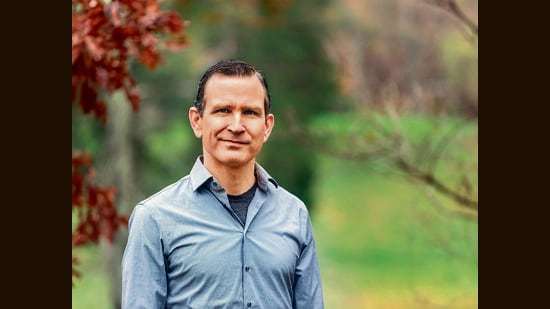
Friedrich, 57, is an activist and founder-president of the Good Food Institute (GFI), a non-profit organisation that works with scientists, government bodies and industry on alternative proteins (such as meat made from plant fibres or in a lab).
His journey in this field began with anti-poverty activism, 40 years ago.
As a college student in Iowa, he volunteered steadily with NGOs, and saw his worldview shift when he read Frances Moore Lappe’s Diet for a Small Planet (1971; which advocates a shift from livestock to soy-based protein). Friedrich turned vegetarian (he still is), and became involved in food and animal-welfare activism.
He spent years working with homeless families in Washington, DC, followed by 15 years with the NGO PETA (People for the Ethical Treatment of Animals) and four with Farm Sanctuary. Over time, these experiences reshaped his ideas of what it would take to make progress on the sustainable-food front.
There is not much point asking billions of people to eat less meat, he argues. “We’re not going to solve the harms of industrial animal agriculture by relying on billions of individuals to deny themselves something they love.”
His preferred approach now is to deal with the world as it is, give people the product they love. But change the way it is made.
Across countries, rising wealth is raising meat consumption. It has risen roughly three times in India in about 25 years, he notes.
The fundamental inefficiency Friedrich keeps returning to is easy to understand: Growing crops and feeding them to animals before eating them is an immensely carbon-intensive way to make meat, with massive amounts of energy wasted along the way.
It is a method that multiplies the demand for land, water and other resources in ways that could be avoided too.
It is not just a matter of dietary preference any more, he argues. Food production is an economic system, a land-use system, a public-health system and increasingly a biotechnology system. It alters the landscapes of hunger, climate, antimicrobial resistance, pandemic risk and industrial policy.
Alternative proteins are “not a silver bullet”, he admits, just as no single technology solves the energy transition. But “we’re not going to solve the harms of fossil fuel production without renewables,” he adds, “and we’re not going to solve the external costs of meat production without alternative meats.”
TO MARKET, TO MARKET?
The commercial question is simple: How soon can alternative meats match the real thing in taste and price?
“Consumers love meat because it’s delicious and affordable; they are not wedded to its current method of production,” Friedrich writes.
In conversation, he draws an analogy with electric vehicles. EV adoption required several things to improve together: price, battery range and charging infrastructure. Similarly, alternative meat cannot depend on consumers accepting inferior products because they are environmentally virtuous.
There is a fairly literal chicken-and-egg problem here.
Prices need to achieve scale in order to drop, but products may need to lower prices before they can achieve scale. The struggles of alternative meat bellwethers such as Beyond Meat have tempered investor enthusiasm for the sector. Private funding for alternative proteins has become harder to come by.
This does not mean the underlying technology is doomed. Deep-tech projects routinely require more patience than consumer apps.
Friedrich believes Wright’s Law will kick in at some point: as cumulative production doubles, the cost of production falls by a constant percentage, because producers learn by doing.
Look at solar power and genome sequencing and one sees possible precedents, he says. “There doesn’t appear to be anything about scaling plant-based and cultivated meat that would stand in the way of a Wright’s Law analysis.”
A looming question still remains: Will taste and price be enough?
Culture, trust, perception and the ties between food and identity matter too.
“The point at which you are telling people that they should change their diets is the point at which things become very political,” Friedrich admits. His way around that resistance is not to ask consumers to adopt a moral stance, but to make the production method increasingly irrelevant to the eating experience.
Eventually, the aim would be to make mock meats preferable, and edible animals the anomaly. As horse-drawn carriages are today. There was a time when the idea of swapping a horse for an engine that might suddenly run out of fuel caused peals of laughter. Innovation, scale and markets combined to erase that argument.
THE HOME ADVANTAGE
India is home to the world’s largest vegetarian population, even though a majority of Indians do eat meat. There are persistent issues of malnutrition and protein inadequacy here; there are also enormous public-feeding programmes, and ambitions to build a larger bioeconomy.
Friedrich thinks these strands could converge. In the same way the country built world-class capabilities in producing pharmaceutical drugs and vaccines at comparatively low cost, India could take a leap in alternative proteins, he says.
GFI is working here with what he calls the three-legged stool of innovation — scientists, governments and industry — to develop a policy framework. Perhaps this country could do for alternative proteins what China has done for renewable energy and electric vehicles, he says.
This is a more interesting proposition than merely asking whether Indians will agree to eat faux-chicken nuggets. It places alternative proteins within larger questions the country is already grappling with: farm incomes, public nutrition, food sovereignty, manufacturing, biotechnology and exports.
For just these reasons, India could become “the backbone of a global alt meat economy,” he says.
One Subscription.
Get 360° coverage—from daily headlines
to 100 year archives.
Archives
HT App & Website