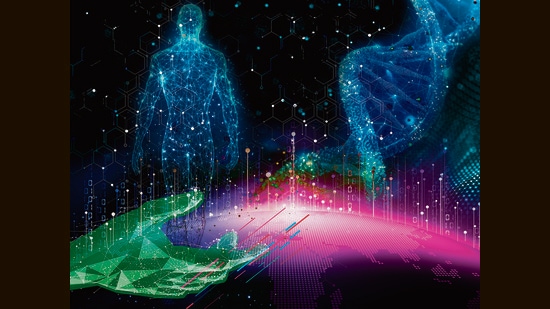
A new ‘Superman crystal’ holds a map of the entire human genome. It could live forever. But who would resurrect us? What else can the crystal do? Take a look.
In the sci-fi short story The Monster (1948), Canadian writer AE van Vogt imagines an alien race landing on a dead Earth.
In an effort to find out what happened here, which they must do before they can begin to colonise the planet, they resurrect a human being, bringing the planet’s apex predator back from extinction.
{{^htLoading}} {{/htLoading}}
Reading the story today can feel a bit strange. Particularly since, this September, researchers at the University of Southampton took a final step in
The crystal (above) will be stored at the Memory of Mankind archive. (Photo courtesy University of Southampton)
If we should go extinct sooner, amid natural calamity or a cosmic accident, the crystal would be available to whatever takes our place — whether life forms from another planet (there are scientists who believe life got here from somewhere else too), some sort of remnant AI, or potential genetic offshoots of the species.
{{^htLoading}} {{/htLoading}}
“We know from the work of others that genetic material of simple organisms can be synthesised and used in an existing cell to create a viable living specimen in a lab,” Kazansky said, in a post on the University of Southampton website.
It’s not just humans, of course. “The 5D memory crystal opens up possibilities for other researchers to build an everlasting repository of genomic information from which complex organisms like plants and animals might be restored should science in the future allow,” Kazansky writes.
***
The “Superman crystal” is only the latest of humanity’s attempts to ensure continuity beyond our own extinction.
In his book X-Risk: How Humanity Discovered Its Own Extinction, historian Thomas Moynihan traces the intellectual history of our engagement with this idea. Since the early years of modern archaeology in the 17th century, he writes, we have known what the risks can look like, and what their impacts have been.
{{^htLoading}} {{/htLoading}}
This combined with 18th-century Malthusian population panics, 19th-century theories of evolution, and the development of nuclear weapons and environmentalism in the 20th century, to create our Modernist understanding of human extinction.
Today’s debates about super-intelligent AI and designer pandemics are all, Moynihan argues, part of this “centuries-long globe-spanning drama.”
This awareness of our own precarity, he writes, is one of the most significant milestones in human intellectual history. “[It] allows us to present a novel case for why we must expend more effort on protecting the future of the human project. Even in spite of the many failures and unforgivable sins that have blighted its past.”
In this context, Kazansky’s memory crystal represents a hedging of humanity’s bets, a Hail Mary pass to the future.
{{^htLoading}} {{/htLoading}}
The memory crystal will be stored at the ceramicist and archivist Martin Kunze’s Memory of Mankind archive, situated deep in an ancient Austrian salt mine. Here, ceramic microfilm — modern versions of the legendary Sumerian clay tablets — and a range of other materials hold libraries worth of information, ranging from replicas of books and art to individual CVs, all of it aiming to preserve a sense of who we were and what we knew.
***
Of course, there are more prosaic uses for the crystal too.
It could be used, as Kazansky has noted, to preserve the genetic data of currently endangered plant and animal species, in preparation for a future when we have the wherewithal to resurrect them.
{{^htLoading}} {{/htLoading}}
The crystals could then be combined with de-extinction efforts such as those underway at the Texas-based Colossal Biosciences, which is working to revive four extinct species: the dodo, Tasmanian tiger, northern white rhinoceros, and woolly mammoth.
The Superman crystal has applications as a storage device too, with one disc holding about 360 TB or 514,000 CDs worth of data. Given that humanity churns out hundreds of zetabytes (that’s 1 billion terabytes) of data a year, the commercial implications of a low-cost, easy-to-produce, robust, low-energy data storage material are huge.
As for the human genome buried in the salt mine, whether future archaeologists will be able to read, interpret, or even find it is, of course, uncertain. Perhaps the only thing more uncertain is what kind of world such a post-extinction human would wake up to find themselves in.
{{^htLoading}} {{/htLoading}}
All Access. One Subscription.
Get 360° coverage—from daily headlines to 100 year archives.
Explore the latest Lifestyle News on health, fashion, travel, relationships, food and festivals. Find useful tips, expert advice, trends and inspiring stories for everyday living.
Explore the latest Lifestyle News on health, fashion, travel, relationships, food and festivals. Find useful tips, expert advice, trends and inspiring stories for everyday living.