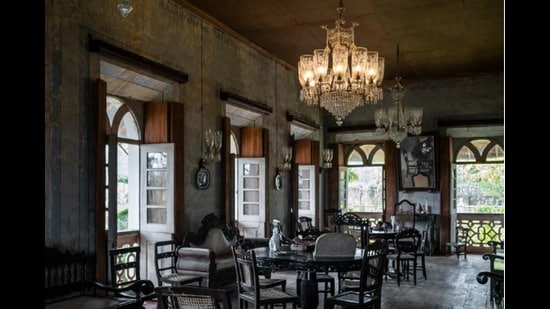
Wander through Goan homes of a certain vintage, and every corner tells a surprising story, says Ulka Chauhan.
In her photobook, The Memory Keepers and Future Seekers, the advertising executive-turned-documentary photographer visits six such bungalows, recording a history that could soon be gone. Within, she represents through 120 photographs furniture with Hindu iconography carved into it, large salas or halls that seem to echo with the music of saxophones and trumpets, a nonagenarian sitting alone at a rosewood table that
Wander through Goan homes of a certain vintage, and every corner tells a surprising story, says Ulka Chauhan.
In her photobook, The Memory Keepers and Future Seekers, the advertising executive-turned-documentary photographer visits six such bungalows, recording a history that could soon be gone. Within, she represents through 120 photographs furniture with Hindu iconography carved into it, large salas or halls that seem to echo with the music of saxophones and trumpets, a nonagenarian sitting alone at a rosewood table that once seated 20.
Stories spill out of the book. In one, windows have recently been fitted with grilles, in a quiet reminder of how much has changed. Until a decade ago, in most villages here, front doors were left unlocked.
These bungalows represent a permanence that is rare today, Chauhan says. “Walls still display rows of ancestral portraits, from a time those alive have no record of.”
They also hold signs of key turning points: bullet holes from revolts; changing architecture.
In pre-colonial Goan homes, for instance, the aangan or courtyard was the heart of family life. It was with the arrival of the Portuguese in the 16th century that houses turned outward, with the colourful facades, oyster-shell windows and shaded balcaos.
In the different architecture styles preserved, this transition is visible.
ROOFS WITH ROOTS
Chauhan’s book was born during a period of looking inward herself, she says.
Confined during the pandemic to her family’s nearly-80-year-old two-storey bungalow in the suburbs of Mumbai, she found herself thinking about what makes homes endure as heritage.
She was struck at the time by photographer Prabuddha Dasgupta’s photobook Edge of Faith (2009), a look at Goa’s Catholic community. In 2021, as the world opened up, she began to make frequent trips to the state.
She became intrigued by the grand houses she saw in the villages she visited most often, and started to visit them to talk to their owners. Through conversations over long lunches and dinners, and one 92nd birthday party, Chauhan pieced their stories together.
This grew into a project for an international photo festival in Zurich. Then came the photobook, with six essays by art writer Samira Sheth, one on each of the families featured.
Each of the six tells a dramatic story. In Ranjeev Pele Jesus Fernandes’s 500-year-old family home in Chandor, there is a hidden underground passageway, and bullet holes in the walls from local uprisings against Portuguese rule. In the deed of the house, a piece of incredible history emerges: it is written in the ancient Modi script.
FADING BLUEPRINTS
This was, of course, once the heart of a global trading empire, so there is plenty of opulence too.
Chauhan was proudly shown Ming dynasty washbasins, boxes made of the rare Siberian amber, ivory from Mozambique, chandeliers of Belgian glass, and an exquisite purple-and-yellow bedspread bought and monogrammed in Macau in the 1800s.
In the 300-year-old D’Sa Condillac House in Aldona, she met a structure adapting gently to its owner. Vicente Antonio Clarence Condillac, 79, was once a seafarer and now lives here with his wife Maria das Merces Lucia de Santana Godinho e Condillac, 73, and their five dogs.
Every morning, he descends the steep steps with help from a knotted rope he affixed to the ceiling. “It’s another reminder,” says Chauhan, “that heritage homes endure by slowly evolving with the people who inhabit them.”
It is anyone’s guess how long they will continue to endure.
These spaces bear witness to a way of life that is fast fading, says architect Gerard Da Cunha, who founded the Houses of Goa Museum in 1997. “As the world becomes a place of sameness, these homes offer character, distinctness,” he adds.
These are things Goa is losing, as change continues to race through it.
Tellingly, Chauhan’s next photobook will focus on who now lives in Goa, telling stories, among other things, of migration.
One Subscription.
Get 360° coverage—from daily headlines
to 100 year archives.
Archives
HT App & Website