* “Yesterday was a bad day…,” a 12-year-old from Lombardia in Italy writes, during World War 1. “Today the sun barely shines and although it’s just one o’clock there have already been three alarms. I cannot understand how I’m supposed to live this way.”
* In 1824, in the city of Craon in France, a middle-school girl writes to her mother, asking to be allowed to continue her education. “My Dear Mama,” she says, in careful, cursive lines. “I received
* “Yesterday was a bad day…,” a 12-year-old from Lombardia in Italy writes, during World War 1. “Today the sun barely shines and although it’s just one o’clock there have already been three alarms. I cannot understand how I’m supposed to live this way.”
* In 1824, in the city of Craon in France, a middle-school girl writes to her mother, asking to be allowed to continue her education. “My Dear Mama,” she says, in careful, cursive lines. “I received with pleasure the letter that you did me the honour of writing... Your silence began to cause me worry. I feared that you were ill; it is very unlike you to let pass such a long time without writing to me… I beg you to give me another six more months… I beg you, Dear Mama.”
* In Jaipur, the diary of a child of about 12 goes from descriptions of daily life and poems about her sister to anguish over a fire at an oil depot. (The 2009 fire at an Indian Oil Corporation terminal blazed for 11 days and claimed 12 lives). She is horrified to learn that rescue operation cannot even begin for the first 48 hours. As highways are shut and trains halted, “The fire could be easily seen from my classroom,” she notes. “Nothing is in order.”
We don’t think of children as keepers of history, but as they too navigate the world and attempt to make sense of it, there is emotion, pathos and immense detail in the records they keep; and a view from a unique perspective.
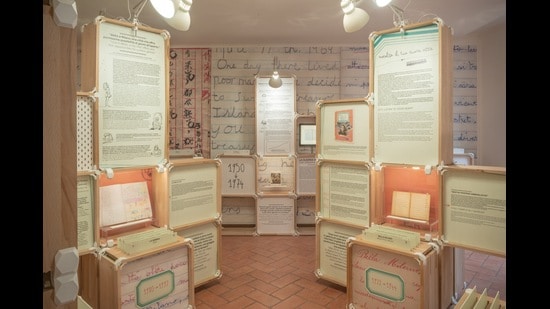
An entire parallel history of this kind now sits in a 650-sq-ft museum of children’s notebooks in Milan, Italy. There are 2,500 documents preserved here. Most are notebooks, diaries, letters and journals, sourced via antiques dealers and collectors or sent in by families.
They contain the impressions of children from over 35 countries, written in more than 18 languages. (All names are withheld, to protect identities. All works are translated into Italian and English by museum volunteers.)
The oldest artefact is a penmanship exercise book from Shropshire, England, dated 1773. The most recent additions are exercise books from Ghana, dated 2012.
LINE DRAWINGS
The Museum of Children’s Notebooks began in 2004, when reporter, storyteller and photographer Thomas Pololi, then 22, invited people from across Italy to send in their old school essays for an archive he planned to create. These tended to be personal takes on their world, their most recently holidays and routine events from their lives, and he thought they would serve as an interesting parallel history.
As the collection expanded, support and funding grew. In 2014, Pololi founded the non-profit organisation Quaderni Aperti or Open Exercise Books, which now runs the physical museum too. In addition to sealed-off displays, there are reproductions of notebooks here that visitors can leaf through.
“I believe the universal voice of children is one of humanity’s most important heritage assets, not only for understanding childhood, but for understanding humanity itself,” says Pololi, now 44. “We have found that this is true beyond national borders and historical periods.”
He points to the diary from Jaipur. “It is especially interesting because it describes everyday life, her relationship with schoolwork and her relationships with her peers,” Pololi says.
Then, as the tragedy disrupts her life, “it becomes an example of how history on the grand scale intersects with the microhistories of ordinary people, including children.”
SEND A TEXT
Pololi believes the diaries hold something more too: clues to ways in which we can make the world better.
Leafing through the notebooks is a reminder of what humanity needs more, and less, of.
“The first thing children ask for is often freedom. They want spaces where they can play freely with their peers, and they want to be able to reach those spaces independently,” Pololi says. Today, that freedom to play is increasingly threatened.
With fewer physical spaces set aside for them, and many more screens accessible to them, they seek their sense of freedom and community online, Pololi points out. “Sadly, this can be far more harmful and dangerous than a park or public square.”
The artefacts he has collected immortalise other ways in which conflict and change are experienced. Looming through the museum’s collection, for instance, is the tragic ever-presence of war.
The institute is currently preparing for an exhibition titled War Notebooks, that will explore conflicts of the 20th century through such testimonies by children from Italy, Japan, China, Germany, the UK and US.
Unsurprisingly, another key area of conflict that emerges in the writings is the pressure of expectations. This tension between their needs and innate nature, and the pressures of family and society, surface over and over. Children write of working harder to make parents proud; of adhering to lists of set goals
It shows, Pololi says, that all too often, what we think of as the kind of discipline that is needed, to help a child become an informed adult, is experienced as a kind of indoctrination, a pressure to be useful, gifted, exceptional — which, by the math alone, the average child simply cannot be.
There are scribbles from children as young as four in the museum, “but we generally focus on somewhat longer, more ‘aware’ texts. Those written between the ages of eight and 13 or 14 tend to have both the expressive freshness of childhood and the communicative precision of someone who has already gained real writing competence,” Pololi says.
Only material from people who have reached adulthood are accepted. “This is partly for reasons of privacy and data protection, and partly just practical: without the “filtering” effect that the passage of time provides, we’d likely end up with far more material than we could ever manage,” Pololi says. “Though submissions are always welcome.”
In the library are accounts of an Australian child who dreamed of travelling to the Moon in the 1950s; the adventures of a group of Finnish Girl Scouts who recorded their outings in a shared diary during the same period; writings by a French girl who enthusiastically described a flight on a Boeing aircraft in the 1970s.
Sometimes, nothing serves as a record of history too.
A tiny pocket diary belonging to a child from Connecticut in the late-1800s notes the repetitive course of his life in rural America. “It is cloudy and looks like snow… It is still very cold. I did not go to school today.”
(To share a text written by you or a member of your family, go to childrensnotebooks.org)
One Subscription.
Get 360° coverage—from daily headlines
to 100 year archives.
Archives
HT App & Website