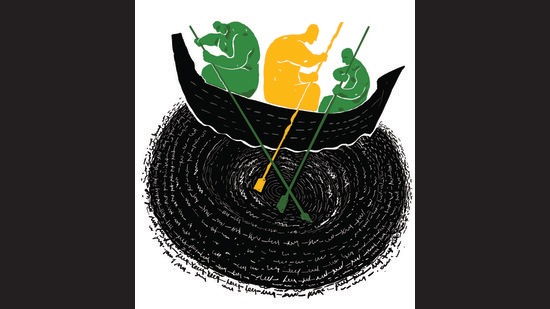
India and Pakistan: A sad stop-start arrangement
Imtiaz Alam
It depends on from whose standpoint you perceive India in Pakistan — hawks or doves, religious extremists or moderates, nationalists or internationalists. Despite being part of the Indian subcontinent for thousands of years, the two states were carved out on the basis of religion in a bloody partition. Most brutal were the partitions of Bengal and Punjab and the unscrupulous drawing of an arbitrary border. An elitist national liberation leadership failed
India and Pakistan: A sad stop-start arrangement
Imtiaz Alam
It depends on from whose standpoint you perceive India in Pakistan — hawks or doves, religious extremists or moderates, nationalists or internationalists. Despite being part of the Indian subcontinent for thousands of years, the two states were carved out on the basis of religion in a bloody partition. Most brutal were the partitions of Bengal and Punjab and the unscrupulous drawing of an arbitrary border. An elitist national liberation leadership failed to handle a tedious minority question and axed the unity in diversity of our helpless subcontinent.
Caricaturing Indo-Pak relations, a Pakistani hawk, in an address to students at Jammu University, once observed that “they are like Tom and Jerry”, a combination of mutuality and hostility. Regardless of this love-hate relationship, India was the inheritor of the British empire in the region, and was supposed to set the direction and standards for itself and the broader region around it.
A “moth-eaten Pakistan”, a byproduct of the Two-Nation Theory, had to struggle with a dilemma of terrestrial nationhood or a celestial brotherhood. Separation from Hindustan had its own consequence of searching for an image different from the mother country — a reverse self-image, however self-damaging. Suffering from the wounds of separation of its own geographical limbs, the Indian leadership could not reconcile with the division that coalesced in the Partition Plan. Starting with the first Indo-Pak war over the princely state of Jammu and Kashmir, partisanship continued to be regimented.
The Republic of India did show a secular, democratic and non-aligned path, which was not traversed by a fearful Pakistan deeply suspicious of a Monroe Doctrine being coined by the “Big Brother”. A strong Centre, authoritarian regime, Islamic moorings defined the distinct route, which was characterised by a nationalism-in-adversity, duly reinforced by India as the adversary. The Cold War period provided a unique opportunity for an authoritarian Pakistan to seek the umbrella of Western alliances to balance an increasing asymmetry in conventional forces. Another opening was created with the India-China War of 1962 for Pakistan to take refuge from its eastern neighbour’s “hegemony”.
While safeguarding its north-eastern “soft belly”, Prime Minister (PM) Indira Gandhi did succeed in drowning the Two-Nation Theory in the Bay of Bengal by dismembering Pakistan and unburdening it of the internal colonisation of its eastern wing. It helped create yet another nation on the basis of Bengali nationalism, but Bangladesh, because of its Muslim majority, was to remain a nation separate from West Bengal.
The dramatic change in the balance of forces in what was left of Pakistan also paved the way for the passage of the 1973 Constitution in Pakistan, and the signing of the Shimla Agreement between India and Pakistan. But then came Operation Smiling Buddha, the 1974 nuclear tests, sending a chilling signal to the tarnished security apparatus of a dismembered State. An inherently escalating nuclear and conventional arms race followed, to ensure the potential for a mutually assured destruction of our subcontinent.
The wages of the Cold War between the two superpowers were quite deceptively rewarding for the military junta, headed by a most reactionary General Zia-ul-Haq. While fighting the US Central Intelligence Agency’s not-so-clandestine war, Pakistan became a pawn in the American fight against the Soviet Union for the former’s exclusive imperial hegemony. As a consequence, Pakistan turned into a client- jihadi State. In the interests of democratic continuity and civilian ascendancy, the four short-termed civilian governments somehow lowered the anti-India rhetoric and looked towards India for reconciliation in the 1990s.
The demolition of the Babri mosque in 1992 triggered xenophobic communal politics not only in India but also reinforced already rising Muslim fundamentalism in Pakistan. The Lahore peace process between AB Vajpayee and Nawaz Sharif was subverted by the Kargil misadventure and its perpetrator, General Pervez Musharraf, staged a fourth military coup. The terrorism of 9/11 allowed Musharraf to run with the hare and hunt with the hounds.
But, with PM Vajpayee in 2004 and PM Manmohan Singh in 2007-08, General Musharraf set in motion a most conclusive composite dialogue process which was to culminate in a pragmatic settlement of the Kashmir dispute. But that was not to be. The Mumbai terror attack of November 2008 disrupted the peace process, despite the continuation of a fragile democratic transition in Pakistan.
The rise of Muslim religious extremism in Pakistan found its corroborating counterpart in the Hindutva revivalism in India. With the rise of a Rashtriya Swayamsevak Sangh or RSS-driven Hindu Rashtra, India is, unfortunately, drifting away from its secular basis, which tends to reinforce Muslim fundamentalism in the region and vice-versa.
The Partition of the subcontinent on a religious basis and communal politics complement each other across the borders as religiously majoritarian States continue to target their minorities and, in turn, drive their majority communities towards fascism. That is most devastating and must be prevented.
(Imtiaz Alam is a veteran Pakistani journalist and peace activist)
The views expressed are personal.
.
Bangladesh: A sibling, and some rivalry, to the east
Farid Hossain
From village tea shops to plush clubs in Dhaka, no political conversation in Bangladesh is complete without mention of India.
Bangladeshis, who feel indebted to their giant neighbour for its total support in Bangladesh’s 1971 War of Liberation, applauded when New Delhi sent the first doses of Covid-19 vaccines to Dhaka in February this year. The same Bangladeshis were upset and wondered if India really cared for their welfare, when vaccine supplies were halted. The mood of Bangladeshis with regard to their largest neighbour fluctuates from positive to critical on issues that governments and diplomats in both capitals tend to brush aside as not so significant.
At the political level, India and Bangladesh currently enjoy the best relations, with Prime Minister (PM) Narendra Modi hailing this country as a “major pillar of our ‘Neighbourhood First’ policy”. Responding with the same warmth, Bangladesh PM Sheikh Hasina calls India a true friend of her country and expresses deep gratitude for New Delhi’s support in helping Bangladesh gain independence from Pakistan in 1971.
The credit for elevating bilateral relations goes to the leaders of both countries, but more so to Sheikh Hasina, who made bold decisions such as expelling Indian rebel groups from the northeast from the soil of Bangladesh. She has remained a steadfast friend of India, taking care of pressing issues such as transshipment facilities and building a network of connectivity through roads, railways and rivers. In an important development, Sheikh Hasina has also stopped mounting any serious pressure on New Delhi to settle the dispute over the sharing of the Teesta River water, braving strong criticism from her own people.
Both countries have benefited from the stable ties. Bilateral trade has increased, with India’s annual exports reaching $10 billion and imports from Dhaka amounting to a little over $1 billion. Over the years, India has announced three lines of credit worth a total of about $8 billion (though disbursement, admittedly, has been slow).
India has now become a most favoured destination for Bangladeshis, who travel to the country for medical treatment, leisure and tourism. India, which has the largest overseas visa applications centre in Dhaka, issues an average of 1.5 million visas to Bangladeshis a year.
This good political rapport and increased people-to-people contacts should have removed a long-held perception among many ordinary Bangladeshis that India takes more from Bangladesh than it gives. But public perception does not always reflect the true picture, and this sentiment continues to thrive among the Bangladeshis.
Consider how Bangladeshis felt when India recently made an abrupt decision to stop the export of onions when they needed it the most. The move forced Dhaka to go onion-shopping even to Pakistan, a move made quite reluctantly considering the bad blood between the two States. That happened in 2019, just before Sheikh Hasina went to New Delhi to attend a business summit in the first week of October. Referring to the ban, she quipped: “I have told my cook to stop using onions.”
To many Bangladeshis, this reflected India’s somewhat erratic behaviour. Ask the average person on the street about their feelings towards India, and they will likely refer to New Delhi’s failure to keep its commitment of bringing down killings by the Border Security Force (BSF) to zero. The memory of 15-year-old Bangladeshi girl Felani Khatun, killed in 2011 by BSF, while stuck in barbed wire, still haunts many Bangladeshis.
But focusing on the negative would present an incomplete picture of how Bangladeshis feel about India, as its big neighbour marks the beginning of celebrations to mark 75 years of independence. Despite the kinds of issues that are not uncommon between neighbours, India remains the most trusted friend of Bangladesh and its people. The relationship that was forged in the bloody battlefield of 1971 is flourishing, overcoming occasional hiccups. Most Bangladeshis admire India for its uninterrupted journey of democracy, and for the values of secularism it has upheld. Monjurul Ahsan Bulbul, a senior Bangladeshi journalist, echoed this mood to me recently, saying: “As India celebrates its independence we feel it is our festival too.”
(Farid Hossain is a Bangladeshi journalist)
The views expressed are personal.
One Subscription.
Get 360° coverage—from daily headlines
to 100 year archives.
Archives
HT App & Website