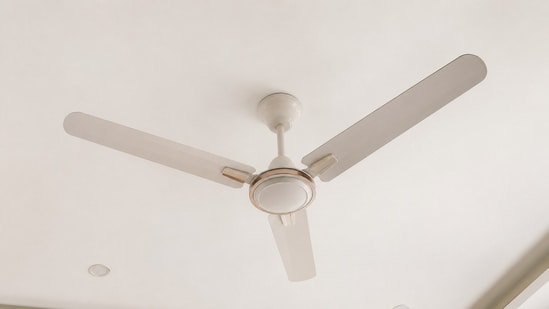
Many everyday objects exist around us, but we rarely take the time to consider why they look or function the way they do. For example, take the ceiling fan. In most Indian homes, it has three blades and spins overhead for hours, but the reason behind its design is rarely examined. So, why do ceiling fans usually have three blades? Is there actual science behind it, or is it merely a design convention?
On the subreddit Explain Like I'm Five, one Redditor posed the same question, prompting netizens to weigh in with different explanations. From efficiency to turbomachinery, there are various explanations behind.
Why does the number of blades affect efficiency?
The first reason was how it increased efficiency. One Reddit user wrote, "The reason fans don’t usually have a large number of blades has to do with efficiency, not air resistance. When a blade goes into the former blade’s ‘wake’, the air pressure is lower in that area, leaving ‘less air’ for the blade to pull. You’ll actually get less resistance, but be less efficient because some of the blades would be working almost at a vacuum.” This means each rotating blade leaves behind disturbed air. As more blades are added, the distance between successive blades decreases, potentially causing them to interact more closely with one another's wake.
Another elaborated with the help of a simple analogy, “Any fan with any number of blades is prone to precession, even a disc would, for that matter. To understand what precession is, hold a fidget spinner lightly with two fingers and try to move it while it’s spinning, and you’ll see how it moves in a different direction. You’ll also see that it only matters when you change the plane of rotation.”
Why not use only one or two blades?
{{/usCountry}}Another elaborated with the help of a simple analogy, “Any fan with any number of blades is prone to precession, even a disc would, for that matter. To understand what precession is, hold a fidget spinner lightly with two fingers and try to move it while it’s spinning, and you’ll see how it moves in a different direction. You’ll also see that it only matters when you change the plane of rotation.”
Why not use only one or two blades?
{{/usCountry}}The blades should be placed in such a way that their weight is distributed evenly and allows the fan to rotate smoothly. For regular household ceiling fans, three blades provide an evenly distributed and relatively simple arrangement.
So, three blades basically offer a practical middle ground. They are spaced far enough apart to reduce excessive interaction between their wakes but still produce airflow for a room.
In the end, the reason is simple. There is no magic rule that a ceiling fan must have three blades. There are also some with four or five blades, but common household fans in India mostly have three blades. The arrangement has simply become common because it offers a practical balance between airflow, energy efficiency, weight distribution and smooth rotation. So, this is not just a basic design norm, but there is actual science behind it.