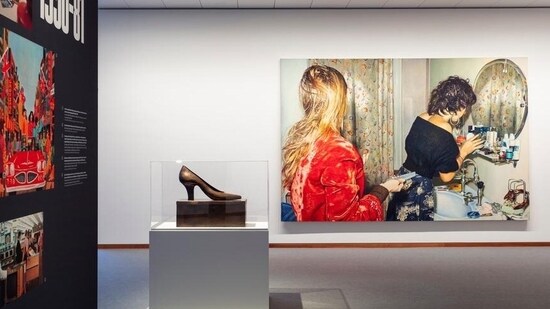
What is the best title for art created between 1945 and 2000? The Neue Nationalgalerie in Berlin is giving it a go for its new permanent exhibition and came up with "Zerreissprobe" — translated into English as “Extreme Tension.” From performance to pop art, it is a ride through recent art history and shows the complex relationship between art and politics and society. "Zerreissprobe stands for the radical upheavals post-1945," says co-curator Maike Steinkamp. (Also read | Focusing the lens on rural lanes of Bengal: A photography exhibition in Delhi)
And indeed, there were plenty of trials and tribulations in the second half of the last century — political and economic, social and artistic. These include upheavals in civilization such as World War II and the Holocaust, the ideological confrontation between East and West during the Cold War and the fall of the Iron Curtain, to name just the most dramatic. They all kept the world on tenterhooks. At the same time, they inspired artists, gave them cause for reflection and often for redefinition. Some broke new ground.
Artists react to terrible experiences
This becomes particularly clear in the exhibition's "Existential Experiences" section. It shows how artists reacted with deep uncertainty to the horrors of war and the cultural collapse of the Holocaust after 1945. Fear and inner turmoil are reflected in the spindly, overlong figures of Swiss sculptor Alberto Giacometti, for example. The unfathomable black holes on the gloomy reliefs by US artist Lee Bontecou cry out for orientation, as does the surrealism attached to the "articulated doll" by Dresden artist Wilhelm Lachnit (1899-1962).
The political and military division of the world between East and West, the struggle between ideologies for sovereignty of interpretation and propaganda, provides a completely different test of endurance. This can also be seen in the visual arts. An artistic battle for direction breaks out between figurative and abstract. In Western Europe and the United States, younger artists turn to new, abstract forms of expression. The German artist K.O. Götz (1914-2017), for example, throws paint onto the canvas and blurs it with a squeegee to create abstract, informal structures. The Americans Mark Rothko (1903-1970) and Morris Louis (1912-1962) painted large, sometimes monochrome, color fields.
Art controversy between abstract and figurative
{{/usCountry}}The political and military division of the world between East and West, the struggle between ideologies for sovereignty of interpretation and propaganda, provides a completely different test of endurance. This can also be seen in the visual arts. An artistic battle for direction breaks out between figurative and abstract. In Western Europe and the United States, younger artists turn to new, abstract forms of expression. The German artist K.O. Götz (1914-2017), for example, throws paint onto the canvas and blurs it with a squeegee to create abstract, informal structures. The Americans Mark Rothko (1903-1970) and Morris Louis (1912-1962) painted large, sometimes monochrome, color fields.
Art controversy between abstract and figurative
{{/usCountry}}In the GDR and other socialist countries, on the other hand, Socialist Realism was raised to the highest level. It was supposed to show the toiling workers and farmers as they were; state art as propaganda. But there were also GDR artists who defied the political guidelines, such as Harald Metzkes or Werner Tübke (1929-2004). And figurative art also lives on in many studios in the West, for example in the paintings and sculptures of Pablo Picasso (1881-1973) or Henry Moore (1898-1986).
In the field of tension between politics and society, art finds its role. "Art often functions like a seismograph in that it can pick up on trends earlier than elsewhere," says curator Maike Steinkamp.
A naked Marina Abramovic dancing until she drops, for example, or Rebecca Horn, whose constricted naked woman with a unicorn on her head strides through the landscape, become pioneers of women's liberation. The Neue Nationalgalerie's new permanent exhibition, which runs through till September 28, 2025, shows all of this and so much more.
This article was originally written in German.