
 E-Paper



Tamil Nadu: In Keeladi dig, artefacts, history, heritage and politics
Since 2015, for several months every year close to a dozen archaeologists and labourers have been digging a 110-acre area of what was once a coconut farm.

 Prefer HTon Google


One day in April, Periya Ganesan started work , the same way he had for the previous four days, sifting through the sediment and dirt in his assigned trench at the dig site.
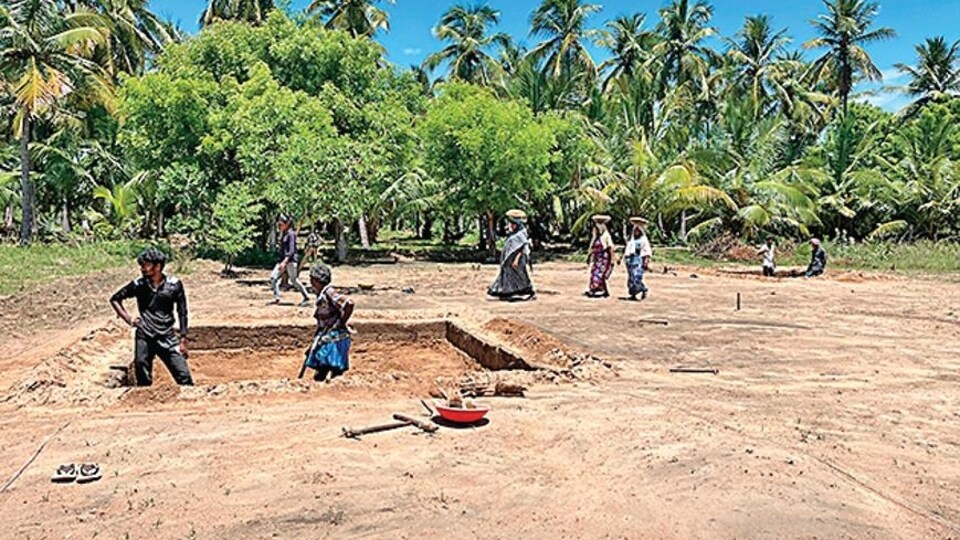
It was tiring but significant work, the brass tacks that archaeology is built on but rarely spoken of in the final telling of discovery. Like some of the others on the site, this was Ganesan’s ninth year at the dig. Like every year, work started in early April this year.
At 9.30am on that day, April 10, he saw a flash of white. It was right below the surface. It looked hard. It looked like a floor. Ganesan ran to archaeological officer Ajay Kumar, and told him something was different. Kumar knew Ganesan was not lying. The workers at the dig site were well versed with the topography. The senior officer descended the trench and started digging. Soon, it became ever clearer that Ganesan was not mistaken. Underneath, there was something white and firm; a mixture of clay and lime, over 2,000 years old. Kumar’s eyes widened. “It even looked like a modern concrete floor.”
In 2015, excavations began in the town of Keeladi, around 500 kilometres away from Chennai, after carbon dating samples from the area were traced back to 580 BCE, suggesting that similar to the “second urbanisation” in the Gangetic plains, there was a civilisation that existed in Keeladi, and Sivakalai (172 km away) between 2,600 and 3,200 years ago. It narrowed the gap between the imaginations of the Tamil and the Indus Valley Civilisations (3300 BCE to 1300 BCE), the earliest known in the Indian subcontinent.
Since 2015, for several months every year close to a dozen archaeologists and labourers of, first, the Archaeological Survey of India till 2018 and then the Tamil Nadu government have been digging a 110-acre area of what was once a coconut farm. Less than six acres have been excavated thus far.
In April this year, in the ninth season of excavations, M Ramesh, co-director of the Keeladi site, says they made a breakthrough; what he terms a “floor activity”. Three months later, in mid-July, labourers are working feverishly inside a fifth trench dug under the discovered floor. It rained briefly in the early days of the month, and a lot of time is spent scooping out wet mud. Yet, it is all worth it, for the goal is to find missing links from the results of previous excavations.
There is, of course, a political underpinning to the sense of urgency.
For several in Tamil Nadu, the reconstruction of an ancient society evokes both linguistic and cultural pride. The findings have prompted chief minister MK Stalin to claim that the Tamil civilisation was rich, modern and developed, and juxtapose Tamil pride against the Hindi heartland.
“Our government’s mission is to prove scientifically that the Indian subcontinent’s history should be written starting from the Tamil landscape,” Stalin said in the state assembly in September 2021, four months after his Dravida Munnetra Kazhagam party formed its government. On April 6, Stalin himself launched the ninth phase of excavations at Keeladi and the surrounding clusters of Agaram, Manalur and an ancient burial site at Kondagai.
The journey so far
Some time in the 1970s, locals in Keeladi began digging a well in a local coconut tree farm. They found potsherds, or broken pieces of pottery. Excited by the discovery but blissfully unaware of the significance, children at the local government school took the potsherds to their history teacher V Balasubramaniam, who in turn wrote a letter to the Tamil Nadu state department of archaeology (TNSDA). But it was only 40 years later that officials from the Archaeological Survey of India (ASI) went hunting for that well, after Keeladi was earmarked with several other sites in Madurai as part of ongoing research on a possible civilisation that existed on the banks of the Vaigai river. A team led by K Amarnath Ramakrishna, then the superintendent archaeologist at ASI, officially commenced excavations in March 2015. Since then, 18,000 artefacts have been unearthed from Keeladi alone.
Across Tamil Nadu, there are eight sites where archaeologists are hard at work: Kilnamandi (Tivuvannamalai), Porpanaikottai (Pudukkottai), Boothinatham (Dharmapuri), Gangaikondacholapuram (the capital under Chola king Rajendra I in present day Ariyalur), Vembakottai (Virudhunagar) and Thulukkarpatti (Tirunelveli).
But of all these, Keeladi has remained firmly in the spotlight -- for the mixture of the wonder its discoveries have produced, and the controversies that have followed, exposing fault lines between the state and the Union government.
Ramkrishna led the team for the first two seasons and members said they found evidence of brick construction, terracotta and beads that matched with the descriptions in Tamil literature of the Sangam era. But after the second season of excavations, Ramkrishna was transferred to Odisha, and at the end of the third season, ASI declared that there were no “significant findings”. There was a political storm. Regional parties protested loudly and there were multiple approaches to court. Eventually, in 2017, the Madurai bench of the Madras high court handed over the responsibility of excavations to the state government, then led by chief minister Edappadi Palaniswami of the AIADMK.
TNSDA took over and began excavations almost immediately. By 2019, the government said that extractions from the excavation had pushed back the imagination of the Sangam era three centuries from what was originally thought to be, something that aided the argument that Keeladi was contemporaneous with the civilisations in the Gangetic plains. The fifth and sixth seasons found water channels made of brick, and subsequent digs seemed to confirm a thriving sea trade, weaving, and agrarian management.
In May 2021, the DMK stormed to power defeating the AIADMK-BJP alliance. Much of the DMK’s political narrative was built on regional pride, and the change in guard added new impetus to the sense of a “civilisational battle”, challenging the imposition of Hindi and celebrating Tamil pride. Four months later, Stalin proudly told the state assembly, “I am extremely happy to announce that the rice samples have yielded the date of 1155 BCE and hence, the Tamiraparani river civilisation (in Tirunelveli) is 3,200 years old. This is scientifically validated.” The government made this claim based on a communication by Beta Analytic Inc, a Miami-based company, writing to the TNSDA that a rice and husk sample, scraped off a pot in Sivakalai, that they had sent was dated around 1155 BCE.
In many ways, this government enthusiasm is what sustains Keeladi.
The ninth phase at Keeladi
A narrow bitumen village road, dotted by coconut trees, leads off from the Madurai-Mandapam national highway, and almost immediately brown boards that say “Keeladi Archaelogical Site” begin to emerge out of the idyllic countryside. For the most part, the village looks like any other, operating at a gentle pace; MGNREGA workers dot the area; villagers amble, as they keep watch of their goats.
There is one corner of the village however, that is now home to a constant stream of visitors and curious school students. In 2021, trenches dug that year -- the seventh season of excavations -- were thrown open to the public. Inside the trench, the remarkable findings include a terracotta ring well with the symbol of a fish, and markings of full lives once lived; dice and evidence of hopscotch. The government plans to transform this into a full-fledged on-site museum soon.
Beyond this point, restricted to the public for now, a team of 10 painstakingly dig. Every day, less than 10 centimetres of sediment from a square trench is removed. It was here that on April 10, Periya Ganesan first saw something white, something hard, the first evidence of a floor.
Ajay Kumar remembers that day. He remembers bursting with joy when he confirmed that it was indeed a floor, and his thus far unsuccessful hunt for a roof on every side of the square trench. “A roof would have confirmed that this was a living settlement. But it is unexpected to find something so important at such a short depth,” Kumar said.
The logical next step was to find out what lay under the floor. Archaeologists began digging to the right of the trench. There, they hit another first; thousands of pots within one square trench of about 10x10 metres. While finding pots themselves is not unusual, Ramesh said that it was not normal for thousands of pots to be in such close proximity. “Maybe they stored these pots for floor activity,” Ramesh said. The pots have hundreds of graffiti markings. It is graffiti like this that is the genesis of the Tamil Brahmi script, experts said.
Since then, soil from the “floor activity” and the recovered potsherds have been collected, and will likely be sent for further examination to institutes such as Pune’s Agharkar Research Institute, Deccan College, French Institute of Puducherry and Madurai Kamaraj University.
The way ahead
Thangam Thenarasu, Tamil Nadu’s minister for finance and archaeology, said that the state government wants to establish a clear link between the Tamil civilisation and the Iron Age from excavations this year. “We are not at war with anyone but our ideological stance is that Indian history should be written starting from the banks of the Cauvery river rather than the Ganges. We have solid evidence and make announcements only backed by scientific evidence,” he said.
Thenarasu pointed to excavations between 2021 and 2022 in Mayiladumparai that ostensibly suggested that the Iron Age in Tamil Nadu took root around 4,200 years ago. “Sivakalai and Keeladi have already established links with the Iron Age and the prehistoric period. Thulukkarpatti will help us in determining the cultural coincidence within Adichanallur (Thoothukudi),” he said.
There are other clear signs of a government push. In March 2023, Stalin opened the Keeladi museum, a kilometre away from the excavation site, and set up at a cost of ₹18.4 crore. The once dormant state archaeology department is now flush with money -- ₹5 crore was allotted last year, and another 5 crore this year. There are two more on-site museums in the pipeline at Tirunelveli and Ariyalur as well as a Chola museum that will showcase the contribution of the famed dynasty, government officials said.
Kurush Dalal, archaeologist and director of the School of Archaeology at Mumbai-based India Study Centre-Trust, said that Keeladi is one of the most important explorations in India. “For the longest time, archaeology in southern India, not just in Tamil Nadu, was in the doldrums. That the south was given stepmotherly treatment is not in doubt, but Keeladi has now received lots of eyeballs.”
Experts, however, have urged for politics and archaeology to be kept separate, and said that it does not inspire confidence when announcements on discoveries are made by government representatives and not archaeologists.
“Looking for the oldest, greatest, most fantastic finding is parochial. There is a bizarre game of one-upmanship between the north and south for glory, which does not help archaeology,” Dalal said.
Dalal for instance, is sceptical about the claim that Tamil Nadu’s ‘Iron Age’ is the oldest in the world. “This Iron Age, according to the government’s claims, is older than the Neolithic and Stone Age in the area. To believe that stone-tool-using Neolithic citizens were preceded by iron-using people in the area means a practice mysteriously disappeared and then returned, or continued to coexist in multiple communities without any impact on the other,” he said.
With two months left for the ninth season to end, a team of six interns from Pune’s Deccan College and Tamil Nadu’s Thanjavur University works barefoot in a trench, trowels and picks in hand, in a quadrant to the right of where the floor activity was found. One student has found a tiny bone while another has found the tooth of a bovine. Animals such as cows, bulls, buffaloes, deer, goats and wild pigs have been identified in Keeladi earlier. And the hope is that soon, after the discovery of the floor, more evidence of a residential living quarter emerges, perhaps a furnace.
But Ajay Kumar has words of reassurance for his young wards nonetheless. “Teeth are precious for DNA, crucial for analysis,” he says.
In Keeladi, everything is a source of wonder and discovery. And the repository of not just historical evidence, but political bragging rights.


