With the Asian Games now just weeks away (they’ll be held in Hangzhou, China, from September 23 to October 8), this is a good time to take stock of India’s elite athletes.
The season is well underway, and our best athletes have moved on from the previous Tokyo Olympics (scheduled for 2020, eventually held in July-August 2021) to the next Olympic cycle, ahead of which the Asian Games will offer some good last-mile perspective.
Instead of the usual four-year cycle,
With the Asian Games now just weeks away (they’ll be held in Hangzhou, China, from September 23 to October 8), this is a good time to take stock of India’s elite athletes.
The season is well underway, and our best athletes have moved on from the previous Tokyo Olympics (scheduled for 2020, eventually held in July-August 2021) to the next Olympic cycle, ahead of which the Asian Games will offer some good last-mile perspective.
Instead of the usual four-year cycle, the Asian Games are being held after a gap of five years, a long time in sport, making it all the more important for countries to use it to assess where they stand in relation to each other, ahead of Paris 2024.
India will not, of course, overtake the big four in Asian sport — China, Japan, South Korea, and Indonesia — any time soon. But some countries that finished above India in the medals tally in 2018, such as Uzbekistan and Iran (India came in eighth), are likely to find themselves below India this time around.
This, despite that fact that some of India’s finest wrestlers — including guaranteed medallists at the Asian level Vinesh Phogat and Bajrang Punia — may not be in China, having sacrificed this phase of their careers to stand alongside survivors of alleged sexual abuse, in an extremely hostile environment. Though the protest has ended, for now, and they are back in training, the status of the federation is uncertain and the wrestlers themselves have likely lost too much time and momentum to make it to these Games.
Who, then, are the country’s greatest hopes at the Asian Games? The contest will likely be a breeze for Neeraj Chopra, who has not hit his 90-metre target with the javelin yet in competition (he has at practice). But Chopra has improved his mark consistently since his historic Olympic gold in Tokyo. This is a man who has forgotten what it’s like to throw anything below 88. He registered his best throw of the year (88.67 metres) some months ago at the Doha Diamond League. Over the last year, he has breached 89 metres thrice, and struck 88 metres or more in all but one competition.
Mirabai Chanu, the weightlifter with a silver from Tokyo, has a bit of a struggle on her hands, and is not lifting close to her personal best (which is also the current national record). She is working her way back into form after an injury. She is such a strong athlete, with such an accomplished team behind her (including national lifting coach Vijay Sharma and American physiotherapist and strength coach Dr Aaron Horschig), that it is only a matter of time before she is back at her best. But even that doesn’t guarantee a medal at the Asian Games, since her main rivals are Chinese, Thai and Korean, and they’ll all be at Hangzhou.
The giant Tajinderpal Singh Toor, who won gold in shot put with a games record and national record in the 2018 edition, broke his own record last month and set a new Asian mark at the National Inter-State Senior Athletics Championships in Bhubaneswar, with a throw of 21.77 metres. He is the undisputed king in Asia in his event.
The inter-state championships, held amid terrible heatwave conditions in June, still threw up amazing performances. The best of those has to have been 16-year-old Pooja (who goes by one name), who won gold and qualified for the Asian Games with a 1.8-metre high jump. Her personal best is even better: 1.82 metres, which is just a few millimetres short of the bronze-winning jump in 2018. She may not be a clear medal prospect at this Games, but with jumps like these at this age, she is arguably the best young talent India has ever seen in this event.
The daughter of a mason, mentored by a sports and yoga coach named Balwan Singh who has no formal training, she practised by jumping over a bamboo pole and landing on sacks full of rice husk. This nowhere-village-to-global-stage arc of Indian athletes continues to play out like a movie script. (But why does it have to be like this? Why is our grassroots infrastructure still such a shambles? That’s a script that needs some rewriting.)
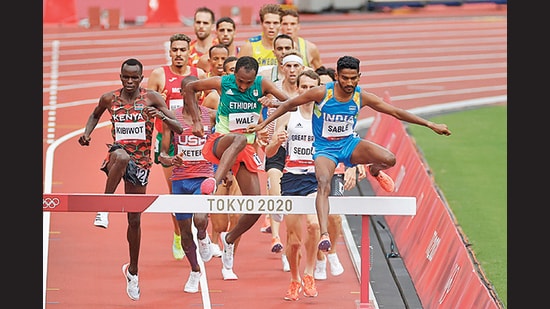
Meanwhile, other bright hopes include national-level record setters such as Jeswin Aldrin and Murali Sreeshankar, who have had some of the best long jumps seen globally, this year. Praveen Chitravel has set a new national record in the triple jump. Avinash Sable has smashed his own 3,000-metre steeplechase national record thrice in the last year. And the incredible Jyothi Yarraji has set and reset the national record in 100-metre hurdles five times in a few months, dropping it below 13 seconds for the first time ever in India, which makes her a favourite for the gold in Hangzhou.
All this, and we haven’t even mentioned the women boxers, who had their best-ever showing at the world championships held in New Delhi earlier this year, netting four gold medals.
It’s set to be an exciting Games. And then onward to Paris.
One Subscription.
Get 360° coverage—from daily headlines
to 100 year archives.
Archives
HT App & Website