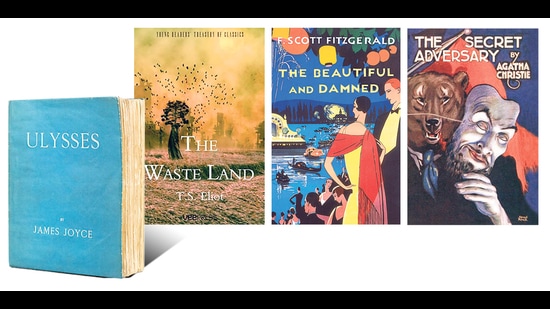
In May 1922, the British novelist Sydney Schiff threw a party in Paris. The attendees included the writers Marcel Proust and James Joyce, composers Igor Stravinsky and Erik Satie, artist Pablo Picasso, critic Clive Bell, and the founder of the Ballets Russe, the impresario Sergei Diaghilev.
The story goes that Proust offered Joyce a lift back to his hotel, and a drunken Joyce told the Frenchman that he hadn’t read a word that Proust had written. The offended Proust went
In May 1922, the British novelist Sydney Schiff threw a party in Paris. The attendees included the writers Marcel Proust and James Joyce, composers Igor Stravinsky and Erik Satie, artist Pablo Picasso, critic Clive Bell, and the founder of the Ballets Russe, the impresario Sergei Diaghilev.
The story goes that Proust offered Joyce a lift back to his hotel, and a drunken Joyce told the Frenchman that he hadn’t read a word that Proust had written. The offended Proust went to the Ritz Hotel — where he had an agreement that he would always be fed, whatever the hour — to sulk.
Proust would die later that year, but May 1922 had seen the publication of Sodome et Gomorrhe II, the latest volume of À la Recherche du Temps Perdu (In Search of Lost Time), his multi-volume magnum opus. Joyce, of course, had seen the publication of Ulysses stoke controversy and admiration in February that year. One of its admirers and staunchest defenders was the critic and high priest of culture, TS Eliot, who would have his equally seminal poem, The Waste Land, appear in September 1922.
Annus Mirabilis
There are some years when creativity explodes. Sometimes it’s through an individual, as in the case of Einstein in 1905, or Newton in 1665. Sometimes it’s across a medium — like 1939 in films (Gone With The Wind; The Wizard of Oz; Goodbye Mr Chips; Wuthering Heights and many others) or 2007 for videogames (Mass Effect, Assassin’s Creed, The Witcher, World of Warcraft: The Burning Crusade and others). But none of these years can match, for scale, the impact and influence that 1922 would have on English literature.
Ulysses or The Waste Land by itself would have been enough to mark a year for literary achievement, but there were so many others. Virginia Woolf’s Jacob’s Room, her first attempt to strike out in a new direction, came out that year. Woolf, who had called Ulysses “An illiterate, underbred book... the book of a self-taught working man, and we all know how distressing they are” and “the scratching of pimples on the body of the bootboy at Claridges”, was hard at work on Mrs Dalloway and, in her diary, she would wonder if the kind of work she was attempting was “probably being better done by Mr. Joyce”.
Katherine Mansfield published The Garden Party and Other Stories. DH Lawrence, England, My England and Aaron’s Rod. Aleister Crowley, the notorious occultist, wrote his first novel, provocatively named The Diary of a Drug Fiend. After the death of a close friend of his daughter, the poet Rainer Maria Rilke wrote 26 sonnets in two days in February.
Franz Kafka, who arrived in the resort of Spindermuhle, began work on The Castle. In Ticino, Hermann Hesse, the grandson of a German missionary in India, would experience his most fruitful year, one which would result in the publication of Siddartha, which explored Hindu and Buddhist themes, and would become a counterculture classic in the 1960s.
There were books by John Galsworthy and GK Chesterton, AA Milne and Edgar Rice Burroughs, Rafael Sabatini and Baroness Orczy; plays by Pirandello and Jean Cocteau; non-fiction that included Sir James Frazer’s magisterial The Golden Bough, TE Lawrence (of Arabia) and Seven Pillars of Wisdom and The Meaning of Relativity by Albert Einstein.
A confluence of rising literacy and prosperity, the gradual fading of the immediate horrors of the Great War, the electrification of the world, the change in the nature of recreation, all played a part in what made the ’20s roar. This was a year when the British empire was at its geographical zenith, where one in every four people in the world was a citizen of the empire. It was the year of the Chauri Chaura killings and Mahatma Gandhi’s arrest for sedition. This was the year Lenin died and Stalin took over, culminating in the creation of the USSR in December 1922. This was the year of Tutankhamen’s tomb, the Irish Civil War, and the creation of the BBC.
American interests
In New York, the Harlem Renaissance — the explosion of creativity across art and music and literature among Black Americans that spanned the ’20s and ’30s — was in full swing. Magazines such as The Crisis, under the stewardship of Jessie Redmon Fause, showcased up-and-coming Black authors. Black — and white — authors, poets and intellectuals such as Langston Hughes, Zora Neale Hurston, WEB Du Bois, Clarence Darrow and James Weldon Johnson would congregate at A’Lelia Walker’s West 136th Street townhouse to talk and to party.
Also in America, Sinclair Lewis released Babbit, his examination of the problems and preoccupations of the American middle class and its empty adherence to conformity. F Scott Fitzgerald published his first anthology of short stories, Tales of the Jazz Age, as well as his second novel, the semi-autobiographical The Beautiful and the Damned, based on the early years of his marriage to the socialite Zelda Sayre.
Plays Pleasant and Unpleasant
The world of theatre was humming with activity across the Atlantic. George Bernard Shaw watched the premiere of what he would consider his ultimate work, Back to Methuselah, while beginning work on St Joan. Eugene O’Neill’s The First Man and The Hairy Ape made their debuts on Broadway. Noel Coward ruled the stage in London with his only Ruritanian romance, The Queen Was in the Parlour. The Cabaret Girl, with lyrics by PG Wodehouse and music by Jerome Kern, debuted in London’s West End that year. In addition to the play, Wodehouse would publish The Girl on the Boat, and begin work on one of his greatest comic novels, Right Ho, Jeeves.
Thrills and Murder
There was frenetic activity in popular fiction as well. A young Agatha Christie published her second novel, The Secret Adversary, featuring Tommy and Tuppence Beresford. HC McNeile published Bulldog Drummond and the Black Gang, where the eponymous hero hunted Bolsheviks in England, as well as a sinister criminal mastermind called Carl Peterson. The Drummond books were devoured by a young Ian Fleming, who would go on to model James Bond on Drummond and Bond’s nemesis, Ernst Stavro Blofeld, on Peterson.
Periodicals and Pulp
While there was plenty, in terms of plays and novels, to suit any taste, the most popular fiction was quickly becoming what became known as “pulp”. Black Mask Magazine, which would go on to publish authors such as Dashiell Hammett, Raymond Chandler and Erle Stanley Gardner, grew in popularity with its serials and short stories. Carston McCullers’s Zorro made his second appearance in the pages of the popular Argosy magazine. There were magazines dedicated to crime and horror, to Westerns and romance, and they were consumed in bulk by legions of newly literate readers.
Junior Section
One of the most enduring pulp magazines was The Magnet. Launched in 1908, a year after its sibling, The Gem, it would have a tremendous influence on English children, and would become popular across the Commonwealth. In 1922, The Magnet changed its appearance, and hit new highs in circulation, as people followed the adventures of Billy Bunter and his classmates at Greyfriars school. Meanwhile, a young woman named Enid Blyton published her first book, a volume of poetry called Child Whispers. The year also saw the first appearance of William Brown, Richmal Crompton’s archetypal unruly schoolboy, in Just William.
It’s hard to pin down the specific alchemy that led to 1922 being such a watershed year for reading. And maybe it’s pointless. But you could spend a lifetime reading just the books that came out then, a moveable literary feast of a year.
One Subscription.
Get 360° coverage—from daily headlines
to 100 year archives.
Archives
HT App & Website