Delhi’s DAG gallery didn’t set out to capture the zeitgeist with its new show. But days after Indian Blue: From Realism to Abstraction opened to the public in October (it’s on until December 1), came the news that paintmakers might be running out of synthetic blue pigment.
DAG’s show was intended to be a sweeping look at the colour — 150 works that covered abstracts, landscapes and portraits, history paintings and figurative narrations. What it has become is a rare
Delhi’s DAG gallery didn’t set out to capture the zeitgeist with its new show. But days after Indian Blue: From Realism to Abstraction opened to the public in October (it’s on until December 1), came the news that paintmakers might be running out of synthetic blue pigment.
DAG’s show was intended to be a sweeping look at the colour — 150 works that covered abstracts, landscapes and portraits, history paintings and figurative narrations. What it has become is a rare examination of our tenuous hold on the material world and manmade solutions. Shatadeep Maitra, who curated the show along with art historian Giles Tillotson, says it’s rare for exhibitions to focus on a single colour. Excerpts from an interview.
What made DAG decide on a colour, and for that colour to be blue, for a whole show?
For us, blue was an obvious choice because of the colour’s symbolic relevance to India and its overarching presence in our art. The show traces the many changes that took place in modern Indian art through the use of blue. The exhibition spans three historical genres — colonial-era academic art, landscape and figurative art, and abstraction, which followed them in the 20th century.
What roles have shades of the blue family played in the visual world?
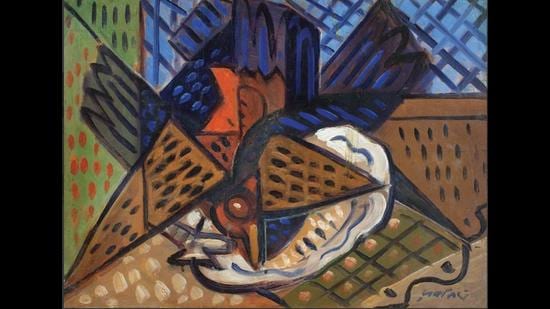
Blue is a soothing colour. It can be loud and silent at the same time. It does not threaten, but it demands your attention. That’s perhaps why it is so popular around the world today. Indian Modernists have been pushing the boundaries of the colour for some time. KCS Paniker’s 1954 painting of the backwaters of southern India is a great example. Not only is the river blue, but also the trees, bushes, land and people. Another work, an undated Cubism-inspired Ramkinkar Baij painting, shows a rooster perched on a table. Viewers find the meaning behind a work (or draw their own conclusion) from the artist’s imagery. So the way you see blue in any painting is also a reflection of how you see it in life.
How might the impending shortage of blue pigment affect art?
Blue is a primary pigment that creates so many colours, and it is necessary for art-making: from painting skies and water in landscapes, to creating skin tones (by mixing with browns and ochres) in figurative art, and for the abstractionist to use as per their heart’s desire. The thought of blue pigment disappearing is a dreadful thing. But the shortage seems to have been caused by a supply-chain issue that should normalise by next year.
One Subscription.
Get 360° coverage—from daily headlines
to 100 year archives.
Archives
HT App & Website