Nitrogen is remarkable.
That breath you just took is four-fifths nitrogen, but the gas does pretty much nothing to you or for you. Nitrogen in the air is essentially unavailable to living things, and yet, in one of those delicious paradoxes, all life depends on nitrogen’s unique ability to hold its electrons close, but not too close.
Electrons are a key currency of the chemistry of life, and that makes nitrogen a key player in how the molecules of life get built. Every amino acid and every rung of our DNA depends on it.
Mediating this paradox — abundant but unavailable, scarce but necessary — is a bond. In the atmosphere, two nitrogen atoms clasp each other with a triple bond that is one of the strongest in all of chemistry. A bond so strong that it literally takes a lightning bolt to break it. (Is that why Indra and Zeus are leaders of their respective pantheons?)
Indeed, before organisms could crack that bond themselves, the only “reactive” nitrogen (a compound that life could actually use) on young Earth came from lightning, or from hydrothermal vents.
Then Life caught on.
{{/usCountry}}Then Life caught on.
{{/usCountry}}Eva Stueken, a geochemist at the University of St Andrews, UK, led research that measured nitrogen isotopes (isotopes being atoms of the same element with slightly different weights; the ratio between them leaves a fingerprint of whatever process produced them) in rocks up to 3.2 billion years old, and found a signature chemically consistent with biological nitrogen fixation.
This suggests that the amazing enzyme nitrogenase, which replicates what lightning can do, but on a molecular level, is at least that old.
The ability to tap into the enormous atmospheric N2 reservoir conferred a huge advantage on any organism at a time when usable nitrogen was scarce. So the enzyme machinery lasted even as the oxygen filled the skies.
The trade-off came in energy. Converting one N2 molecule into a usable form of nitrogen is enormously energy-intensive. For aeons, this method of nitrogen fixation was the exclusive domain of bacteria.
Then something changed.
Plants got into the act. Not directly, but in cahoots with the bacteria.
By analysing the evolutionary traits of flowering plants and working backwards through the family tree, scientists have concluded that symbiotic nitrogen fixation by plants arose a little over 100 million years ago.
Legumes show up not long after, between 65 and 74 million years ago. Then, in the ecological flux that follows the extinction of the dinosaurs, the fossil record suggests the legume family diversifies and spreads rapidly.
The partnership between plant and bacteria is mutually beneficial. The plant gets usable nitrogen delivered to its roots, while the bacteria get safe harbour and food. But, the enzyme, a carryover from a bygone age, doesn’t like oxygen, and so the plant creates a room for it.
On its roots, it creates nodules with a chamber where a filter allows nitrogen in preferentially; what little oxygen gets in is either rapidly consumed by the plant or captured by the plant’s leghaemoglobin. There, the bacteria’s nitrogenase breaks apart the nitrogen, essentially compressing lightning into a molecular space. Since this carries a huge energy cost, and it doesn’t make sense to pay this cost when usable forms of nitrogen are available; indeed, experiments in legumes show that when a soil contains nitrate, nodulation is repressed.
THE HERO INGREDIENT
In recent millennia, humans have caught on, partnering with plants who partner with bacteria.
Lentils and dals, both good sources of protein and fibre, appear very early in the written and archaeological record. The latter suggests that mung, urad and tur originated in India, while chickpea likely did not (although the late food historian KT Achaya noted that it was found at Kalibangan, an Indus Valley site in present-day Rajasthan, as far back as 2500 BCE).
The Vedas contain several references to these dals. One of Rama’s favourite foods (still an offering on Ram Navami, the festival that marks his birth) is kosumalli, a preparation of soaked mung dal and cucumber.
Achaya notes that the Buddha placed mung in a group of foods “full of soul qualities” and “devoid of faults”. Dals appear in Sangam-era literature too. And the 12th-century text Manasollasa (Mind’s Delight), written by King Someswara contains a recipe for idlis (called iddarika) made by soaking ground urad dal in buttermilk and adding pepper, cumin and asafoetida. This is incidentally quite similar to the Kanchipuram idli, which is spiced but now made with rice.
By the time of 19th-century cookbooks, dals were everywhere. Lightly sautéed with chillies, prepared as sundal (an offering during Navratri), in sambar, in the simple dal-and-rice, in vadas, dosas, idlis and other tiffin items, and in desserts such as laddoos, often paired with carbohydrates such as rice.
GUNS AND BONDS
As we began farming, though, settled agriculture posed a unique challenge: how to replenish the nitrogen, phosphorus and potassium removed in harvests.
While mulching and manuring played a role in recycling the elements within a landscape, some plants, which could bring new nitrogen into the farming system, became highly prized. Legumes, which had the added benefit of being edible, and crops such as dhaincha (Sesbania aculeata) and sunn hemp (Crotalaria juncea), became integral to agriculture.
Always, though, a sense of scarcity hung in the air.
As the 19th century dawned, the English economist Thomas Malthus began to issue warnings that the world’s population would soon overshoot Earth’s ability to provide, if something didn’t change. A series of terrible famines, compounded by the brutalities of colonialism, claimed millions of lives and appeared to lend credence to his words.
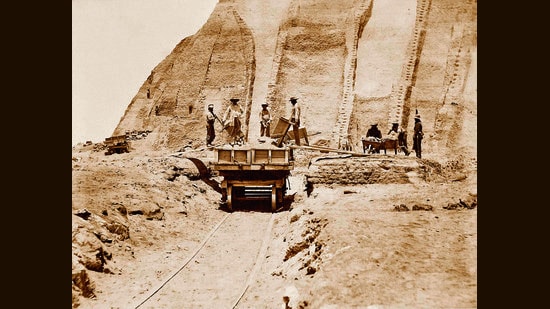
In this century, a sort of gold rush began, as adventurers searched far and wide for new kinds of nitrogen fertilisers. The mid-19th-century became the age of guano, the excrement of seabirds. The islands off the coast of the Peru were exceptionally rich sources of it. There were even wars fought over guano.
The guano market came crashing down in the early 20th century, as a German chemist named Fritz Haber found a way to break down the formidable bonds between two nitrogen atoms using very high pressure, high temperatures and a catalyst.
At the chemical company BASF, chemist and senior executive Carl Bosch, a reserved man with a passion for collecting beetles, took Haber’s laboratory-scale invention and developed the metallurgy and chemical engineering to scale it cheaply and safely.
Many hail the Haber-Bosch process as one of the greatest inventions of humankind, ahead of the microchip and electricity. Bosch would win the Nobel for his work, in 1931. Haber, who won the Nobel in Chemistry in 1918, meanwhile, would go down as the hero who helped save the world from starvation, and the villain who invented chemical warfare. Such is the mixed legacy of efforts to feed the world.
There is always a trade-off. Join me next time for more on the world of pulses, and on how Haber’s gift helped sideline them.
(Mridula Ramesh is a climate-tech investor and author. She can be reached on tradeoffs@climaction.net. The views expressed are personal)