
 E-Paper



Preserving art: Traditional craft of making Buddhist and Taoist deities in danger of dying out in Singapore

 Prefer HTon Google


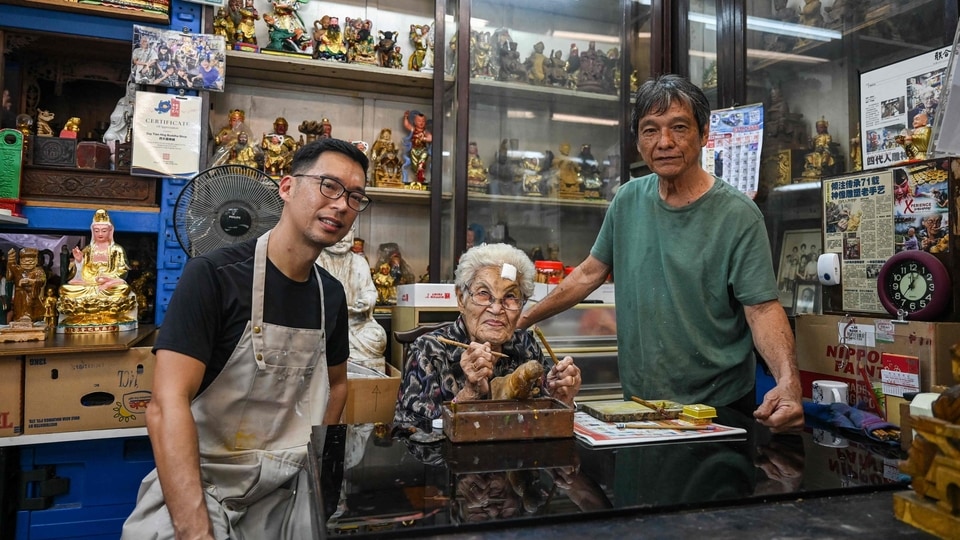
In Singapore, a 92-year-old matriarch leads one of the city's last artisanal shops crafting Buddhist and Taoist deities.
Tan Chwee Lian picks up a small paddle, her finger resting on a groove worn into the wood over 70 years of making Buddhist and Taoist deities in her shop, one of the last of its kind in Singapore. Facing competition from mass-produced items and lacking heirs to take up the trade, the traditional craft is in danger of dying out. Tan's more-than-a-century-old shop in downtown Singapore, tucked between hip cafes and boutiques, is one of the city-state's last effigy establishments still making the wooden statues by hand. The 92-year-old great-grandmother has been making the wooden statues since her arranged marriage to effigy craftsman Ng Tian Sang at the age of 18.
"I sat beside (my husband) and watched... when he left to buy things or run errands I would take over, then he would come back and tell me what I did wrong," Tan told AFP while using the wooden paddle to roll out a piece of dough made of joss stick ash using a secret family recipe. She rolled out the mixture until it was a thin thread, then used two bamboo sticks to attach it to a wooden statue in an intricate pattern to demonstrate thread sculpture, a traditional carving technique from southeastern China.
Although she is now retired from crafting, she comes to the Say Tian Hng Buddha Shop daily, helping out with odd tasks from her desk at the front of the traditional shophouse stacked with hundreds of gods looking out from the shelves. Her son, 71-year-old Ng Yeow Hua, runs the shop, making, selling and repairing Taoist and Buddhist idols for temples and devotees.
Like many Singaporeans, the family's origins can be traced back to China, from where many people emigrated in the 19th and early 20th centuries in search of a better life. Ng's grandfather founded the shop along with his brother in 1896, after moving to Singapore from Kinmen, an island in modern-day Taiwan. Ng's son, Ng Tze Yong, is now reinventing the business by running tours of the workshop as well as educational programmes on Chinese culture.
Ng hopes the art can be passed down through the generations. "If (my son) has the interest he can continue, but don't force it," he told AFP. To ensure that the art continues, the 43-year-old former journalist decided to become an apprentice several years ago. He now works in the shop one day a week, in addition to his day job at a local charity.
'Beauty of imperfection'
Handmade effigies take up to three months to make by artisans who must pick up the skills over years of informal learning and are entrusted with trade secrets passed down over generations. In comparison, machine-made statues are mass-produced, cost a fraction of the price and can be delivered quickly.
"The customers that come to us believe in the beauty of imperfection, of things made by hand... in the authenticity of something that is made to worship divinity," the younger Ng said. "But yes, it has caused a decline in the business," he admitted. “I'm trying to learn the craft from my dad and my grandma before it's too late.” In addition to learning decorative techniques, he must familiarise himself with scores of Taoist deities, each with a unique story. "In Taoism (there) is this idea that you don't have to be perfect. None of these gods are perfect," he said.
For example, legend has it that the monkey god rebelled against heaven but redeemed himself after protecting a monk on a journey to procure holy texts from India. He is sometimes depicted with golden eyes believed to be able to spot evil. For the family, the pieces play an important role in the lives of their customers when they are going through rough patches.
"Throughout that time, these effigies were the ones that gave them the hope and encouragement to move on... so we take that very seriously," Ng said. He is recording all of his family's knowledge and eventually hopes to take on other apprentices to ensure the shop can keep operating beyond his generation. "The fact is that if (I) don't do anything, the shop dies."


