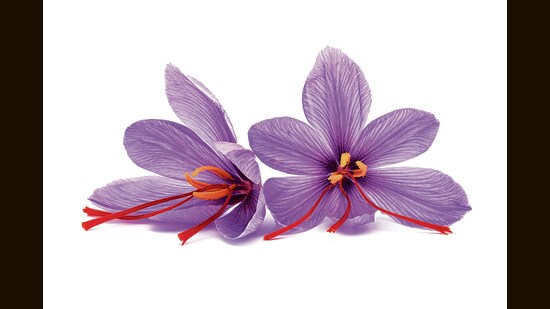
Why is there so little of it in the world? Why does it cost so much? Plus, see how to tell if there’s any real saffron in that little box of it in your kitchen.
Even though it has been cultivated for more than 4,000 years, saffron remains the most expensive spice in the world.
It has been a luxury product since at least the time of Cleopatra (1st century BCE), who is said to have added it to her baths, for its colour, aroma and medicinal properties. So how is it that we have found no way to mass-produce it well enough to lower its price?
{{^htLoading}} {{/htLoading}}
Well, the plant Crocus sativus blooms only once
A serving of rabri, topped with saffron strands. It takes about 1.5 lakh flowers to produce 1 kg of dried saffron. (Adobe Stock)
The colourfully named Operation Golden Harvest ended with the arrest of 17 members of a gang in 2021. They had allegedly been responsible for the bulk of fake saffron, exporting a brand that specialised in low-grade strands with flower debris and illegal colouring agents.
{{^htLoading}} {{/htLoading}}
In a study conducted in India in 2010, meanwhile, it was found that only 52% of saffron was completely genuine; 30% was of poor quality (real saffron mixed with adulterants) and 17% was “fully adulterated” (contained no saffron at all).
Fake strands can be made from materials such as corn silk, coconut fibre, even dyed horsehair or shredded paper. Adulterants used for colour range from turmeric and paprika to artificial dyes. Fillers such as chalk may be added for weight.
Chemically, the quality of saffron is determined by three compounds: crocin (which gives it colour), picrocrocin (which gives it its earthy, floral flavour), and safranal (which gives it its powerful aroma). The more of these compounds there are, the higher the quality of the batch. Experts grade the spice by measuring these factors in a lab, but consumers can be cautious too.
{{^htLoading}} {{/htLoading}}
When buying saffron, keep an eye on the price. If it seems too good to be true, then chances are it is. Keep in mind that there is global demand for this substance from the pharmaceutical, beauty and perfume industries too, and so no vendor need lower their prices just for you.
Next, examine the threads. They should have a pleasant aroma similar to hay and honey, and each one should be shaped like a small trumpet.
To test saffron at home, place a single strand in lukewarm water for 15 minutes. The real thing will slowly turn the water a golden yellow, while the strand remains red. If the water changes colour immediately, or the thread loses its hue, whatever is in the box is not real saffron.
{{^htLoading}} {{/htLoading}}
As a final step, sip the solution. The real thing will infuse the liquid with flavour. Fake saffron will colour the water but yield little to none of that highly prized, ethereal taste.
(To reach Swetha Sivakumar with questions or feedback, email upgrademyfood@gmail.com)
All Access. One Subscription.
Get 360° coverage—from daily headlines to 100 year archives.
Explore the latest Lifestyle News on health, fashion, travel, relationships, food and festivals. Find useful tips, expert advice, trends and inspiring stories for everyday living.
Explore the latest Lifestyle News on health, fashion, travel, relationships, food and festivals. Find useful tips, expert advice, trends and inspiring stories for everyday living.